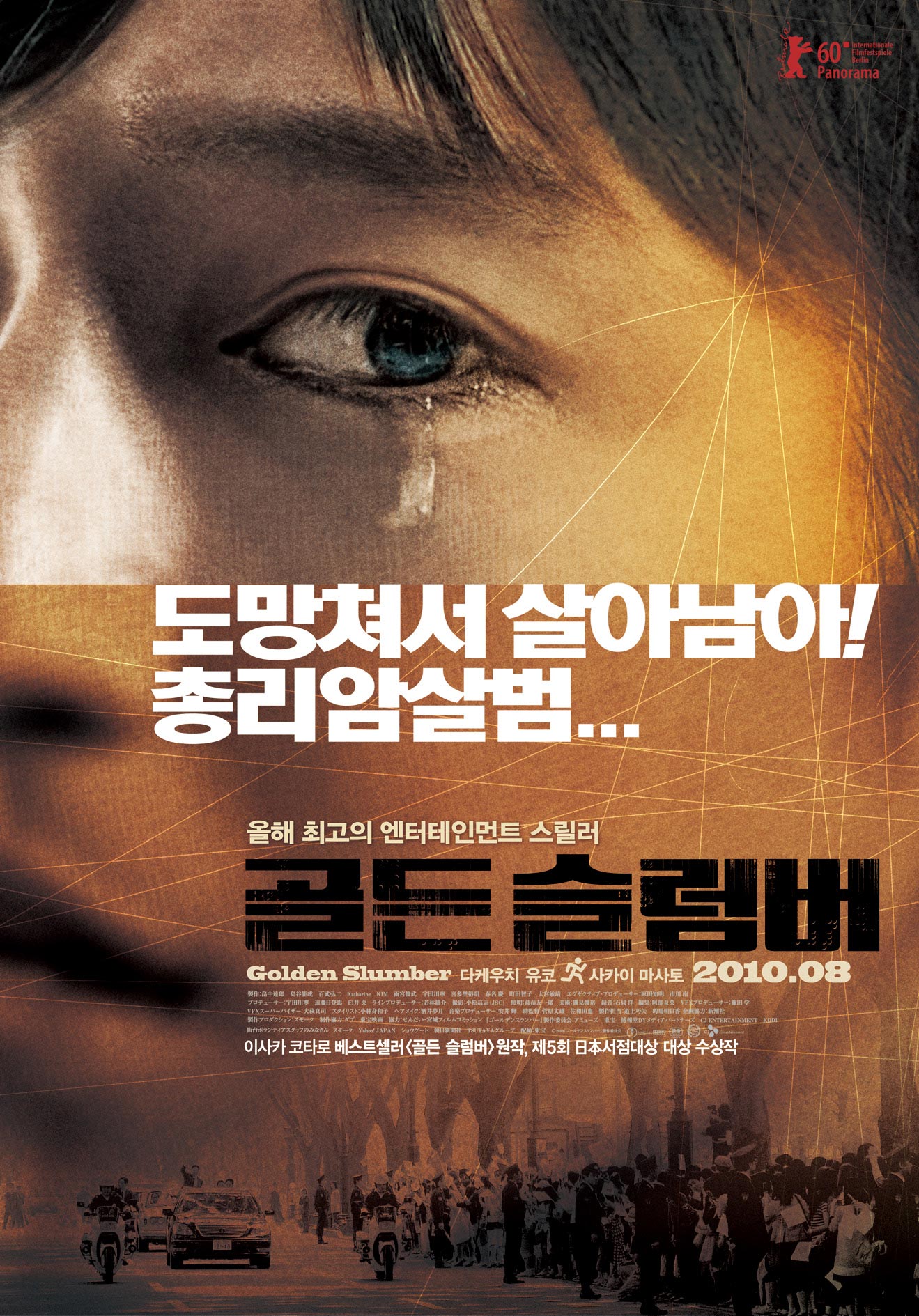
Golden Slumber (2010)
Golden Slumber
7.4
- Director
- Yoshihiro Nakamura
- Cast
- Masato Sakai, Yuko Takeuchi, Hidetaka Yoshioka, Gaku Hamada, Kiyohiko Shibukawa
- Info
- Thriller | Japan | 139 min | 2010-08-26
What exactly is humanism? The suffix 'ism' itself refers to some thought, current, or tendency, so is it right to say it means 'being for people'? I would like to call humanism the last 'consideration' humans possess and an instinct for the preservation of the species. A great many humans do not readily extend 'mercy' and 'consideration' to other creatures that are not of their own kind. Unless it is 'oneself' or 'one's own,' humans generally treat it carelessly, do not acknowledge it, and handle it roughly. But not all people are like that. Though they are a small minority, 'those people' freely give to others and do 'good.' Why do they do so? They have no reason at all. They simply do what they think is right.
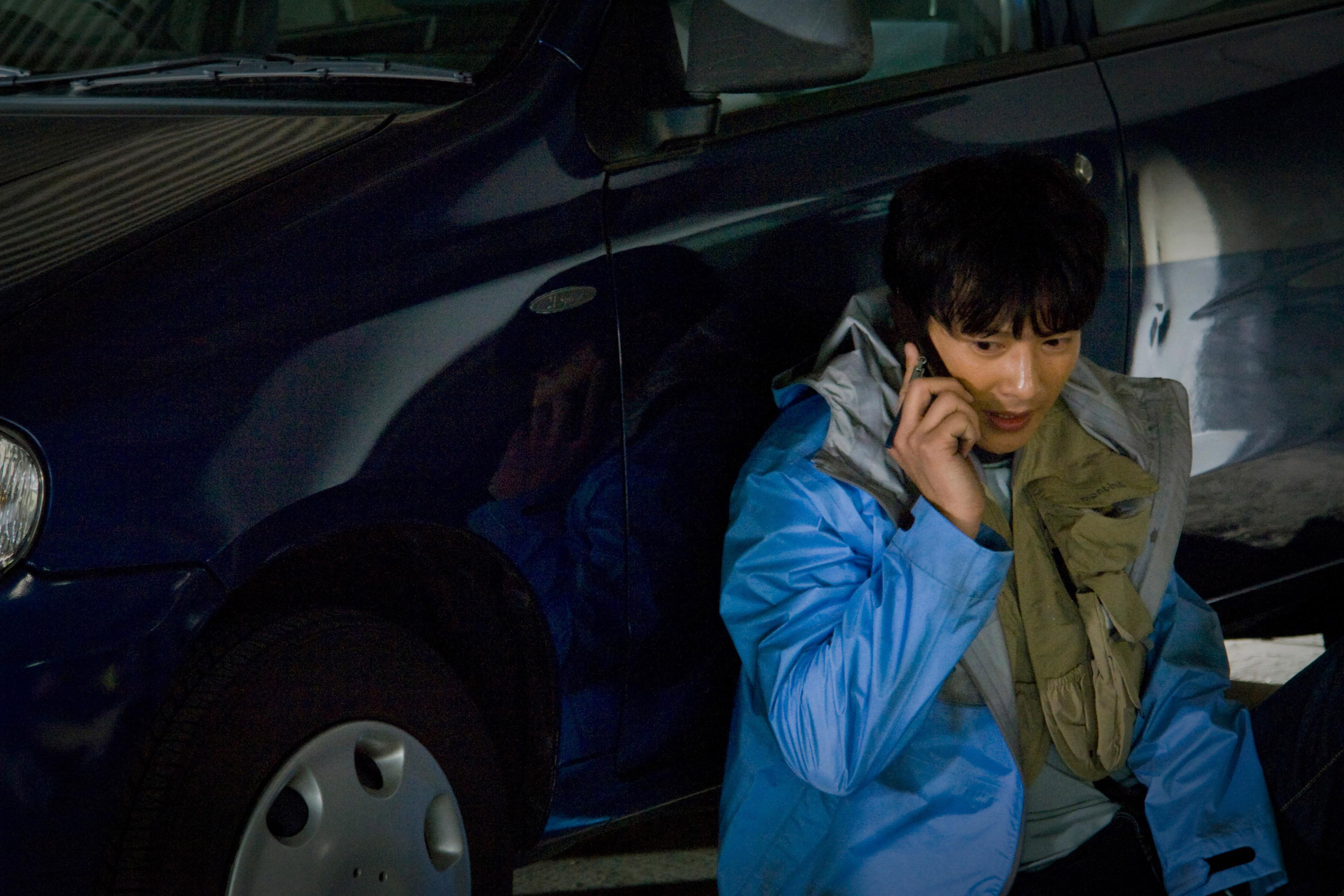
The greatest weapons of humans are habit and trust.
This line runs through the entire film. Long ago, 'Masaharu Aoyagi,' a figure who became a social sensation by rescuing a female celebrity from danger, falls into a conspiracy. Just as his friend says, 'You're going to become Oswald,' he is named as the killer of the newly inaugurated prime minister, and the vehicle he was riding in with his friend is blown up. He flees at his friend's urging to run, but falls into danger everywhere he goes. In the midst of this, his life is saved by a wanted 'killer.' But soon government officials begin to act to capture Aoyagi, as if it had been planned long ago, declaring they will catch the culprit even if they have to seal off every passage in the city.
Let me pause here to consider something. What kind of value is the value called trust? I think 'trust' is the most basic of basics in human relationships. In relationships between people, trusting another is not an easy thing. In my case, 'trust' is hard to build unless a very, very long time passes. Part of it is that my relationships are very closed off, and part of it is probably that it's hard for me to easily reveal myself to others, but like this person, I have within me a character that doesn't easily trust. But Masaharu Aoyagi trusts the other party very easily and very strongly. That is because he thinks trusting the other party is ultimately a matter of protecting his own values and something he ought to do. And who that 'other party' is doesn't matter at all. Even if it's someone known as a 'murderer.' People trust Aoyagi. So they begin to help him. Meanwhile, as he flees, there is something he recalls. It is the past.
He digs up his past memories one by one. Two spacetimes exist: one is the 'present,' a very urgent and unstable state, and the other is the 'past,' which remains as very happy, good memories. The 'past,' as a sharply contrasting space, faintly shows the background by which Masaharu Aoyagi was able to earn 'trust.' He doesn't earn trust from everyone, but the fact that, through his habits and everyday behavior, the people around him extend 'trust' to Masaharu raises the possibility that Masaharu will 'survive.' Of course, his personality looks good just from his face, but it's a fact anyone knows that everyday behavior has a greater influence.
Past behavior seems to be the 'evidence' that gauges how he will be remembered and judged. The past Aoyagi was seen by those around him as a very 'good' person. After Aoyagi was framed as the assassin, interviews swarmed his father, but his father said his son couldn't have done it and told him to flee as soon as possible, and the owner of the fireworks shop where he worked also trusted Aoyagi.
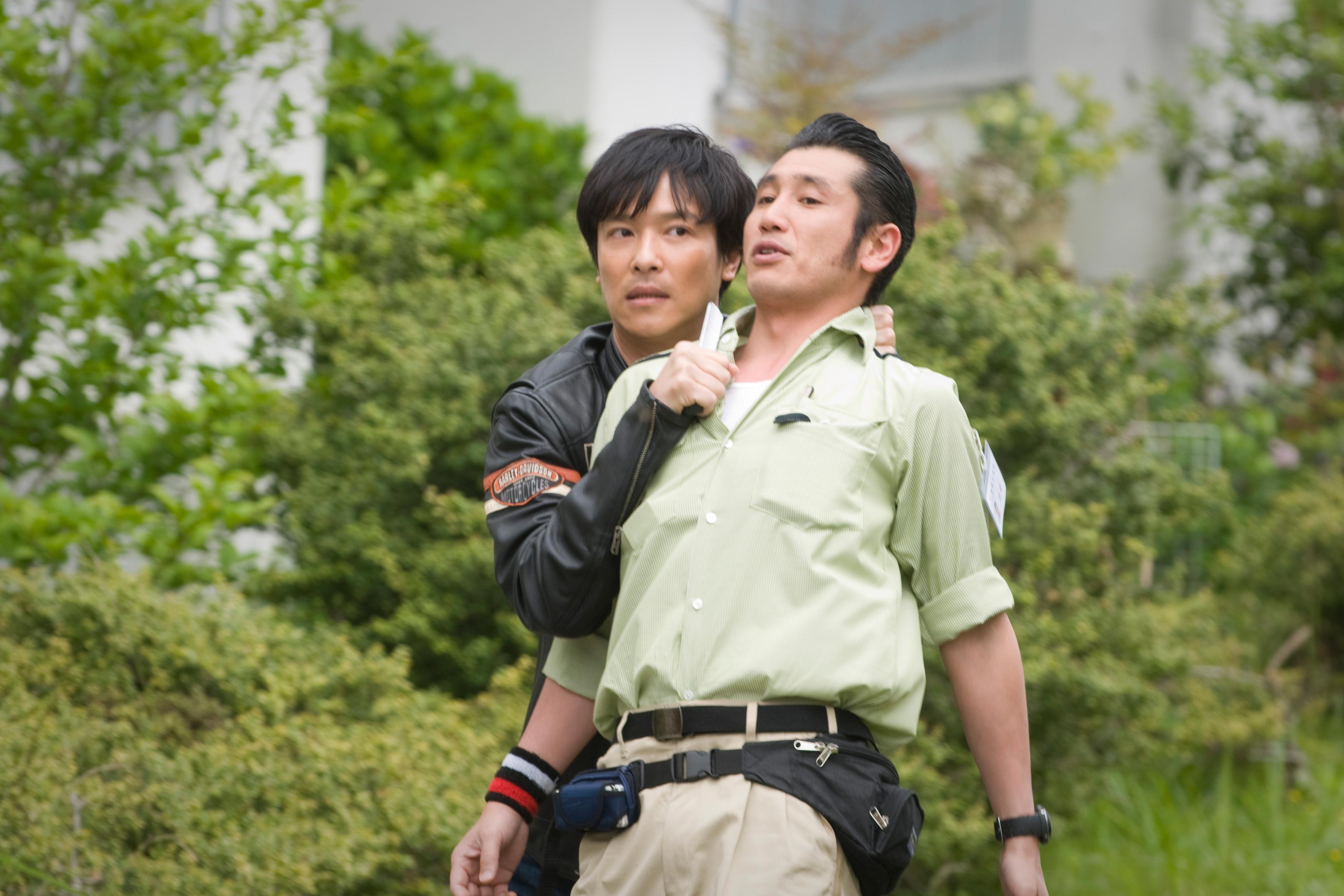

Mr. Iwasaki, a delivery-company colleague he worked closely with, lets him escape by taking himself as a hostage. Aoyagi endures another day this way, and at this point another person who helps him appears. It is his old girlfriend, Haruko. In the past, Aoyagi and Haruko promised their love in an old empty car on a vacant lot, and remembering that car, Haruko replaces its battery, making Aoyagi's life a little more viable. And the 'killer' finds the fake who had impersonated Aoyagi, but while trying to reveal that stand-in, the killer too is taken out, and Aoyagi can only watch as many people are sacrificed because of him. Still, to make the 'truth' known, he contacts a broadcasting company asking them to prepare a space where he can be reported on, and scouts a location where he can negotiate with the police organization trying to catch and kill him.
In a park, late at night, he gets the chance to speak before a camera and begins to speak. But this too is brief; the camera is removed and snipers appear here and there, and Aoyagi is once again cornered on all sides. But at this point, thanks to Haruko, who held memories of 'fireworks play,' and the fireworks-factory owner, the gaze of the people around is drawn for an 'instant,' and Aoyagi escapes into the sewers and saves his life. And then he vanishes for a while.
After some time, Aoyagi, who lives concealing his existence through plastic surgery, runs into 'Haruko' by chance at a department store. Flustered, he presses his body as close as possible to the front of the department-store elevator, not wanting to show his face, and Haruko's daughter, carelessly poking at him, makes the 'anxious atmosphere' even more anxious. But soon Haruko's family gets off, and Aoyagi, out of a little curiosity, follows her and belatedly steps off the elevator, and Haruko's daughter comes and stamps a 'Well done' stamp on the back of Aoyagi's hand, and the film ends.
Throughout, the film crosses between present and past, but rather than focusing on showing how Aoyagi earned the most precious value called 'trust,' it begins to spotlight, paradoxically, the value of 'humanism' in the person who earned trust. From the people who help him to the end and at the same time the people around him whom he trusts (Haruko, Iwasaki, his parents, the killer, the hospital man, and so on).
In speaking of 'humanism' in a society that makes everything ambiguous, even controlling information delivered to the people, this film is effective, but it was a film whose immersion may drop a little because it carries a somewhat awkward and ambiguous story. Still, it was a relief that what it wanted to say was conveyed enough to be understood. Watching films that come out on EBS like this every week, I keep pondering what value I should be thinking about this month, and the fact that it was the 'humanism' that society points to was not bad, as it seemed to be a connecting point with the agonizing over 'love and freedom' that 'Your Paradise,' which I happen to be about to read, points to.
I picture a society where I can come to trust other people more, and where I can earn people's trust.
Comments 0
No comments yet. Be the first.