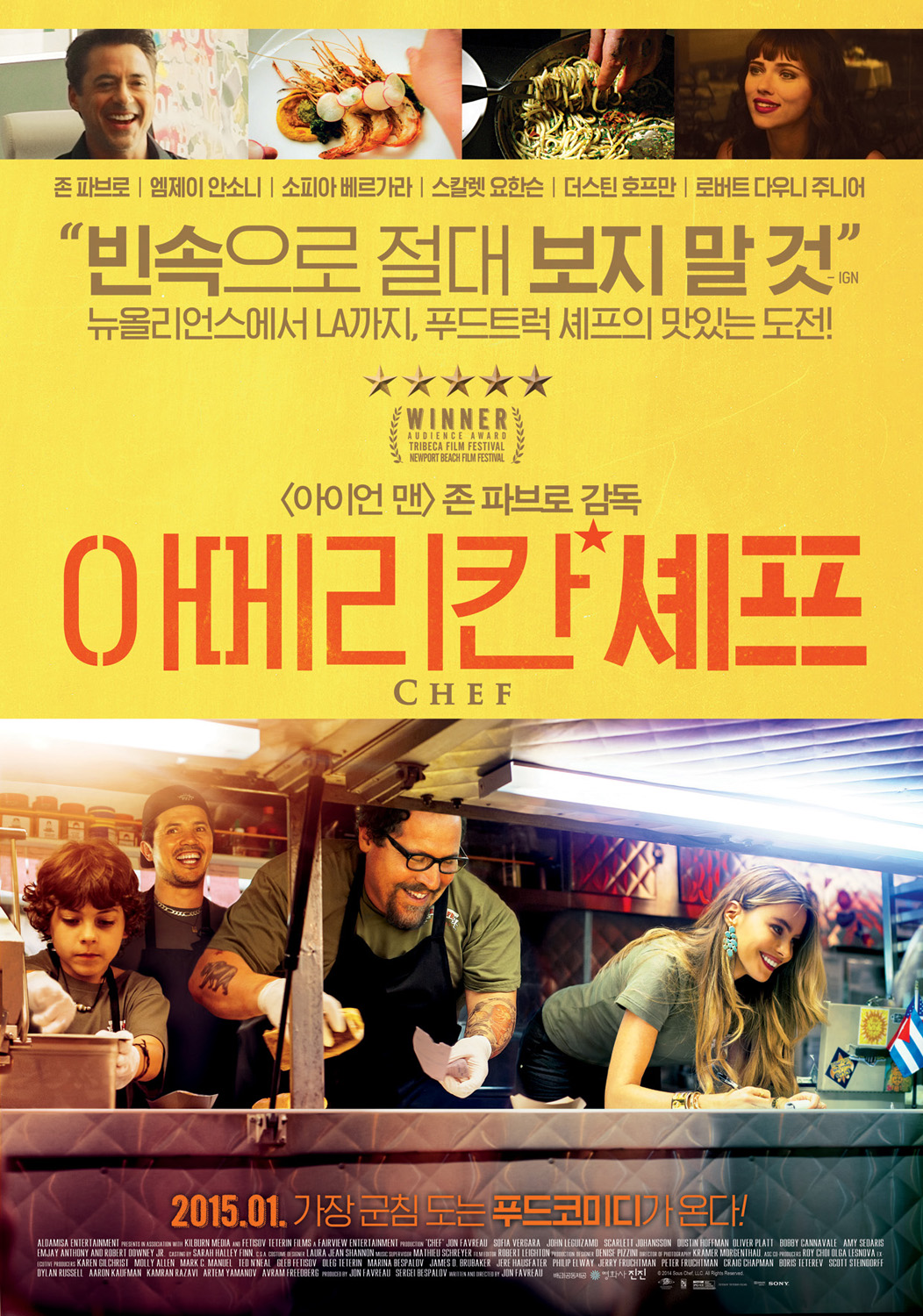
Chef (American Chef) (2015)
Chef
8.1
- Director
- Jon Favreau
- Cast
- Jon Favreau, EmJay Anthony, Sofía Vergara, Scarlett Johansson, Dustin Hoffman
- Info
- Comedy | USA | 114 min | 2015-01-07
0. Before getting started.
These days I watch movies fairly often. Ah, of course, as my friend says, I'm trying to watch movies that people don't usually watch. So I didn't see Ode to My Father, and I didn't see The Admiral: Roaring Currents either. There's a personal conviction of mine at work here. To unpack that conviction, it goes like this. My Love, Don't Cross That River drew over 4 million viewers, and that was for no other reason than that Lotte, CGV, and Megabox screened it—so if they hadn't screened it like that, could that film really have surpassed 4 million? I don't think so. It's the same reason. In a situation where large distributors and box-office chains with nationwide reach are carving up Korea's monopolistic market among themselves, I have no need to watch films like Ode to My Father or The Admiral. No, I don't want to. 'Film' is now no longer confined to being merely an art genre or a means of expression; in Korea it has become a very ordinary scheduled activity. As a result, people often go to the cinema on dates, and families go to the cinema often too. A reality in which you can only watch what they screen for you—that's the current state of the moviegoing public in Korea. So, as part of a boycott against CJ and Lotte, I try to avoid CGV and Lotte Cinema as much as possible, though on the other hand I do try to go to Lotte Cinema Arte or CGV Arthouse. Those are their 'small-distributor cosplay,' but the alternatives are gradually disappearing. The film I'll discuss this time, 'Chef,' is distributed by <Jinjin Pictures Co., Ltd.>. Given that they also have a track record of distributing 'Moonrise Kingdom' (a work by 'Wes Anderson,' who directed The Grand Budapest Hotel), I can roughly guess what kind of distributor they are.
The theater was the Gwangju Theater. Maybe because it's winter, I watched the film shivering, which was a bit rough, but in any case, I'll begin the story with the fact that this is how I've been thinking about movies lately.
- This time's topics: food, power bloggers, SNS,
1. 'Food'
There are many cases of movies made with food as a subject. Among the films I've seen before, 'Julie & Julia' was one of them. There were films like 'Le Grand Chef' too. I remember barely getting to watch 'Julie & Julia' in the army when it was shown as 'the good movie,' and later watching it once more—and whereas back then the protagonists of that film were 'women,' the difference this time is that a male chef is the protagonist.
Making this 'food' requires bloody sweat and effort. Large-scale catering, feeding soldiers in an army mess hall, is hard, but it's no different at an ordinary restaurant. If anything, it would be even harder. As Casper says, critics who only eat the food and critique it don't understand the effort of the people making it. For them it's over once they've criticized with words, but for the people making the food it's a wound. Casper pours out his anguish over this wound to the critic Ramsey. He asks whether they have any idea of the pain of people like us.
2. SNS and Power Bloggers
This 'Ramsey' is precisely an element that heightens realism. The director worked very hard to make a 'realistic' film. The very material that gives that 'realistic' feel is SNS like 'Twitter' and the power blogger 'Ramsey.' In an era like today's, blogs and Twitter are channels for exchanging information instantly. In a world full of various SNS platforms—Tumblr, Twitter, Facebook, Yelp (a kind of review program usable only on iOS devices), Pinterest, Instagram, and so on—the moment a celebrity posts a single piece of writing, people instantly read it and retweet it (re-tweeting 'tweeted' text to others) or hit the Like button (Facebook's Like). In that way it instantly spreads to people and makes oneself known. This creates a psychology in which people unconsciously want to imitate what others are doing, which is to say collective behavior becomes possible faster than before. This film deals in great detail with how information spreads and can't be erased. What should I call this—a characteristic of SNS? A story development that leverages the characteristics of SNS is the core of this film. When Ramsey posts a single remark online, his more than a hundred thousand registered Followers spread that single remark over and over.
Third, this film deals with the typical American family's 'divorce' and 'child-rearing.' As thoughts kept occurring to me, I drew the conclusion that the reason Americans think of divorce so lightly is precisely that their own parents often divorced as well. In the film, Inez married Marvin and divorced, then married Casper, gave birth to Percy, and divorced. She has no child with Marvin, but between Casper and Inez there's a child named 'Percy,' so Casper continues to meet Inez through the legal 'obligation' of raising Percy and through a small will of his own. And what Percy says to his father 'Casper' is to come back home and live with them again. Together with his mom (Inez). Such scenes overlap with 'Boyhood,' which I saw not long ago. Not just Boyhood—in most American films, the part dealing with 'family' usually has 'divorce' lying at its foundation.
Fourth is that reconciliation among the family is achieved at the end. I'll deal with this part in a bit more detail later.
2. The Food-Critic Power Blogger
Finding a 'power blogger' these days isn't all that hard. There's at least one power blogger around you, too. Of course, since there isn't one around me right now, I'd like to become a power blogger myself, but in any case the influence of these power bloggers is enormous. Because a power blogger is 'one with authority,' a product they say a single word about can see its profitability change depending on what kind of evaluation that word is. The power blogs I frequent would be 'Sangsang's' blog and Team Underkg, or thereabouts. In this era, they are tools of marketing and also gathering points for sharing information. In the film, it was precisely 'Ramsey,' who holds such power, who set off the events.
The conflict begins when Ramsey, a very famous food critic, comes to the restaurant where the protagonist Carl Casper is head chef, and posts a scathing piece on his blog saying the food had lost its old freshness and was hackneyed. Casper had his own reasons here, and the reason was that the restaurant's owner demanded he serve according to 'the existing menu.' For Casper, who couldn't put out the menu he had envisioned, it was disappointing. As his ex-wife 'Inez' says, if you run a food truck you can cook whatever you want, but the 'chef' at a restaurant someone else owns has to follow the owner's word no matter what, so this is what happened. 'Riva,' who tells him to make the usual fare rather than creative dishes, is a character reflecting a 'manager' incapable of growth. In everyday life too, you can see plenty of managers who stubbornly cling to 'the existing way' and cannot innovate, and here Riva plays exactly that role.
After seeing Ramsey's critique, Ramsey's countless fans endlessly retweet his tweet. The link by which Casper—who doesn't know that 'fucking tweet'—comes to learn about 'Twitter' is precisely his son 'Percy.'
3. 'Percy' (the son) and SNS
The places where he spends time with Percy are several: first, the market where they bought food ingredients; second, the 'cinema' and 'amusement park,' which were very perfunctory ways of passing time; third, Casper's house; fourth, the food truck after that. If I had to pick the most meaningful time, it would surely be the trip period (summer vacation) spent on the 'food truck.' During this summer vacation, Percy and Casper grow closer, and the biggest factor seems to be that they cleaned the 'truck' together through hard work, and after that, riding around in the truck together, working together, Percy got to know what his father does and was recognized.
I think the biggest reason the food truck could become a 'hit' was precisely Percy's SNS. In the film, Percy uses geo-tags to promote the food truck's location. Because Casper is such a famous chef, when they tag him with a hashtag and say we're here now, people see that hashtag and geo-tag and come find them. I couldn't help but think the director wove SNS in with a very modern sensibility. In fact, I'd only thought about this many times but never imagined I'd actually see it (even if within the fiction of a film), and on top of that, if our country's celebrities posted geo-tags, it would cause an uproar. So how wonderful this film is.
4. Things that come to mind.
What I envied throughout this film was precisely the family affection. Family affection—um, and the father-son relationship at that? The truth is, my relationship with my father isn't as harmonious as in the film. This is partly the family environment, and as my mother says, it's probably also because my father never properly observed any father other than my grandfather. As a result, the very feeling this film gives off began from 'envy.' Um, of course, at first Casper and Percy don't appear to be an especially close and affectionate father-son pair. Whereas Inez and Percy look really, really close.
Many parts seemed to represent American family society, so while it was hard to relate to, there were also aspects I could understand. After all, I watch the film from 'Percy's' standpoint but also from Casper's standpoint. Next time I should write a more organized piece. It feels like it ended anticlimactically.
Comments 0
No comments yet. Be the first.