I worked a lot. By 'I worked a lot,' I mean I worked a considerable number of hours. I worked 56 hours a week, so I worked more than the hours written in the law. If you ask why I worked more, I can only say I went without knowing it would be like that, so I had no choice but to go along with it. I'd already arrived in England, going right back would cost a lot of money, and it wasn't as if I had no thought of just giving it a try.
1. Work (hours)
They say it's a maximum of 45 hours a week, and since I worked 56 hours, I effectively worked 8 hours straight without rest over the week. It was a tougher schedule than I'd thought. But since I had 2 days off a week, it was effectively 56 hours over 5 days, so I worked about 11 hours a day. Of course, the actual schedule was as follows.
Sunday, Monday off
Tuesday 7 a.m. ~ 5 p.m.
Wednesday 4 p.m. ~ 10 p.m.
Thursday 7 a.m. ~ 10 p.m.
Friday 7 a.m. ~ 10 p.m.
Saturday 9 a.m. ~ 10 p.m.
I wonder how many people have worked on a schedule like this, but to clock in at 7 a.m. I got up at 6:30, and when I got off at 10 p.m. I could go to sleep from 10:30. But talking with people, it was rare to sleep at 10:30. So I remember usually falling asleep at 11 at the earliest. When it got later I'd sleep at 12 too. And this schedule was much harder than I'd thought. At the very beginning I felt I could do it, but at some point it got so hard, and once I adapted to this schedule I could handle it to some degree. That adaptation came around the 5th month, as I recall, so... hmm, I can't say it was easy. Unfortunately. It was so hard. Honestly... if you ask what was hard, holding my own body up was hard. No other thoughts came to mind at all; just adapting to the schedule alone left... no time to contact anyone. Heh, this murderous schedule is not a good schedule to remember..
2. Work (what I did)
The institution I was at was a 'school' attended by people who were past adulthood in age but had disabilities. It was a school, but in English it's closer to an institution, and the place's name was college. So it was a school after all. The work done here was largely divided into two kinds. One was living together with the students, and the other was classes. As for the work in daily living, to borrow a friend's expression, saying I did 'helper-type' activities for 6 months would be the quickest explanation. Waking the students, sometimes washing the students, sometimes just keeping watch, eating together, cleaning together, getting ready to go to class together, then doing morning/afternoon class/work according to each schedule, eating lunch together, and after dinner carrying out the set schedule according to the week's routine. The evening schedule consisted of dancing / chatting / swimming / pub / club (Mon~Fri), and weekends were at the house's discretion (even this discretion is decided after discussion with the students).
If I convert a schedule like this into the 7 a.m.~10 p.m. timetable, it's as follows.
Wake up by at least 6:30 a.m., clock in by 7.
7 a.m.~9:15 a.m.: waking / washing, keeping watch / medication / breakfast / cleaning / class prep
9:15 a.m.~12 p.m.: morning class / tea time
12 p.m.~1:30 p.m.: lunch, kitchen cleaning and afternoon class prep
1:30 p.m.~4 p.m.: afternoon class / tea time
4 p.m.~6 p.m.: pre-dinner tea time, chatting, chilling out, DVD - usually varies by student
6 p.m.~7 p.m.: dinner and kitchen cleaning
7 p.m.~10 p.m.: Mon~Fri evening schedule / house cleaning / medication / putting to bed / clocking out
After 10 p.m., personal time and then prep for the next day.
So waking at 6:30 and going to bed at 11 was roughly the most average daily routine. Honestly, if a day like this came only once a week it'd be bearable, but the problem is there are 2 such days. Since this is a 13-hour schedule, even with 2 days I still had to do 30 hours over 3 days.
There were various classes. I went to Cooking and Printing. As for cooking, there's cooking done together with students and cooking done just among staff, and in my case there were both. For cooking done with students, the students were given tasks too and we made the food together. The menu tended to follow what was set by the house. There was almost no autonomy, and it tended to follow a somewhat rigid food menu Routine. As for cooking among staff, the amount of autonomy granted varied by house so it's hard to judge, but the place I worked gave quite a lot of autonomy after the first week. Probably thanks to my serving up tasty and unusual dishes. Since they trusted me, it was comfortable from my standpoint too to step outside the existing menu and serve new foods. Plus, there were comparatively many ingredients.
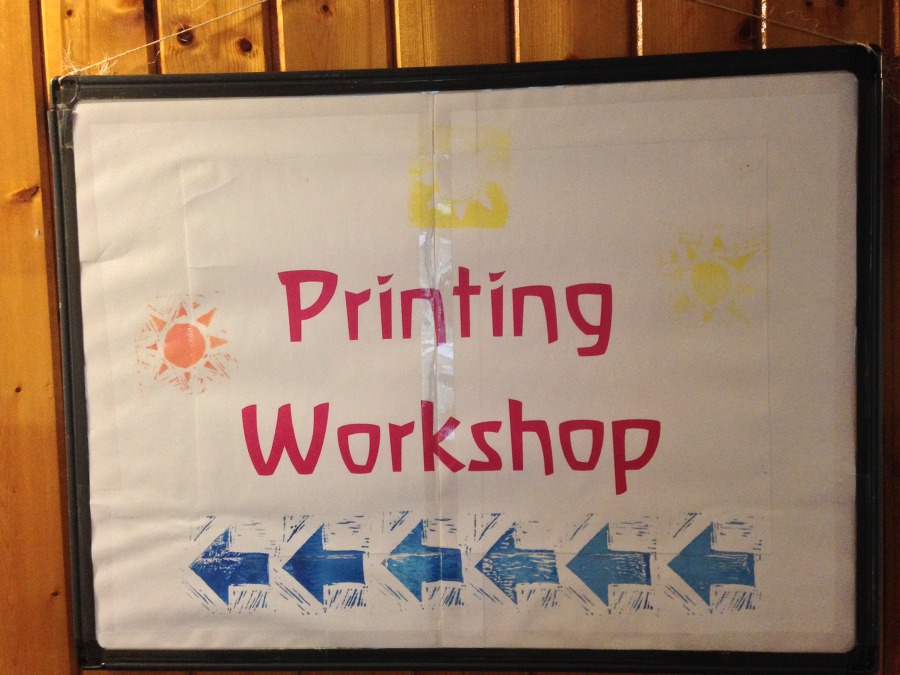
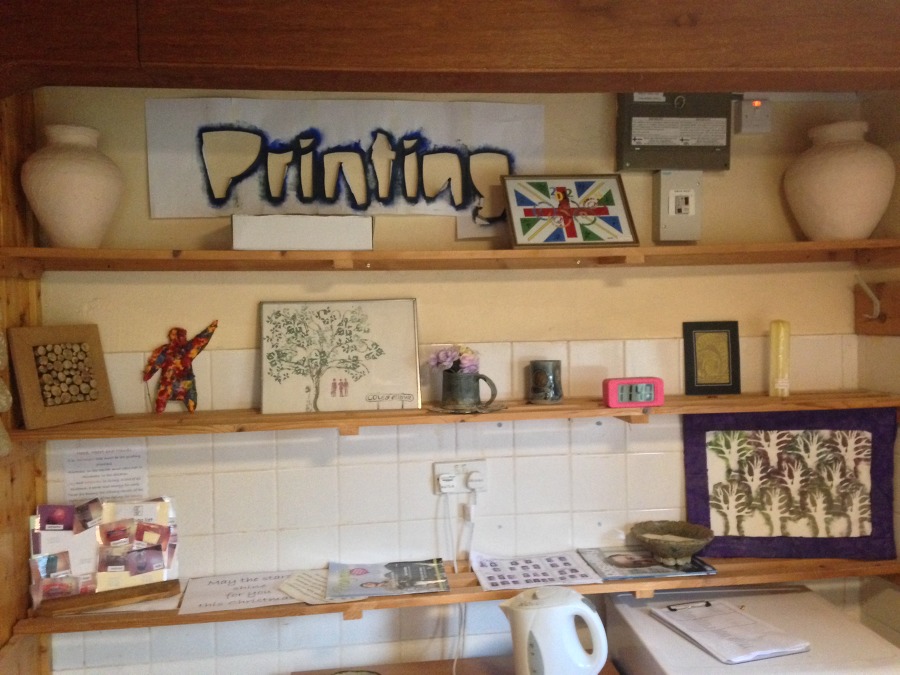
Printing was my favorite class. Unfortunately, I don't have a photo of Grandma Wendy, who I could call my best Tutor. If I get the chance next time, I should ask her for one. Anyway, the Printing class had Christmas cards, silkscreen printing, and wrapping-paper printing, and thinking about it even now, I think introducing gradation was the best choice. The students here had a varied spectrum, but in any case the biggest commonality is that they can be as creative as we are, but it isn't easy for them. I'm not enormously creative. I'm not the first to use the technique of just splattering paint to make a picture, I didn't bring a medieval technique into the present and reinvent it like Mark Rothko, nor did I, like Leonardo da Vinci, draw perfectly symmetrical pictures from familiarity with anatomy. But it seems I did have some unusual methods at a level the students could follow along with. For example, like this.

To make one of these, you needed a board / roller / paint / lino cut / something to press with, and so on, but actually the only things where you can exercise creativity here are the lino cut you make and the color. Among these I chose color, and before going I tried various things at least a little. Starting with a rainbow, I tried making a French flag once and a Colombian flag once too. I tried to do as many things as possible, but because I came back to Korea, the few I brought are all there is. I'll probably give them to someone precious. Or maybe I'll set aside a small room in my house in the future so I can do Printing.
According to Grandma Wendy, she said she herself had never taken a professional art class, but actually, for making very simple things, rather than professional knowledge being needed, I think how well you blend the students together is more important. Producing cards like these well with autistic students and students with somewhat low intelligence and low efficiency isn't easy. On top of that, students must be able to recognize for themselves which work is better during class and must be considerate of others. I don't know how long they'd been at this institution, but it was probably hard at first. But by the time I went and worked there, it felt like things were running to some degree. That is, I was amazed that, though the students seemed not to know much, they were considerate of others to a degree, recognized which was the better work, and made works according to their own taste. It just takes a long time to learn; they can do it too.
The Printing I did with Grandma Wendy will probably keep being an object of longing. I always loved art classes, and on top of that, this was a class that stimulated my artistic desire. Honestly, you might think it falls short for venting an artistic desire, but for everyday-life art, this was enough in its own way. Personally I wanted to bring back the Wrapping paper, but it was so big that bringing it during travel seemed like a hassle, so I gave up—a shame. I should ask someone for it.
- As for Work experience, the time I wrote about before at Many tears is the whole of the job experience I did, which is a shame. There was also working at the Red cross, but I didn't get to go.
That's it for today
16.02.25
Comments 0
No comments yet. Be the first.