0.
I agonized a bit. Whether to go to Dongdaemun or to the National Museum of Modern and Contemporary Art. In the end I went to the contemporary art museum, which was holding a free-admission event. The weather was a little hot, but I really liked the exhibition itself. So today I'm thinking of writing my thoughts on contemporary art and installation art together with an exhibition review. I also have a plan to translate it into English, though I'm not sure whether it'll actually be possible. For now, since I plan to translate what I wrote in Korean into English anyway, I'll write in Korean first and then translate into English.
1. Introduction
The truth is, until now the distinction between installation art and painting wasn't clear to me. The point at which I began to clearly distinguish these was from 2014, because by then it was possible after a certain amount of knowledge about painting, sculpture, installation art, and video art had accumulated. After visiting the contemporary art museum exhibition this time, one new concept formed, namely the concept of 'installation art.'
Most people tend to prefer painting more. In particular, many like modern Western painting rather than contemporary painting. Renaissance painting is somewhat classical, and medieval Western painting is heavily deified and mythologized, and because of the unrealistic images it was hard to see people resting their eyes on them unless they had a religious interest. (Even when going around museums in Europe, it's vivid in my memory that there were definitely fewer people on the medieval side. The works around the time of the French Revolution were swarming with people....) I too agree that modern Western painting is the most universal painting among today's pictures. Most of the Western painters we know well are all modern painters. The same goes for Manet and Monet, whom a friend was talking about a few days ago, and Van Gogh, Gauguin, Cezanne, Seurat, Goya, and so on—modern painters make up the mainstream, and modern Western painting is probably one 'category' gathering only the most popular artists in current Korean society. But, the thought that came to me while viewing this exhibition settled, again, into the idea that the art of the future is 'installation art.'
If I were told to talk about the characteristics of installation art, I'd pick three-dimensionality and reality as its biggest features. Painting exists as a picture. It exists as a picture inside a frame. Sculpture, another kind of art, often reproduces in plaster or bronze the themes or figures that appeared in paintings. Of course, it's a 'recreation' and a completely different work, but in any case, in that it tries to embody the perfect human, it shares a large context. (Impressionist painting is a somewhat unique case, so I'll say in advance that it's far from reality.) However, this 'reproduction' is generally a limited reproduction, and apart from ancient Greece, large sculptures are hard to find. Moreover, sculpture exists as sculpture; there's a limit to looking like a person. Among Rodin's works there are some so 'realistic' sculptures that they give a slightly different feeling. But on the larger themes, Renaissance sculpture and modern sculpture don't show much difference. Even if we know artists like Michelangelo or 'Rodin,' there are few sculptors we otherwise know well, and since most of those sculptures don't differ much in form, there's no great difference in diversity. For example, if you can tell which era a particular sculpture A belongs to, it's more likely you recognize it because you know the work's shape rather than from the sculpture's body proportions. But these days, watching installation art, I began to think it has diversity, is three-dimensional, is the most realistic yet heterogeneous, and is the hardest for the artist's intention and the viewer's interpretation to mesh—precisely 'postmodernism' itself. The feeling of slightly grasping what's discussed in books, in newspapers, in essays? Post-modernism arts achieved tremendously great upheaval, calling themselves avant-garde and so on, but I actually had many doubts about whether that upheaval was any good. We usually equate 'art' and 'music' with art, but we don't equate certain acts, certain installations with 'art.' The word 'art' has to be attached to that object. When called performance art, it becomes 'performance art,' and when called 'installation art,' only then is that installation recognized and acknowledged as one form of art. You could say that's how fearsome the power of language is, but this language is something humans assign, and every human has their own unique concept of 'art' that they think of.
I'll give a few of the installation art works I saw this time as examples.
2. Bit fall pulse
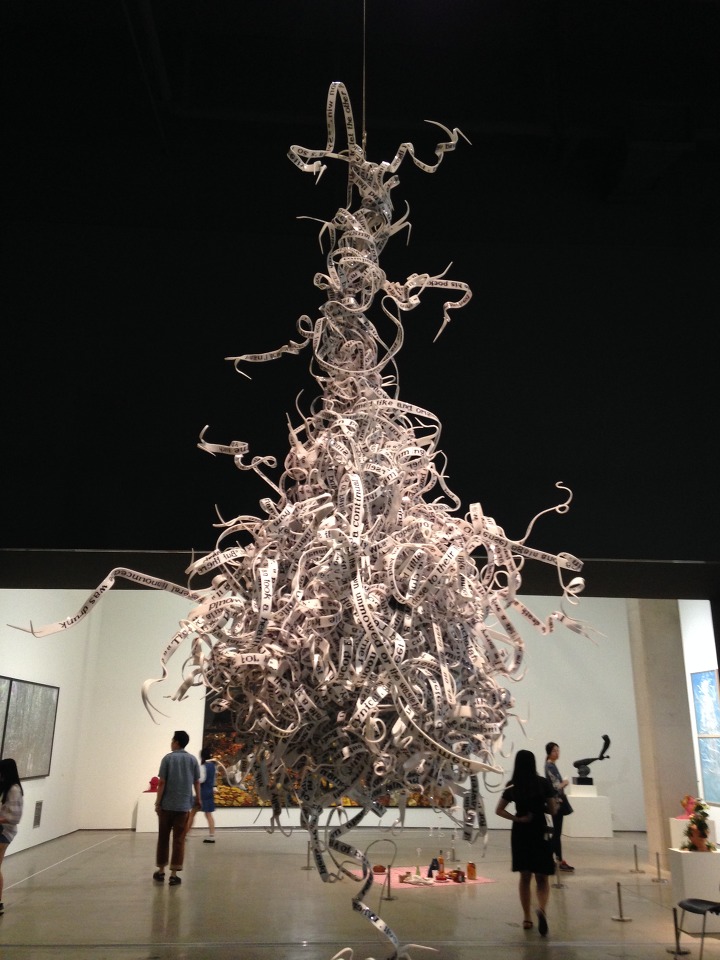
Before explaining this work, I think I should give a rough explanation of this exhibition. The National Museum of Modern and Contemporary Art is a 'contemporary art' museum. Contemporary art can be seen as the art whose forms are the most diverse. Perhaps that's why the spectrum of works is so varied, and what I saw this time were the work of 'Gilles Barbier,' Julius Popp's 'bit.fall pulse,' the 'Delusion Earth' exhibition, and one photography exhibition. The first work I'll mention is Julius Popp's bit.fall pulse.
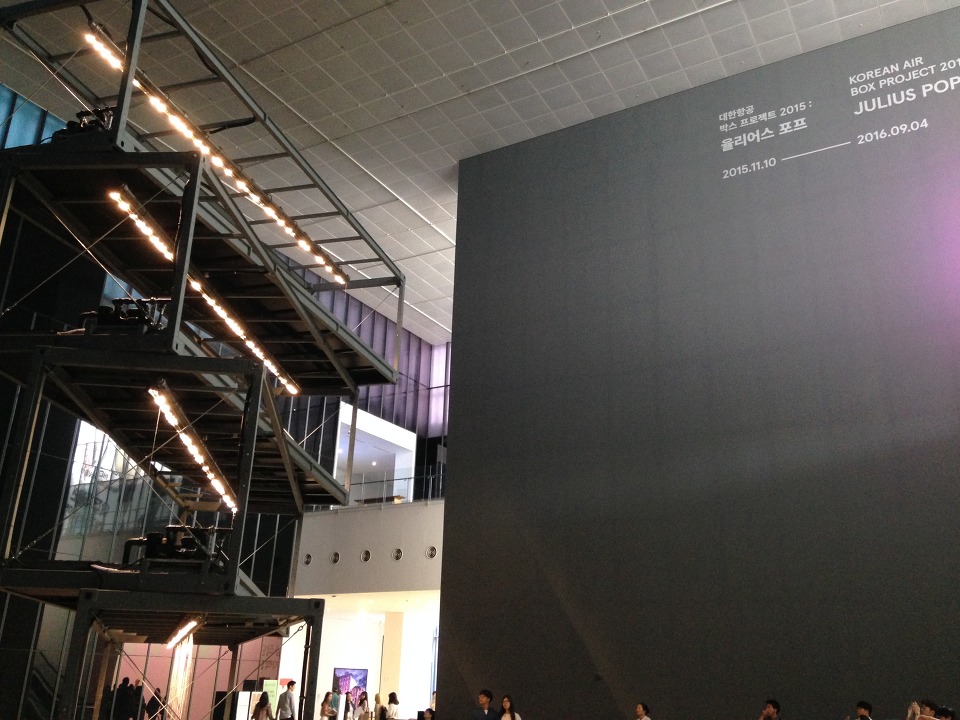
This structure is the work I saw as soon as I went down to the basement from the entrance. This project, created with the sponsorship of Korean Air, is a work utilizing a container. It momentarily sprays water to randomly create 'letters,' and people seemed to have various thoughts while watching this. Only, since the letters were hard to make out, many were watching intently, and seeing that when a familiar word appeared people would read that word aloud, I thought that in any case every person wants to read the message the work gives. In the interview video, I think the artist said his intention was 'to show various words and thereby make the viewers form various associations,' but I don't remember well. Well, rather than the artist's words being important, there was a point I considered important separately. Namely, the feeling that 'installation art' was no longer simply unfamiliar—that feeling was important. In any case, it's hard to think of 'art' as a field based on logic rather than on the emotional part. That's why 'feeling' is all the more important.
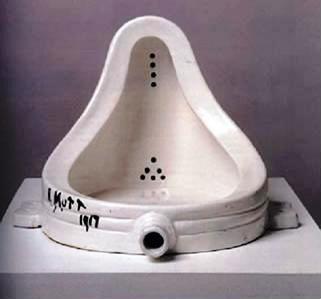
After Duchamp's 'Fountain,' which can be called the starting point of installation art, artists must have agonized a lot. If at first there was really a lot of 'avant-garde' installation art, now I see it changing into somewhat communicable installation art, contemporary art. Honestly, I'm not an authority enough to evaluate the works of famous artists. There's no certificate to back up my values for viewing artworks. I'm not sure whether the countless tickets I've used up so far can substitute for that certificate...anyway! Thinking about who could look at a 'Brillo Box' and recall capitalism, the only conclusion that comes to mind is that it'd be too difficult. Whether it's a Brillo Box or the countless photos of Beethoven, while I rate pop art highly in that it definitely broke down the boundary between particular art and popular art, understanding the object still came with difficulty. But when looking at the works I saw this time, I got a slightly different feeling. It became a bit kinder and easier to empathize with. Whether this is because the context I hold has grown, or because the artist is clever, I can't judge, but at the very least I could see the viewers enjoying themselves. The reason it was hard to see people empathizing with the Brillo Box, with works shaping canned goods, with works shaping a very large cigarette butt, is probably that there's no zone of empathy. To empathize, there must be a connecting point, and creating that connecting point isn't easy. Moreover, the artist's intention has become hard to prioritize in the postmodern era. In an era where the viewers and listeners assign individual meaning, the works I saw this time were quite meaningful. People seemed to understand to some degree what the artist intended (judging from their reactions), and at the same time individual meaning-assignment by people was taking place too. People thinking, people imitating—whatever it was, in 'their own way.' As a result, 'bit fall pulse' satisfied several expectations. Diversity of interpretation, the work's difficulty (abstruseness), contemporary artistry in the aspect of using materials (the lessening of material constraints and limits), and so on—in various respects it was a work befitting 'contemporary art.' If modern art was mainly painting and sculpture (excluding opera, theater, etc.), now I felt anew that another world is opening through video art, installations, and the like. Materials departing from the existing materials of 'paint' and 'plaster' were revealing contemporary art itself, which shows the identity of contemporary art.
3. Gilles Barbier
The truth is, the exhibition I'd wanted to see was the 'Gilles Barbier' exhibition. I have good memories of French contemporary art from before. There aren't many exhibitions I went to twice, but the Art of Today France exhibition held in Gwacheon at the time was an exhibition I went to twice. It was composed mostly of installation art and video art, with a bit of painting. Given the nature of the Gwacheon branch, where if the scale is large the exhibition hall is big enough to contain that large scale, and they utilized all of that space, there was quite a lot to see. At the time they brought works by 10 contemporary French artists. At that time 'Gilles Barbier' wasn't on that list. So for me this exhibition is the first time for this person's work. The theme was 'eco system,' and a certain particular mood coming from the word made me wonder whether it was about 'eco-friendliness' or something, but as I saw the exhibition I again thought language really has a strong arbitrary aspect. But since the curator who planned this exhibition said they chose this artist because Gilles Barbier had been making works expressing his own color for over 20 years, I think the artist's unique identity was well dissolved into the works. Although the space was a little small, I think there was no problem in expressing his works.
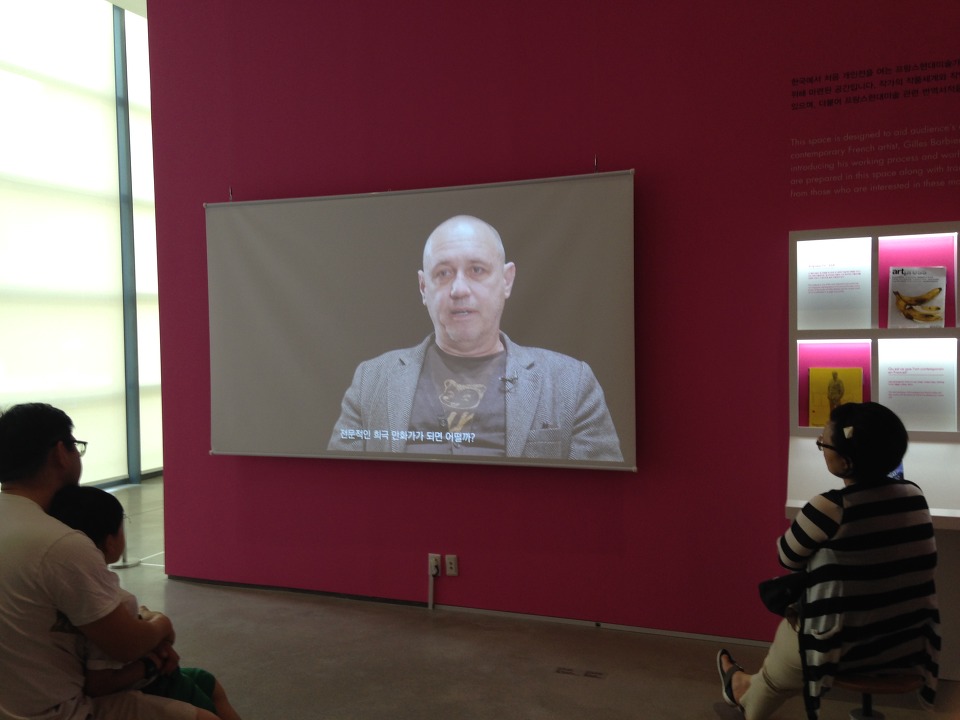
In particular, as the artist said, the artist's remark that, as above, he had no choice but to make works with the materials at hand because the materials he wanted to use weren't available, was curious, and watching the results of a passion that does its best by whatever means possible from one's own position, I learned a bit. The process by which Gilles Barbier, finding modern art and art history so boring while studying them, went to a professor who advised him to try contemporary art, and on hearing that professor's advice stepped into being an artist—this process was quite curious to me. The interview essentially summarizes a situation in which one finds the work one wants to do and ultimately gets to do that wanted work, and I wondered whether it's really such a simple story. There must have been many things within it, but the story—that the core is that he came to find 'the work I want to do' and at some point was beginning his creative activity—seemed to give hope that one can find and do the work one wants. I don't know what the little kid and the elderly folks sitting there were thinking..
4. Delusion Earth
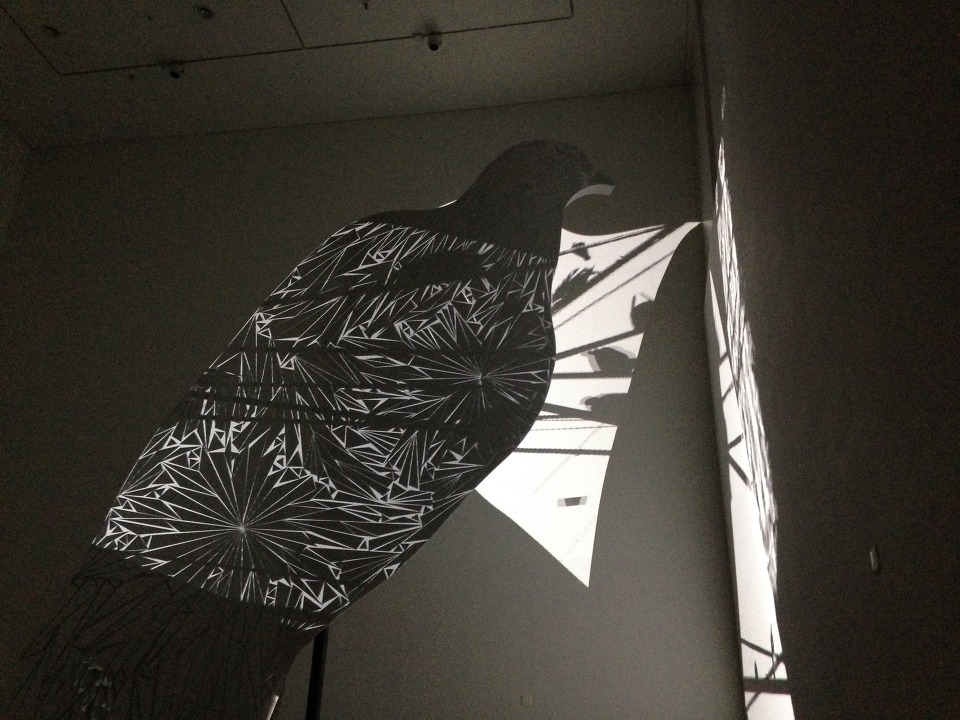
Delusion, wow, really amazing.. Here you have to experience it. No matter how I write it out and bring photos like this, it's no match for actually going. I took photos of the spaces with my camera as best I could, but reproducing that atmosphere is just difficult. It's a bit hard to show. So I recommend definitely going as soon as possible before this exhibition ends. As for an exhibition with blurry 'boundaries,' I think this exhibition was very singular. It's specialized for experience so you pass through quickly, but there's a lot to think about within it. Because I'm surely not the only one who feels that, for any artwork now, the 'interpreter's' portion is greater.
If you have the inclination, I think it's fine to just read the explanation in front of the exhibition hall well before going in. Usually people chatter in front of it without reading the explanation and just treat it as an experience space, going in to have fun and only coming out, but in this exhibition there exists an opportunity for thought that goes beyond fun.
5. Photography Exhibition, Ahn Kyu-chul Exhibition
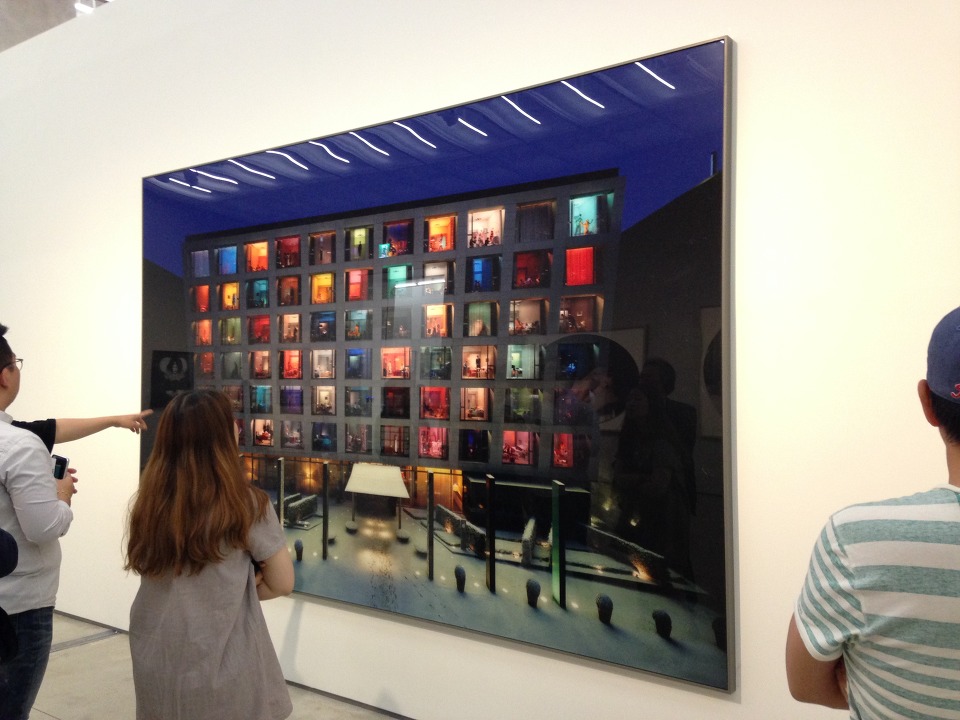
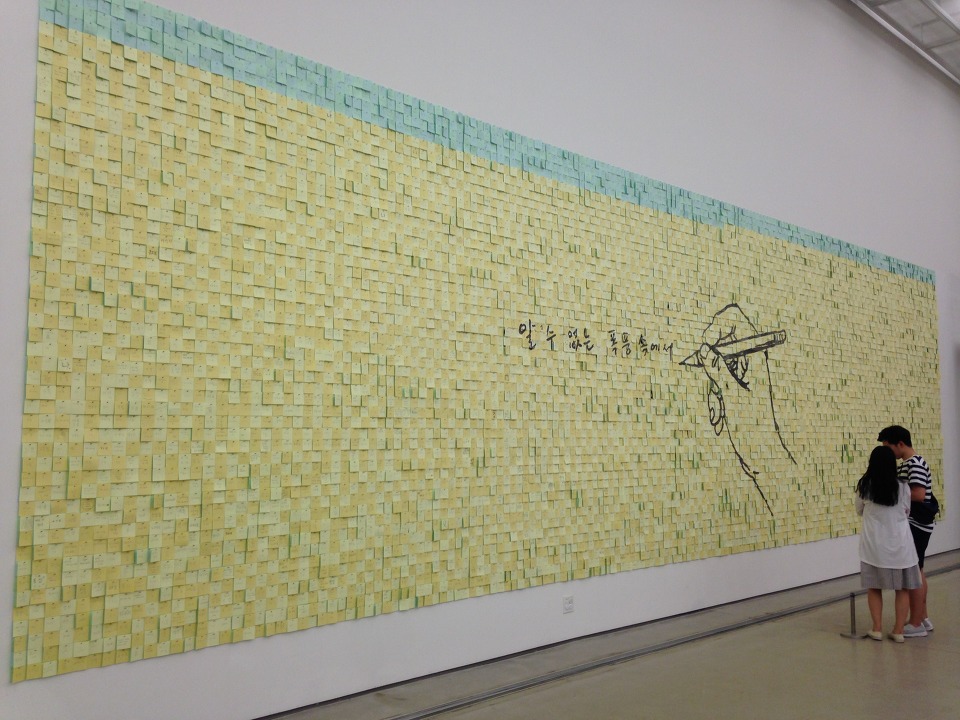
The photography exhibition was hard to concentrate on because there were too many artists, and that became a factor disturbing me. The crowd was too haphazard too, and it seems that when the exhibition scale is large, the power to concentrate on a theme declines. For me, I do need a specific theme. So what caught my eye was the work above titled 'Saturday Night.' A cross-section of contemporary society—I remembered seeing a scene like this before in François Ozon's film 'In the House.' If you're interested, watching it once might also be..
The Ahn Kyu-chul exhibition (bottom photo) I'd like to score highly in the aspect of audience participation. But it's a shame there's no particular special charm. It is contemporary art, but this person's space seemed to be in the process of becoming a space with a bit more 'individuality.' Of course, that installation work that was like a sealed room was curious.
6. Closing
The weather was good this day. Seeing people wearing hanbok made me wish people would keep wearing hanbok, and seeing that there were more people who came to the museum alone than before, I also wondered whether the times have changed a little. Of course, because of the particularity of contemporary art, sharing that taste with someone may not be easy. Looking at the cases of couples who came, some seem to come just for a 'date,' and some seem to come because they're genuinely interested in contemporary art, but in any case, since interest in art seems to have grown compared to before, I held hope that if there were a few more such people, society could move toward a slightly more intellectual society. Of course, there were absurd things too. In Korea, when asking someone to step aside or saying sorry when flustered, they could just use Korean, yet hearing things like "Excuse me" or "sorry" I couldn't understand. Was Seoul that international? Even if it's international, no, it's Korea.. I guess this is what comes of being a Korean-language-education major.
In any case, watching contemporary art grow closer to people felt good. I'm not sure of the exact reason. Probably it's because the distinctive sense contemporary art gives goes beyond simply seeing and appreciating. Contemporary art seems to leave room for seeing, appreciating, and even experiencing. Of course, depending on the work, you may still have to spend time mainly 'appreciating' as with video art, or look from various angles as with 'installation art,' but I got the feeling that this contemporary art is increasingly carving out its own unique place. For adults, most of what we grew up seeing was only painting and sculpture, and it hasn't been long since we just started getting used to installation art, but for children, I got the thought that it seems like a space where creativity is nurtured, a space where vision is broadened. Before, just as for those who grew up seeing the pictures and historical maps drawn at subway stations in Stockholm, seeing the richness of countless designs—for the Stockholm students for whom that has become everyday—the breadth of thought they can ordinarily have is bound to be different, I hope that people and students in Korea will also have a broader breadth of thought. Whatever it is, the moment it becomes everyday, it will become one element that's easier to combine, and accordingly the breadth of what we can experience, perceive, and express will also grow. As that happens, perhaps a moment will come when, at some point, 'diversity' is no longer expressed by the word 'diversity' but becomes everyday.
Comments 0
No comments yet. Be the first.