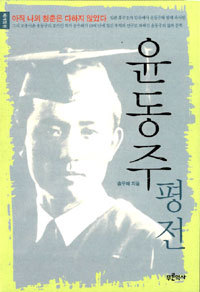
Until the day I die, looking up to heaven,
may I have not a single shred of shame.
Even at the wind that stirs in the leaves
I was tormented.
With a heart that sings of the stars
I must love all dying things
and I must walk
the path given to me.
Tonight, too, the stars are brushed by the wind.
Yun Dong-ju, 'Prologue (Preface Poem)', Sky, Wind, Stars and Poetry, 1948
---
0. Since a film about Yun Dong-ju came out this year - the film 'Dongju' - there was a flicker of conscience in my heart telling me I really ought to open at least one book about Yun Dong-ju. Twentieth-century literature, going round and round, passed through the 1920s and 1930s and at some point reached the 1940s, an era in which the name of the poet 'Yun Dong-ju' held a place, so without much hesitation I borrowed it and read it. This time it's 'A Critical Biography of Yun Dong-ju.' In the history of modern Korean literature, the 1940s correspond to a dark age. Most of the works created in this period were either pro-Japanese works or works like 'historical novels,' and even these were often canceled mid-serialization. The works written in this period generally saw the light of society in the form of being published as story collections or poetry collections after Liberation, and Yun Dong-ju's collection 'Sky, Wind, Stars and Poetry' is precisely a representative case. Considering that this collection was published in 1948, it means that for a good while even after the poet's death he remained unknown to people. A similar case would be Yi Yuk-sa's 'Yuksa's Poetry Collection' (1946). Thus 'Yun Dong-ju' became known to the world after Liberation. To that extent the 1940s were a gloomy period, but Yun Dong-ju also draws attention because the majority of the works he left came from that time.
1. In this piece, the writing consists of running the story of the book - in other words, my assessment of the book 'A Critical Biography of Yun Dong-ju' - in parallel with the story of Yun Dong-ju himself. Since assessment and fact may go back and forth, it might be somewhat confusing, but because I think it's difficult to separate the discussion of the book from the discussion of the poet entirely, the content will be somewhat mixed; the keywords this time are roughly as follows.
1) Periodization of Yun Dong-ju's life and the main activities of each period
2) Things worth knowing: his attitude of self-reflection, and matters worth pondering about his life
3) Sources and structure, and the shortcomings in the content of the book 'A Critical Biography of Yun Dong-ju'
4) Personal impressions and the connection to the teacher certification exam
2. First, if I were to divide Yun Dong-ju's life, I think I would divide it roughly into three periods. The adolescent period when he attended schools in Jiandao and Sungsil School, the period when he attended the literature department of Yonhi College (the predecessor of today's Yonsei University), and then the period after he crossed over to Japan and attended Rikkyo University and Doshisha University until he was imprisoned and then died. I think the 'period of growth' is important for anyone, and the life Yun Dong-ju went through growing up in Jiandao was by no means smooth. If you ask whether any place near Joseon could have been safe during the period of Japanese rule, the answer would of course be that there was no such place; that's why the time when Yun Dong-ju was growing up must have been nothing short of harsh.
In his childhood, the stages of his activity were North Jiandao, Gyeongseong (Seoul), and Japan. Born into the Papyeong Yun clan, he was the family's 'eldest grandson,' and at the time, though his father lived a literary life and could not properly make ends meet, fortunately his grandfather was a 'small landlord' who had a little land, so he was able to attend school steadily. Since he lived most of his life in North Jiandao - up until he entered Yonhi College - it's worth looking back at what meaning the life in North Jiandao held for his poetic activity. In North Jiandao, after the Seojeon Seosuk was established and then effectively ceased to function, a private school called Myeongdong School was established, and centered on this school many people of Yongjeong began to burn with a 'zeal for educating their children' for the recovery of national sovereignty. However, they suffered hardship several times due to the winds of communism and Japanese oppression. Even amid such circumstances, Yun Dong-ju appears to have established his own set of values. I suspect those values were the value of 'independence.' Yun Dong-ju still belongs to the generation that was educated and raised in Hangeul. In the early period of Japanese colonial rule, since the Japanese could not control all the schools abroad and at home, it was an era when Hangeul education was being carried out, an era when classes at school were taught in Hangeul.
Another thing worth considering is 'the breadth of language.' The place where Yun Dong-ju lived was, at any rate, North Jiandao, and North Jiandao was a place to which many people from Hamgyeong Province went. 'Hamgyeong Province' corresponded to a linguistically isolated region where the language of the eras of King Sejong and King Jungjong of Joseon remained, and such traces can be seen in words like 'heda' (to count). Now we write it as heda > seda, but because he depicted the image of counting the stars (the image of 'heda'-ing the stars) in 'The Night When Stars Are Counted,' we can recognize the beauty of Yun Dong-ju's poetic diction. Other poets in whom the sentiment of the displaced migrant and native, local diction appear together include O Jang-hwan, Yi Yong-ak, and Baek Seok; but unlike the impoverished O Jang-hwan and Yi Yong-ak, Baek Seok and Yun Dong-ju lived relatively stable lives, so I think they were able to cultivate a poetic sensibility in which poverty did not surface to the foreground.
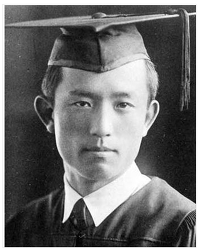
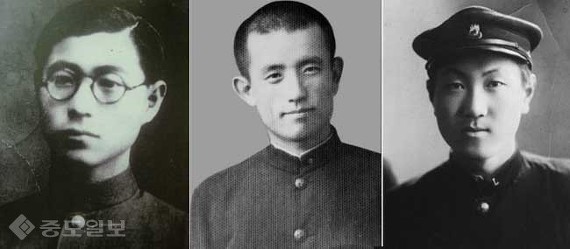
The period when he attended Yonhi College was, I think, truly a beautiful youth in Yun Dong-ju's life. Of course, as graduation drew near, Japanese oppression gradually grew harsher, so it was by no means an easy school life, but here it seems Yun Dong-ju lived a fairly decent life. The things he felt at Yonhi made him dream of studying in Japan, so I can only say so all the more. The photos above are all from the Yonhi days. The Yonhi-era graduation photo, the photo of Yun Dong-ju and Song Mong-gyu, the photo of Yun Dong-ju, and the photo of Jeong Byeong-uk. Even now there remains a Yun Dong-ju poetry monument at Yonsei University; the atmosphere of 'Yonhi' at the time lay in continuing Korean-language education as much as possible, and although in the end Yonhi too had its principal changed and became powerless before the might of the Japanese, up until the time Yun Dong-ju attended it was fine. Also, because there were a considerable number of works he left to 'Jeong Byeong-uk,' I think the Yonhi period is likewise important.
Rikkyo University and Doshisha University are the schools in Japan that Yun Dong-ju attended before he was arrested by the higher police. As for Doshisha University, I already remembered it as the school 'Jeong Ji-yong' attended, but I didn't know Yun Dong-ju had entered there too. However, because 'Song Mong-gyu' had already been under surveillance by the Japanese special police for quite a long time, life at Doshisha did not last very long, and a few days after Song Mong-gyu started to disappear from sight, Yun Dong-ju too was arrested. And so Yun Dong-ju went to prison, and afterward, by conjecture, he is known to have died after becoming a victim of human experimentation.
The fact that Yun Dong-ju's 'belongings' included poetry collections by various poets let me confirm Yun Dong-ju's passion for poetry. There was Kim Yeong-rang's poetry collection, Jeong Ji-yong's poetry collection, Baek Seok's poetry collection, and besides those, books on the poetics of foreign literature as well; at any rate, given that Yun Dong-ju was a student who brought 'magazines' with him whenever he came to his home in Jiandao, the time when he began writing poetry was early, but his passion for poetry also seems to have been tremendous.
3. The person who, in the history of modern Korean literature, properly unpacked Yun Dong-ju's poetry on the basis of keywords like 'self-reflection,' 'self-examination,' and 'agonizing over shame' was none other than Professor Ma Kwang-su of Yonsei University. An article about his retirement came out a little while ago, so I'm not sure whether he has already retired, but at any rate, the doctoral dissertation he wrote - A Study of Yun Dong-ju: Centering on the Symbolic Expressions Appearing in His Poetry - was a very emblematic dissertation that changed the flow of Yun Dong-ju studies, which at the time were split into two extremes, grasping it within the large stream of 'self-reflection,' and after this dissertation Yun Dong-ju was reborn as a resistance poet grounded in self-reflection. It was disappointing that the book contains no direct discussion of this dissertation, but seeing that it's in the bibliography, I figured the author probably referred to it a little while writing the biography. Inherently, a piece called a 'critical biography' focuses more on a life than on discussing literary value or achievement, I suppose. For that reason, the book largely drew heavily on materials from Yun Dong-ju's younger brother 'Yun Il-ju,' and composed its content based on newspaper materials and materials written by 'Jeong Byeong-uk.' Because the content often digresses into stories about Song Mong-gyu here and there, and because there are many parts containing the author's personal lamentations, personally I can't say it was clean to read. Compared to 'A Critical Biography of Yi Jung-seop' (by Choi Yeol), which I read recently and which presented various materials in a more emotionally restrained state, this book - since the author, who was in a family relationship with Song Mong-gyu, wrote it with Yun Dong-ju as the subject - came across to me as having a bit more emotional identification. I can't say which is better, but compared to how the writer Choi Yeol, being a 'fine arts' major, wove together art-historical discussion and the life of Yi Jung-seop very well, this book had almost no 'literary-historical' content, almost nothing about the symbols or expressive techniques that appear in the poetry, so I think it was rather difficult to ponder what meaning the 'Preface Poem' holds for this writer called 'Yun Dong-ju.'
Of course, there was an exception even among that, and that is precisely the interpretation of 'A Record of Repentance.' The author had relatively accurate records about the period when Yun Dong-ju changed his name under the Sōshi-kaimei policy, and on that basis spoke of 'A Record of Repentance' as a work that contains the anguish before applying for the name change. I think it was quite good. Because until then I had interpreted 'A Record of Repentance' simply as a work depicting the pain of a speaker who cannot put action into practice directly. That's also because, while it is possible to make a one-to-one correspondence here between the speaker and an 'intellectual' or 'Yun Dong-ju,' I didn't want to. But just then, with the precise period added in, I was able to gain a more accurate understanding of 'A Record of Repentance,' which was nice. Beyond that, I'm not sure. Because each author's 'direction' differs - whether the purpose is to comprehensively organize research about a certain 'subject,' or whether the purpose is to write a description centered on 'praise' of a certain subject - it's hard to carelessly state which is right or wrong; but at least, while there's no doubt that Ms. Song Woo-hye's critical biography is a Yun Dong-ju seen by 'a close person,' I think this writing is somewhat far from attaining 'academic value.' Even if one is curious about Yun Dong-ju's life itself, it's a style of writing in which it's hard to get immersed in 'Yun Dong-ju's' life itself. Whether it's worth recommending.. I'm not sure. Still, in the sense that there's no alternative, it's also an unavoidable choice.
4. The reason Yun Dong-ju's poems don't often appear on exams lies, above all, in their 'clear symbols' and easily grasped 'poetic intent,' I think. In almost all of Yun Dong-ju's poems, reflection on his own conduct appears. If not that, most are poems in which longing for family, or hardship of a religious nature, is given form. As a result they tend to be relatively lower in difficulty, but that doesn't mean Yun Dong-ju's poems are without value. As written in Ma Kwang-su's research, his poetry broke the composition of works that kept a traditional meter grounded in the 'folk-song mode' being discussed in the Japanese colonial era versus free verse. The result, one could say, is the form of the prose poems Yun Dong-ju wrote. Reading the works in the poetry collection once more, certainly there are many of Yun Dong-ju's poems that make use of various symbols and images, which is nice. Moreover, because there's no trace of being bound to any 'rhythm,' they're comfortable to read and you can feel a charm unique to Yun Dong-ju. It's still doubtful whether they'll appear on exams, but since a film came out this year and was a hit for once, I read it thinking I ought to know about him.
I like Yun Dong-ju's works. Especially among them, I think the various images written in 'The Night When Stars Are Counted' are beautiful no matter how many times I read them. 'The Night When Stars Are Counted' retains a little of a feeling similar to the poems Baek Seok made, but the various nostalgic images recalled within the ideal realm of 'stars' are the most basic things for understanding Yun Dong-ju's works. But for some reason I suspect it won't be close to the exam. At any rate, the main text is too long and there are too many things that could be asked... but still, works like 'A Portrait of My Younger Brother,' 'Preface Poem,' 'A Record of Repentance,' and 'The Cross' are works in which symbols are very well used, so I think they could be set. A work like 'The Eight Beatitudes' is too 'Yi Sang'-like a work, so rather than setting 'The Eight Beatitudes,' it's better to set 'Crow's Eye View.' That's what I think.
5. In closing
If I organize the keywords of Yun Dong-ju's poetry, they're as follows.
1) Poems written on the basis of 'longing for one's hometown (family)'
2) Poems with a 'narrative' that heavily contains religious content
3) Poems mainly consisting of reflective content
That's all.
P.S. For reference, regarding 'children's verse,' Yun Dong-ju is known to have received quite a good impression from seeing Jeong Ji-yong's poetry and to have begun writing 'children's verse,' but since it's content that grows distant from the exam, I left it out.
Bibliography
A Critical Biography of Yun Dong-ju, Song Woo-hye, Purunyoksa, 2004
A Study of Yun Dong-ju - Centering on the Symbolic Expressions Appearing in His Poetry, Yonsei University, Yonsei University doctoral dissertation, 1983,
Comments 0
No comments yet. Be the first.