-1.
I'd been putting off watching films again and again, when suddenly I felt the urge to watch one, but the only showtimes were evening and late-night.... And then, as if heaven helped me, the study group fell through and I was able to go watch a film. After watching it, someone in the theater expressed doubt, saying "This won Best Picture?" as if they couldn't understand it at all, but I thought it was better than La La Land. La La Land is a film composed somewhat of fantasy. It seems realistic, but in fact there are many movie-like scenes. By 'movie-like scenes' I mean scenes in which coincidence appears repeatedly. After all, the very fact that the two leads keep meeting one after another was a movie-like setup. La La Land's only realistic setup was giving up reality for one's dream, and that combined very well in the latter part of the film to give a peculiar feeling. The story drifted off for a moment; returning to this film, I wanted to mention this film's coincidental elements a bit. One is the appearance of a helper called 'Juan,' and the other is the scene where 'Juan' sees Chiron's mother doing drugs. The reason I consider the first coincidence a coincidence is that it's a coincidence based on my belief in the innate goodness of human nature, that everyone can be good; and the second coincidence, 'the scene where Juan witnesses Chiron's mother doing drugs,' is because that woman didn't have to be Chiron's mother of all people. But at the same time I also thought that woman could be Chiron's mother. Seeing the things the mother hurriedly hides when Chiron comes in, I thought it possible, and I also had a vague feeling that maybe 'drugs' were something in easy reach.
For this film I'm going to write under a few subtopics. Honestly it'd be nice to pour out the material the moment it comes to mind, but since I don't know how many days it'll take, it'll go through several rounds of revision. Still, I tried to write as much as possible just as I originally thought it. This time there's no particular reason for the order of the subtopics. I wrote them down as they came to mind, and in the process of restructuring there was only a slight shift in position.
Hmm, and about the peer bullying that appears in the film, I'd like to mention it in advance. John Stuart Mill, discussing freedom in his 'On Liberty,' defines that the only time one may infringe on another's freedom is when one's own freedom has been infringed. Applying that here, those peers are a case of unreasonably forcing a sexual orientation onto 'Chiron.' I don't force my sexual orientation onto others. So I don't care whether others like the same sex, the opposite sex, or both. Because I think that's that person's freedom.
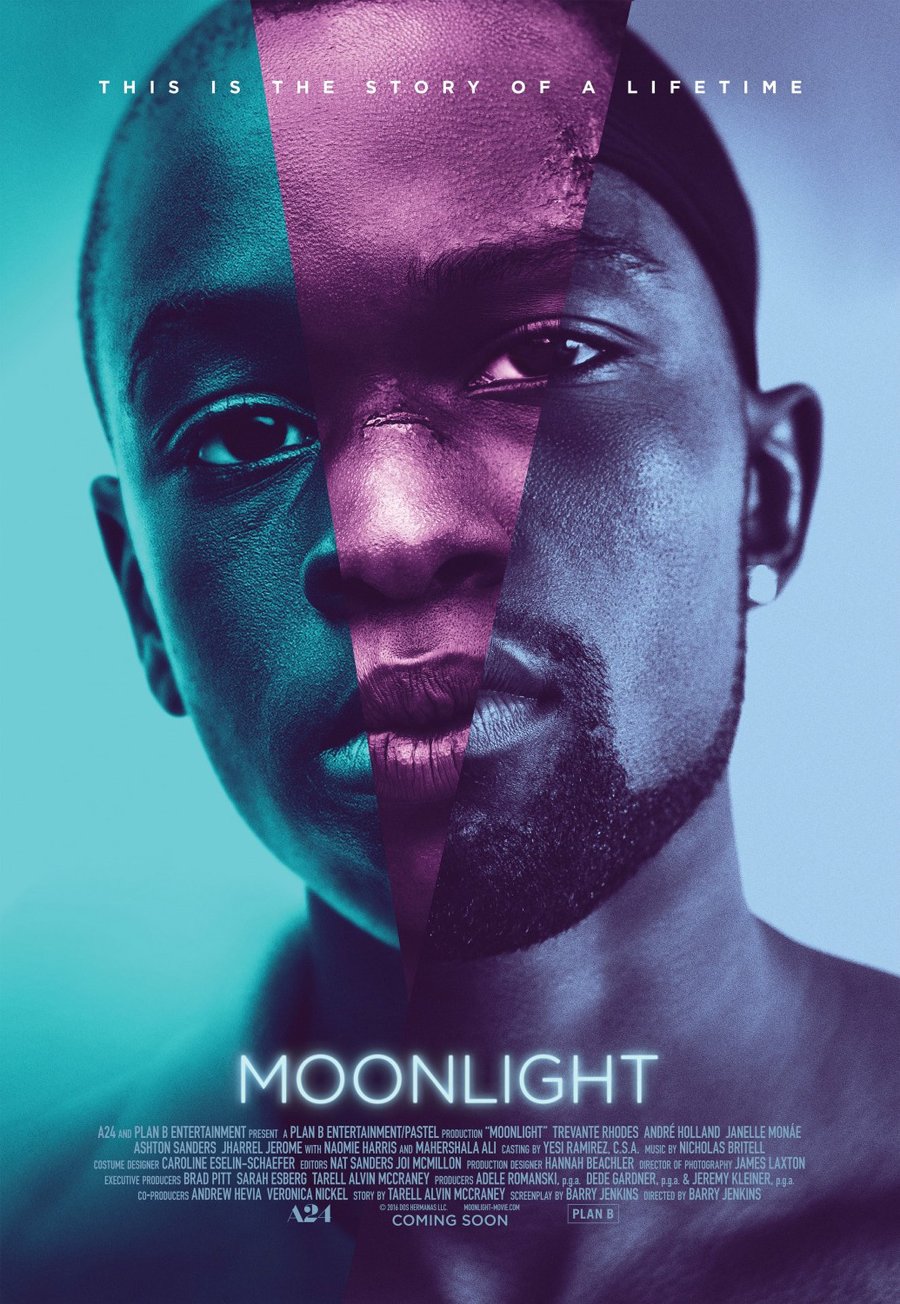
0. The three colors on the poster
As those who've seen the film will know, the three images on the poster captured the three perspectives of the film's protagonist 'Chiron.' Far left is 1. little, center is 2. Chiron, right is 3. Black—these three perspectives. I learned this meaning of the poster after watching the film. Before watching it, when I first saw this poster I couldn't shake the feeling that something was odd, but I thought that feeling wasn't important and just moved on. A bit unusual? That was about the extent of my thought. I just thought the colors and faces were a bit different. In that respect I only now realized this film had captured something through the poster. The eyes were matched so well that I'd thought it was one person..
The perspective of <1. little> is the bluest. This blue also appears at the end of the film, and it's the same perspective as the 'Blue' that some old woman called Juan by when he was in Cuba. For Chiron, this is the 'time of living while gazing at the stars'—that is, the time when he could find happiness while staying with Juan. Also, 'little' is a nickname, a term carrying the teasing of the surrounding peers about Chiron being small in build and not showing socially expected masculinity. In that he told Teresa and Juan he hated the title 'little,' childhood carries an ambivalent meaning. One is the memories gained through 'Juan and Teresa,' and the other is the memories created by the bullying from his mother and the school students.
<2. Chiron> is somewhat red, and this red signifies the time when Chiron's mother Paula screamed at Chiron to get lost. 'That day,' when she screamed at him not to look at her and to go away, is 'that day' when Chiron's mother Paula met Juan and asked whether he was going to raise her child while selling drugs to her. If you think about why the second part is titled 'Chiron,' I'd say it's because of the scene where 'Chiron' doesn't hold back and shows himself. Although he ended up in juvenile detention because of it, in his own way it amounts to expressing himself without backing down. Because the school teachers know nothing.
<3. Black> is a dark color, almost close to purple, and this is a color I wondered what color it really is to Chiron. I don't quite understand it either. There seem to be a few scenes where Chiron appears close to the mood of that color—the scene where he's lying in bed, and the scene where he's leaning on Kevin's shoulder, I think. In fact, since the nickname Black was given by Kevin, you can guess that the composition of the third part of the narrative already meant he'd come to meet 'Kevin.'
1. A coming-of-age film
This film can be compressed into one phrase: 'the story of a man who struggled to find his self-identity.' If you tried to classify 'self-identity,' there would be countless kinds. Only, in the film there's no need to distinguish such identities. Well, some might mention 'sexual identity,' but here I'd like to assume that sexual identity is a part of 'self-identity.' Because, as one part of answering the question 'what kind of person am I,' an answer concerning 'sexual identity' is contained. Chiron's self-identity undergoes a lot of shaking from childhood. This anxiety arises from the bullying of the students around him and from the attitude his mother Paula takes toward 'Chiron.' If the home isn't stable, a growing child can't help but always feel anxious because there's no 'stable place to stay,' and upon learning that his mother Paula does drugs, Chiron got the feeling of already half-giving-up. I think of this film as a coming-of-age film showing the figure of Chiron, who passed through such an unstable growth process, changing as he ages.
The scene that summarily shows Chiron undergoing 'shaking' as he grows up is the swimming scene. The scene of learning to swim with the help of the helper 'Juan' suggested, I thought, through Chiron wobbling on the seawater to learn to swim, that Chiron's life would be amid much shaking. This thought didn't come after the film ended; it came at that moment. Just as learning to swim isn't easy but is ultimately accomplished amid the wobbling, I thought the story too would reach an ending of finding himself after much shaking.
1) Sexual identity: among 'self-identities,' the attitude and agonizing about 'sexual identity' are part of the cause of the much shaking he experienced in childhood. Chiron, not even a peer from a well-off family, just attends school, but after 'that day' when he was teased as a 'homo'—the day someone said it's okay to call him gay but he must not put up with being called a homo—the day this is directly revealed is the day of the 'chair shot,' which personally felt cathartic. Well, setting that aside, that first day of the chair shot can be called the 'day he resolved to become strong,' and in that the biggest reason for becoming strong is being teased about his sexual identity, you could guess the position this 'sexual identity' occupies in the film's narrative structure.
2) What is 'being true to myself'?
This film is one about finding identity. While it seems to reveal merely 'sexual identity,' in fact I didn't feel it was so. As Juan says—that no one else can make the decisions about important matters—in the end the decision is one's own to make, and seen that way, the protagonist Chiron decided to do the work of selling drugs. A life of worry, that is. Meanwhile Kevin, in his own words, entered a life without worry. Of course it's low pay, he gets off work very late, and he has 18 months of probation left, but even so he's found stability for now. That's why Kevin asks Chiron 'what kind of person Chiron is.' Because there's a difference from the Chiron he saw. Since the Chiron Kevin saw was the Chiron who'd revealed even his deepest interior, I think he could have asked back, 'I don't know you?'
For Chiron, the terminus of 'being true to myself' lies, I think, ultimately in accepting his own sexual identity. The look in his eyes the moment he glances at the sea when he comes near Kevin's place, the scene where he confesses that the only person who's ever touched him was you (Kevin), and the fact that in the end, to 'become strong,' he built up muscle and a flashy exterior—in fact that can be seen as far from 'being true to himself' for 'Chiron.' For Chiron, the words 'being true to myself' meant accepting his 'sexual identity.'
3) The interior hidden within living as though strong
The 'being true to oneself' and the 'interior' mentioned earlier are related. Chiron's ego isn't sturdy, yet outwardly he has a very sturdy body. Within the interior of Chiron, who says he sold drugs and lived hard in order to become strong, he still holds the fact that the only person who 'touched' him was Kevin. We can see this kind of 'tough outside, soft inside' anxiety around us too. Aren't there friends like this, tough outside and soft inside? Personally I tend to worry a lot about them. Because the 'strength' of the exterior doesn't guarantee the 'strength' of the interior, a worried life—never knowing when it might collapse—is far from attaining lasting happiness.
Moreover, in that the face of the protagonist of <3. Black> also shows the looks, expressions, and behaviors of the eyes Chiron had in adolescence and childhood, I could easily tell that this anxious interior was hidden behind the exterior. For example, in Kevin's remark asking Chiron whether he still can only manage three words at a time as before, or in his reactions when, in the car on the way home after the restaurant closes, Kevin asks Chiron whether he really came just to say hello, you can tell that Chiron hadn't agonized over and reached a decision about one of his important identities, his 'sexual identity,' but had merely buried it. That's why you can see that Chiron built up his bulk in order to postpone and forget his own conclusion about a sexual identity filled only with the hardest memories to talk about—that interior. If I had to pick one 'thing he did to become strong,' I'd pick the scene of dunking his face in ice water. Maybe they showed the scene of dunking his face in ice water and pulling it out in order to remember the day he delivered the chair shot.
4) Differences from the film 'Boyhood'
The reason 'Boyhood' came to mind after watching this is that both films had the genre of a boy's coming-of-age film. Hmm, only, this film is quite contrasting? In 'Boyhood,' Mason grows up well without any special agonizing. Even one failure in love ultimately shows the growth process of a boy you could call ordinary and exemplary. But Chiron's growth process was rather far from ordinary. 'Chiron,' who grew up amid childhood bullying and the trauma and pain arising from a drug-using mother, didn't even have enough time to think sufficiently about his identity. We could confirm in the film a growth process in which he postponed all that time for agonizing and simply had to appear strong.
5) The mother (Paula) and Teresa
For anyone, in fact, the growth environment is very important. It's no exaggeration to say the growth environment determines our lives up through our early twenties. Language habits, personality, attitudes, and so on, influenced by parents and the surrounding environment, have a great impact on life. But the mother 'Paula' was a mother with many shortcomings. She was a mother in a state of not knowing why on earth her child was being chased by the school students. I'm not sure myself whether Paula should be blamed. Only, one of the unfortunate points is that the one she confided this to was Juan. As Juan himself came to mention 15th Street, I think Paula both believed the fact Juan stated and at the same time had her pride wounded. Disappointment in herself for not performing the role of a mother well, that is. Had she overcome such disappointment well, Paula wouldn't have become addicted to drugs, but that failed. I felt it was quite realistic. That's how hard it is to overcome one's environment.
Coincidence though it may be, 'Teresa' is a being who gives Chiron only love. From the day Juan first introduced her as his girlfriend, she gave Chiron only love. Unsparingly. I don't quite know whether naming her Teresa was meant to hint that she'd bestow an agape-like love, like Mother Teresa, but a nun just came to mind. Within Paula's remark calling such a Teresa a 'fake mother,' there appears the heart of someone who can't perform a proper mother's role. To the extent that, only on the day when, having grown older, after several phone calls to Chiron, she met him in person and confessed she was 'sorry,' the mother-son relationship could achieve a much-belated 'mending,' she herself was a mother of many shortcomings who acknowledged many of her own shortcomings. Whether this is purely because she (Paula) was immature, I can't know. Because we can't know Paula's childhood. Only, what we know is that Paula failed to become a good mother, that she's sorry to Chiron about that past, and that 'Teresa' filled the empty space of 'Paula' even a little.
6) Nightmares
Nightmares are divided into two: nightmares that exist in 'reality' and nightmares that appear as 'dreams.' If we divide the nightmares appearing as dreams into two, one is the nightmare of his friend Kevin having sex with another woman, and the other is the scene of his mother screaming at the protagonist Chiron. This represents two problems that can be confirmed through Chiron. One is sexual identity; in his teens, Chiron is in a situation of holding doubts about the sexual identity he has. Of course he knows, but emotions like uncertainty and instability, held because he hasn't properly confided in anyone and no one has ever touched him, made this up. The other is the instability of his place to stay. Teresa's house is nice, but that place can't become his own place. Because it still isn't 'Chiron's own place to stay.' Because a refuge can't become a home. Because 'Paula' does drugs, Chiron's original home also can't become a stable space. So this nightmare is a recurring space. Even if he leaves juvenile detention and sells drugs in a district of Atlanta, the reason he can't wash away those memories is that his past and his present work overlap. Because he's a protagonist who does the work of selling drugs while looking at a mother ruined because of drugs. The nightmares that exist in 'reality' include bullying, watching a drug-addicted mother, and living a life of selling drugs without revealing his interior. Because all of these do nothing to reduce 'Chiron's' anxiety.
2. Closing
To say one thing about my impression: the final scene of the film—the figure of Chiron's childhood self reflected in the moonlight at the seaside—brought to mind the 'blue' Juan had spoken of, and it was truly impressive. It was beautiful and wonderful. I felt I'd watched the film for that final scene.
And it made me think about my own self-identity too. How much am I struggling—even if not over sexual identity—it made me look back on what I'm doing to cultivate 'being true to myself.' What shaking did I have, what shaking do I have now, and if asked to state what is 'being true to myself' for me now, what could I say, and so on. What's certain is that I'm heterosexual, that there's no one around me who bullies me, that neither of my parents does drugs, and that there are people to whom I can confide my interior. I should be grateful for the fact that I too have a friend like Kevin. I'm always grateful, but on the occasion of this film, once again I express my thanks to the people around me.
Comments 0
No comments yet. Be the first.