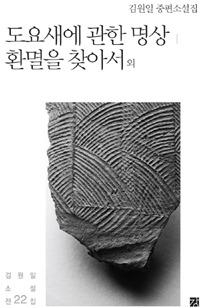
1. A word about the author.
I know almost nothing about the author Kim Won-il. I only have a few things I picked up here and there. That he was separated from his father, who ended up in the North and passed away there; that traces of the national division appear in many of his works; and that he's the author who wrote The Soul of Darkness—about that much I remember. There really are so many authors I know nothing about like this, and they're especially concentrated among authors from the 1980s onward. It's partly a period when the number of authors increased sharply, and partly because there are only a few works I've read among those that came out after the 1980s. Still, since I've read a bit of the book, I think I should at least very briefly mention a word about the author. Today, mentioning the author's gaze as one method of interpreting a work is a bit old-fashioned. Rather than interpreting that the author put this aspect of theirs in, or that this part of the author appears in the work, one weighs questions like: what on earth does this work mean to the author, what was the author thinking at this point in time. It's thinking about what literary works meant to him. The theme Kim Won-il consistently expressed is 'division.' I'd actually thought that 'division' novels had nearly disappeared after the 1960s, but looking back, Park Wan-suh's 'Mother's Stake' is also a work that came out in the 1980s, so division novels were still present in the 1980s. Of course, I think it's much fainter now. Now it's hard even to see anyone reading novels, and it's rare even to pay attention to this issue of division, but a mere 30 years ago it was like that. And it seems the author's agonizing and thoughts were contained in his works.
This time I couldn't read close to 10 pieces. Perhaps because it was a novella collection, the roughly 400-page book contained 4 novellas - Meditation on the Snipe, In Search of Disillusionment, Lost Time, The Surge of the Years. So besides these I read a few more short stories. 'The Soul of Darkness,' 'Delusion,' and 'The Prison of the Mind' are those short stories. Even so, although there's some difference in the number of works compared to reading around 10 short stories by other authors, I think this much isn't insufficient for getting at a particular author's tendencies.
2.
1) Meditation on the Snipe: a novel with a mixed point of view. The stories of Byeong-guk, Byeong-sik, and the father make up the novel. The father is a war refugee who left his family behind in the North, and the older brother 'Byeong-guk' is a protagonist who was hailed as a prodigy in the region and went up to Seoul, but who, after passing through the student movement, became disillusioned with reality and returned to the countryside. Meanwhile the younger brother 'Byeong-sik' is a protagonist who, together with a friend called 'Weasel,' takes an interest in catching the migratory birds that come to the riverside and selling them off for taxidermy. The younger brother doesn't understand his older brother—who, despite being talked about as a prodigy returned to the countryside—staying only in his room, and doesn't much like him because of the situation in which, despite having studied well, he's of no help at all to the household economy. The father's wife and the mother of Byeong-guk and Byeong-sik takes the position that she can't just leave the returned Byeong-guk be, getting angry, and is frustrated that he's of no help to the household economy. At the same time, it's a novel in which Byeong-guk gradually comes to understand his father's past and thinks about how he might stop his younger brother Byeong-sik from killing birds alongside 'Weasel.'
About this novel, critics evaluate it as a novel that deals with 'environmental issues' while also dealing with the issue of division through the father. Kim Won-il is one of the representative division-novel authors, and in most of his novels at least one person carries problems of division—for example, separated families, living away from one's hometown, Communist Party membership, extreme poverty, and so on. This novel is the same.
2) In Search of Disillusionment: a novel that proceeds with a 'book' obtained by the teacher 'Yun-gi.' Yun-gi's father is a fisherman, and one day he discovers a book contained in a secret pouch within his net and gives that book to Yun-gi. After reading a bit of the book, Yun-gi learns that it is a memoir left just before its writer ended his life—someone who had engaged in Communist Party activities and defected to the North before the division, then, through several rounds of ideological vetting, was demoted to a camp. And learning that the memoir's destination is some village in Andong, North Gyeongsang Province, he sets out to deliver the book to the head household in that village.
Both the family of Yun-gi's girlfriend 'Mun-mi' and Yun-gi's own family are families that relocated because of the war. Yun-gi's father left his family in the North and came down to South Korea to start a new household, and Mun-mi's case is one where the mother started such a new household. Meanwhile, the Park family that appears in the memoir also, because of Mr. Park's Communist Party activities, has bad memories of the father, since Mr. Park's eldest son and the master of the head household was tortured several times. So he delivers the memoir, and the novel ends as he hears, even if briefly, the family's circumstances through Jong-geun, the third son of the Park household.
Even though quite a lot of time has passed, the issue of division was still a 'reality' in that village, and at the same time, by showing scenes in which Yun-gi's father too cannot easily forget the North, the novel is still dealing with the issue of division.
3) Lost Time: a third-person narrated novel dealing with Jong-ryeol, who has returned to a head household, his mother, and Jong-ryeol's family. Jong-ryeol's father engaged in Communist Party activities and did not return, and although Jong-ryeol returns to the main house upon being told the story, together with Jong-ryeol's mother, whom the father had met during his time in Seoul, the mother is not accepted and only Jong-ryeol is taken into the household to live—this is the kind of novel you can see. Throughout the content of the novel, characters and events that let you guess the atmosphere of the head household are arranged, and because you come to view most of the content through Jong-ryeol's eyes, you can also confirm his longing for his mother. Jong-ryeol's father Han-seo ultimately dies and returns to the head household as a corpse, the mother too hangs herself, and the novel ends with the grandmother developing sleepwalking and wandering the village every night. You could say the issue of division and the issue of living under one's in-laws are revealed in the novel.
4) The Surge of the Years: of the 4 novellas (Meditation on the Snipe, In Search of Disillusionment, Lost Time, The Surge of the Years), this is the one I read most impressively. In this book, because of the war, a mother appears who, for 'me,' lost my father, and through the mother's steadfastness the household was maintained, so that 'I' have become a grandfather; it's a novel depicting a situation of having come down to the countryside and gathered to hold an ancestral rite.
The part that left an impression was the words the 'mother' used to say about the ancestral rites. Emphasizing the 'spirit of the ancestors,' it's a scene where she asks back whether thinking about where our roots were is what gives meaning to the rites, and whether, on the few days a year that they are, going to work or school without being tired is more important than finding those days burdensome.
"When the household isn't even large, how hard is it to spend one night together at a time like this. If the house were small that'd be one thing, but aren't there plenty of rooms and bedding to sleep over. It's the same with the children. If putting them to bed a little late one night would interfere with the next day's studies, just how much of a loss would that loss really be. It's this old woman's thought that, once they're gone, the devotion of honoring our ancestors is more important than schoolwork. Where did you all come from and put down roots, and where will you go next, and whose spirit will you meet?"
Honestly, in daily life it isn't easy to call to mind words like 'spirit' or 'ancestors.' But a 'remark' like the grandmother's carries great significance for today. I'm not trying to discuss the grandmother's perception of the afterlife. I'm a Catholic, so all the more I have no such intention. Only, I think it's worth thinking about where our 'roots' lie. And among such thoughts, the ones like the above, as I feel it, are hard to come by today, but I think they're necessary.
"Unlike everyday meals, with ritual food you have to pour devotion into every dish, but above all the seasoned vegetables have to be tossed deliciously. Just as you know the taste of a household's food by tasting its soy sauce, if the vegetables taste good you know the other ritual dishes are good without even tasting them. When we held the rite and received the post-rite meal, Father would first pick up the seasoned radish with his chopsticks. Then Mother and I would watch only the elder's expression, on edge as if standing on needles. Only when he said nothing and lifted his spoon to rinse his mouth with the broth would we finally feel relieved."
"Did Great-Grandfather scold you if the vegetables didn't taste good?" Geon-bae's wife asks.
"He didn't scold, but he wouldn't lift his spoon and would survey the whole food table for a good while."
This part too is within the ensuing dialogue. In the novel 'The Memory of the Years,' the protagonist 'I''s mother is a character who tells the family about traditional culture in this way. But its form appears, unlike in the other works, very gently. Probably this is because the values of the protagonist 'I' are revealed here to some degree. Because 'I' doesn't view the mother negatively, in depicting the mother 'I' doesn't look at her with negative preconceptions.
Before reading this novel, I think I'd hardly had a chance to establish my own subjective values about 'seasonal ancestral rites' or to think of the issue of division as my own story. But this novel made that possible. I'd thought seasonal rites were just something you do, but after reading this novel I understand, even a little, the meaning seasonal rites hold, the meaning ancestral rites hold, and the meaning of family gathering during the holidays.
5) The Soul of Darkness: a short story. Reading the studies on the author, many reviews said that in the works written after this one, the author's consciousness about the 'issue of division' is revealed. The content of the novel consists of taking a young boy as the protagonist and depicting the issue of division seen through the young boy's eyes, and the father's death. Among the works I'd read depicted through the gaze of a 'young-aged narrator,' there are works like Joo Yo-seop's 'Mama and the Boarder' and Chae Man-sik's 'My Idiot Uncle,' and The Soul of Darkness too has point-of-view characteristics that can be compared with such works. Because I don't know many works that view the issue of division through a young boy's eyes, this work was quite a fresh one for me.
6) Delusion: a story about 'Yeol-i,' the mother, and the grandmother's death. The term 'Yeol-i' had appeared identically before in 'Lost Time.' Because of that, I wondered whether I should understand that work and this one in connection, but as I read, the content connected at times and didn't at others, so I thought it'd be better to just see them as entirely independent. In the novel, conflict between the grandmother and the mother appears. The father had already passed away, and you can tell the household was run by the mother. Perhaps because of that, there are scenes that let you know the conflict between mother and grandmother never ceased within the household, but at the point when the grandmother is said to be nearly dead, through the mother buying the salted hairtail the grandmother likes, the possibility of reconciliation opens, yet it ends in a state where reconciliation isn't achieved.
What the father's 'Bodo League membership card,' said to have come out of the grandmother's belongings, signifies is that the protagonist 'Yeol-i''s father did not receive a citizenship certificate but a Bodo League membership card, suggesting he may have been enrolled because of a record of left-leaning conduct. As mentioned above, people with a record of Communist Party activity had options like remaining to the end and living in the mountains, going to the North, being executed in the South, coming down to the village and surrendering, or converting early; the protagonist's father had converted early, but you can tell that, as in the 'Bodo League Incident,' he was executed after the outbreak of war. For reference, the content on the Bodo League Incident in the Encyclopedia of Korean Culture reads as follows.
Significance and evaluation
What is important in evaluating the National Bodo League is its anti-communist activities and education as an organization for the conversion of those connected to the left, and the mass killing of Bodo League members. The intent of forming the organization was, modeled on Imperial Japan's Ideological Patriotic League and Daiwajuku, to mainly carry out anti-communist activities for the purpose of the ideological conversion of those connected to the left. However, the fact that, from June 25 to around mid-September 1950, National Bodo League members were taken away by soldiers, police, and right-wing youth corps members and then massacred was the greatest tragedy of modern history—a case in which the government, having formed an organization for the purpose of conversion, failed to take responsibility for its own citizens and instead killed them.
Source: [Naver Encyclopedia] National Bodo League (Incident) [National Guidence of Alliance, Bodo-League] (Encyclopedia of Korean Culture, The Academy of Korean Studies)
7) The Prison of the Mind: the protagonist, I, 'Yun-gu,' upon hearing the news that his youngest brother Hyeon-gu has been committed to a university hospital for psychiatric evaluation, comes running immediately upon returning to the country. I liken myself to a 'gray middle-class intellectual,' whereas Hyeon-gu can be seen as a younger brother whose body has greatly deteriorated from trials and torture while engaging in the labor movement. The expression matching the title 'The Prison of the Mind' literally appears in the novel, and can be interpreted as something like the space of thought, the space of the heart, that the 'mother' holds regarding Hyeon-gu. I, the protagonist, talk about the changes and social currents I experienced in the 'Soviet Union' and let Hyeon-gu know that the world is changing. 'I' meet an old friend Geun-jo at the hospital, recall the memory of April 19th, and reminisce about the harshness of reality. Also, it's content in which I confirm a younger brother who hadn't thought he'd become a political offender but ended up becoming one, who had harbored the ideal of entering a pioneer church in a slum to save people. The novel's ending concludes with the students who'd been demonstrating in the ward clashing with riot police, and several students coming into the hospital room saying they can't let Yun-gu die here, that they've arranged a car, and proposing to take Yun-gu to the place where he'd carried out the reform movement so he can meet his death there. Among the works by Kim Won-il I read this time, it's the work in which the issue of division is least revealed and the life of a 'gray intellectual'—in other words, of a petit-bourgeois—is revealed. Most of the other earlier works, even when the issue of division wasn't revealed at the forefront, were often cases where it was central to forming the novel's structure, but this work alone was not so.
3. Summary
Many of Kim Won-il's works deal with the issue of division. And in that issue of division, at least one strong parent always appears. The strong parent here refers to a parent who takes responsibility for the household economy and tries to raise the children to be strong. Also, it's a characteristic that, content-wise, if the father died early, the mother takes on even the father's role and is revealed as the spiritual head of the household. The problems of ideological confrontation underlying death, and the problems of poverty and destitution, acquire concreteness in depicting a state of affairs that could not but be very serious in the society of the time.
In particular, there's a distinctive point regarding the protagonists and the characters in the novels. It's the presence of a 'strong parent.' Even if one of the father or mother is absent, the figure of the other becoming the pillar of the household and raising the children would have been a sight commonly seen after the Korean War. This concreteness is revealed in Kim Won-il's novels, and through the many people who engaged in Communist Party activities, the partisans, the Bodo League Incident, and so on, you could confirm the author's consciousness and social awareness.
Kim Won-il's novels are novels that wouldn't be strange to appear on an exam at any time. The issue of division is removed from us, yet it's still ongoing. Otherwise there'd be no reason to be 'anxious,' just like the current international situation. The only way to experience an issue still unresolved is to grasp it through literature, film, painting, and the like, and in that Kim Won-il's literary works can show one perspective on this issue of division, I think they have value.
P.S. Reading the works, I thought about how it might be to comparatively study Kim Won-il's fictional world with Park Wan-suh's fictional world, but research on this had already been carried out. If you're interested in this, I think you can check the references below.
----
References
Primary sources
Kim Won-il, 'Meditation on the Snipe, In Search of Disillusionment' and 2 others, Gang, 2012
Domestic studies
Kang Jin-ho, 'The Tragedy of a Family History Sublimated into National History,' Studies in Modern Fiction No. 14, 303-321, The Korean Association of Modern Fiction, 2001
Song Myeong-ju, 'A Study of Postwar Literature - Focusing on Authorial Consciousness by Generation,' Master's thesis, Sookmyung Women's University, 1993
Woo Eun-jin, 'A Study of Kim Won-il's In Search of Disillusionment - Focusing on Masculinity and the Ideology of War,' Baedalmal Vol. 59, 138-163, The Baedalmal Society, 2016
Lee Seong-hee, 'A Study of Kim Won-il's Division Literature,' Doctoral dissertation, Pusan National University, 2008
Jang Hee-won, 'A Comparative Study of the Division Novels of Park Wan-suh and Kim Won-il - Focusing on War Experience and the Modes of Embodying Ideology,' Master's thesis, Hanyang University, 2011
Hong Hye-mi, 'Kim Won-il's Family-History Novels,' Dansan Studies Vol. 4, 158-174, The Jeondan Society, 1998
Comments 0
No comments yet. Be the first.