- YouTube
I happened to come across part of this film's content on YouTube. The actor playing the teacher was 'Adrien Brody,' an actor I knew well and was familiar with. He's the actor who appeared as the lead in 'The Pianist,' a film about a pianist named 'Szpilman' during World War II, and who also appeared as one of the heirs in the film 'The Grand Budapest Hotel.' My interest in the actor shifted into an interest in the film. Just what kind of film was it, where Adrien, playing a teacher, tells students they should read in order to build a system of thinking that can resist the 'mass media'?
- A Film Dealing with Education
Educational problems are not a matter of a day or two. In Korea, in America, in any of the countries of Europe, the discussion of 'how should we educate' is continuously ongoing. This film, too, is a story containing one person who struggles with reality while holding 'an educational philosophy of his own,' and that person's story. That one person, Henry Barthes (Adrien Brody), is a substitute teacher who keeps moving from school to school, living his life as a teacher. He's not more capable than others, but he's a teacher who tries, in his own way, to understand students' hardships and to respect their stories as a person. If you translate the title 'Detachment' literally, it would be something like 'separation,' and this separation can perhaps be seen as the protagonist 'Henry' being separated from the world, or it could be the 'separation' concerning the two female students in the film, 'Meredith' and 'Erica.'
Henry, as on any ordinary day, gets a job at a new school. He's a teacher who teaches literature. But the school he's taken a job at this time gives off an ominous atmosphere from the start. A student's parent comes to the school and protests, shouting at a fellow teacher; the school's counselor counsels students again and again, but the students continue their deviant behavior even after counseling, and she feels her work is 'worthless' and falls into self-loathing. To make matters worse, the principal is on the verge of being driven out of the school. Not only that, the members of this school are also experiencing similar discord at 'home.' One male teacher comes home and no one welcomes him. The principal, too, can't communicate well with her husband. And what about Henry? He entrusts his grandfather, who has dementia, to a care facility and goes to visit him occasionally. By showing that the 'teachers'' families are not so different from others' and that pain still exists in their situations, the film shows that the problems occurring at school have their cause not only in the relationship between teachers and students, but in the problem of 'family discord' that happens to everyone across society as a whole.
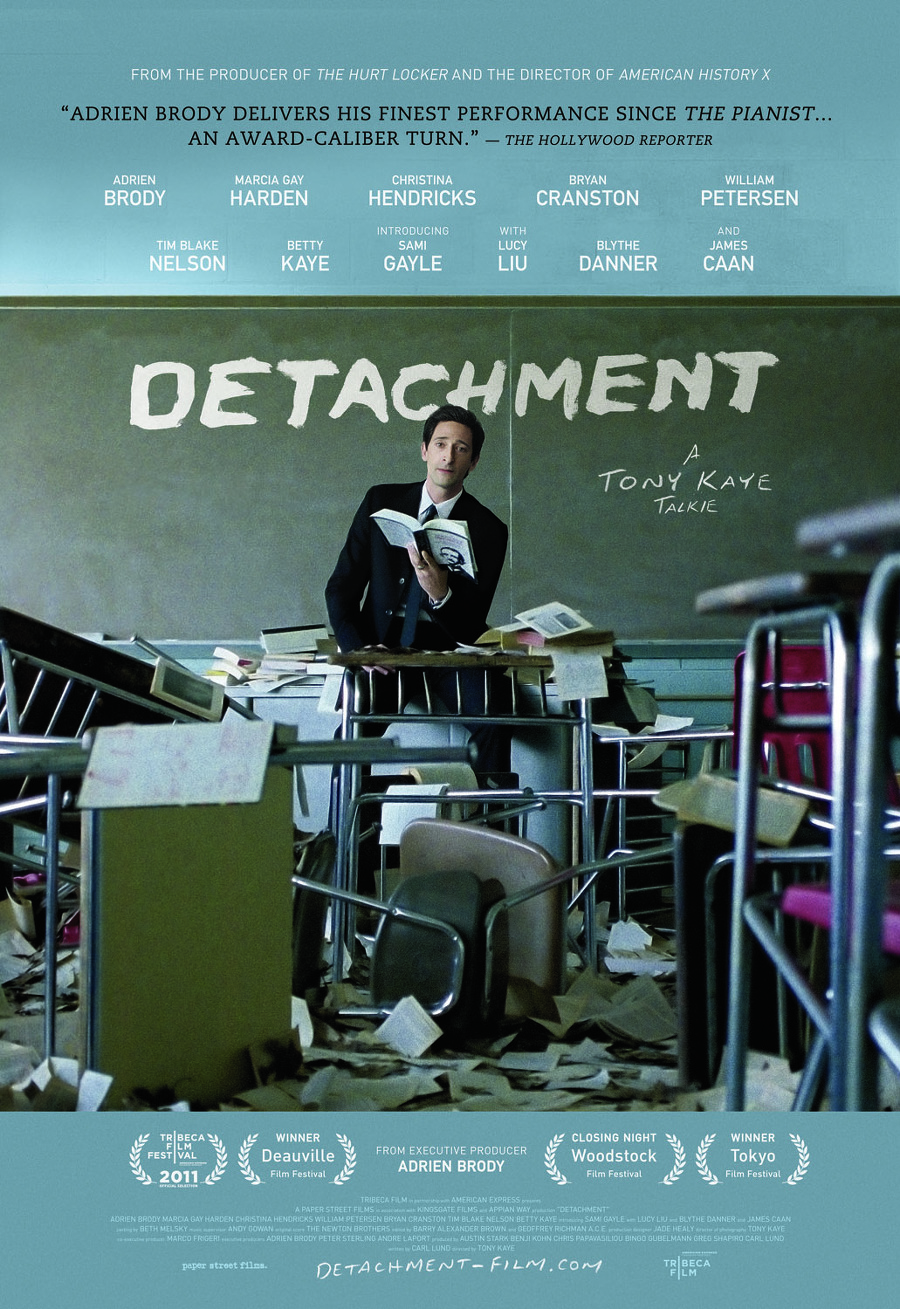
The film's opening is a little unusual. In terms of content it's a 'narrative film,' yet it borrows the documentary form. Since there will probably be many readers who don't quite understand, let me add some explanation: because it's a 'narrative film' it deals with a 'fictional' story, but because it borrows the 'documentary' form, scenes appear here and there in which the protagonist 'Henry Barthes' (Adrien Brody) recalls, in interview format, the events that happened at that school. And at the film's opening, it includes interviews with 'real teachers.' In other words, the film raises issues by going back and forth between reality and the film. It shows the actual state of education and the kind of eyes and approaches those in charge are using.
Henry is an ordinary person. The 'ordinary person' I'm speaking of here is a word used to express that his family is not enormously happy. Henry occasionally goes to visit his 'grandfather,' who is in a care facility. There are times he has to go because his grandfather won't listen to the facility staff and won't come out of the bathroom, and times he has to go because his grandfather is critically ill. Henry remembers the scene of his own mother's 'suicide,' and he carries a memory that his grandfather seems to have provided some cause for that suicide. The fact that the school this Henry has newly been assigned to is not a 'stable place' but a school full of chaos where 'classroom collapse' is happening is an element that pulls the film along more dramatically. Of course, one can't deny that such 'classroom collapse' actually has a realistic side. Moreover, 'Henry's' interviews that appear throughout the film, befitting a film that borrows the documentary form, unpack realistic worries about education in the form of a 'narrative film.' That is, it shows how education is proceeding from an ordinary person's perspective, and how one is trying to improve it.
The 'students' this ordinary person meets in the film number two. There are several students in the class, but the students who come fully to the fore as 'students who share a communion' number two. One is 'Meredith,' and the other is Erica. Erica is a girl in her mid-to-late teens whom he met on the bus and who had been raped, so she doesn't appear as a 'student,' but in effect she should probably be seen as one. Henry meets these two and unfolds the story. Meredith is a student who is 'bullied' at school, but she develops good feelings toward Henry, the only one who shows her any kindness, and Erica too, grateful to Henry, who looks after and cares for her - someone who'd been drifting on the streets - without any pretense, begins to open her heart little by little. But one day, because of Meredith's behavior, Henry feels he can no longer keep Erica in his home and ends up taking the measure of sending her to a protective facility. The director indirectly suggests that even 'Henry,' who at least could communicate with the students at that school, has problems he cannot solve, and that an enormously wide variety of factors affect the growth of teenagers.
Not a single one of the protagonists who appeared in the film is placed in an environment that could be called a 'good environment.' Like 'Hell Joseon,' one of the sad nicknames that refers to Korean society, the students and teachers of this school all live in an environment similar to 'Hell Joseon.' In fact, 'education' is something where it's very hard to find the cause solely in the act of teaching where education takes place. Because 'education' is based on the communion that occurs between 'person' and 'person,' it's one of the domains where an individual's psychological and material environment exerts a very large influence, and the director doesn't depict all those environments positively but reveals them just as they are. The director, even capturing the details that could be missed precisely because it's a 'film,' implies that the problems we're watching in the film are, as in actual society, not merely a problem of 'education' but a problem of society as a whole.
Even so, Henry doesn't merely yield to this. After bringing Erica home, once some stability is achieved, he goes to the hospital with her for a blood test to check for STDs, and tries in his own way to plant positive memories in Erica. But as his relationship with Meredith goes wrong, the scenes - Meredith ultimately choosing suicide, and then Henry going to meet Erica again to restore their relationship - showed a realistic ending that has some prospect of hope while, on the other hand, that prospect has vanished. On the whole I was satisfied with this realistic ending. Generally, once you start weighing the 'prospects' of literary works, you end up finding somewhat 'formulaic' endings in predicting their outcomes. The hero-style film structure in which the protagonist triumphs is a representative example, you might say (since the heroic narrative is still valid even now). But this film, though a narrative film, borrowed the documentary form and thereby resolved well those parts that could have been unrealistic.
- In Closing
It was a film with somewhat realistic reflection on educational problems, yet whose American spatial particularity showed a story different from Korea's. I think Adrien Brody is a really fine actor. Both as a villain (The Grand Budapest Hotel) and as a protagonist like this.
Comments 0
No comments yet. Be the first.