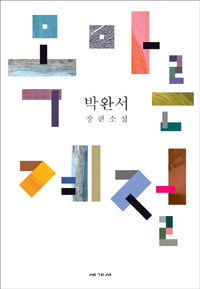
The historical backdrop running through the novel is all too simple. It's partly because the Korean War was a long-standing theme of Park Wan-suh's, and because the novel directly mentions 'reds' and 'whities' to reveal 'Ha-jin's' wandering and anxiety, so grasping it was easy. I didn't look up papers, but I got the feeling that ever so many writings had probably already been written about how the historical backdrop is revealed. But when I actually looked, the papers on this work amounted to only about 10 in all. In dissertations it wasn't treated as a standalone work but was merely one work treated within the author 'Park Wan-suh,' and there were only a few general research papers as well. This time, though, I didn't write this piece after reading those papers.
After reading the novel, I decided to think about the meaning the title holds. I thought that pondering what the title 'The Thirsty Season' suggests would be the most helpful in organizing my feelings about this book. What was this 'thirsty season' in this novel, the one I felt?
The thirst in the novel was a thirst for abstract values like peace, freedom, and humanity. Ha-jin and Ha-yeol, and many other people who appear in the novel - that is, both the soldiers who were parties to the war and the refugees who weren't soldiers - all had this thirst. Ha-jin, who'd thought North Korea's system was equal, criticized her brother who had quit his activities with contempt in her eyes mixed with derision, but after the occupation began she came to realize her thinking was wrong and experienced this thirst directly. Ha-yeol, who realized that they spoke of equality but it wasn't equal, considered talking about his past activities but didn't express it under Ha-jin's glare; that he waited until Ha-jin realized it directly herself; that Ha-jin, having realized it directly, understands her brother Ha-yeol's heart; but that, apart from understanding such feelings, she wanted to halt her own wandering somewhat through her brother but couldn't - these stay with me. They thirsted for peace and freedom. Their wish was not to die, and for everyday lives that weren't coerced.
Another thirst was love. Ha-jin thirsted for love. She wasn't thirsty from the start, but the character 'Min Jun-shik' seemed to throw this thirst for love at her. I got that feeling of how people who don't know love, once they come to know it, flounder in that thirst. While reading the book, from the moment Min Jun-shik's first meeting was described, there was some indescribable feeling, and it really was so. Here Min Jun-shik was revealed as an object of both spiritual love and physical love. Toward Min Jun-shik, the most alien being - him, born wealthy and trying to become a 'red' despite being bourgeois - Ha-jin cast an uncomprehending gaze.
Having finished the novel, the thirst the novel shows had a feeling similar to a line of poetry I'd read before. It felt similar to the line from Jin Eun-young's 'Youth 1': 'I was not wetted; pacing about, it was always a drought.' That the end of that thirsty season comes not by one's own will but is brought to an end by another's will seems to have been the violence the era wielded. The brutality of war that Park Wan-suh's novels show lay at that point. So did 'Mother's Stake,' and so did 'The Naked Tree.' The helpless, powerless 'individual' within history had to accept the things that happened.
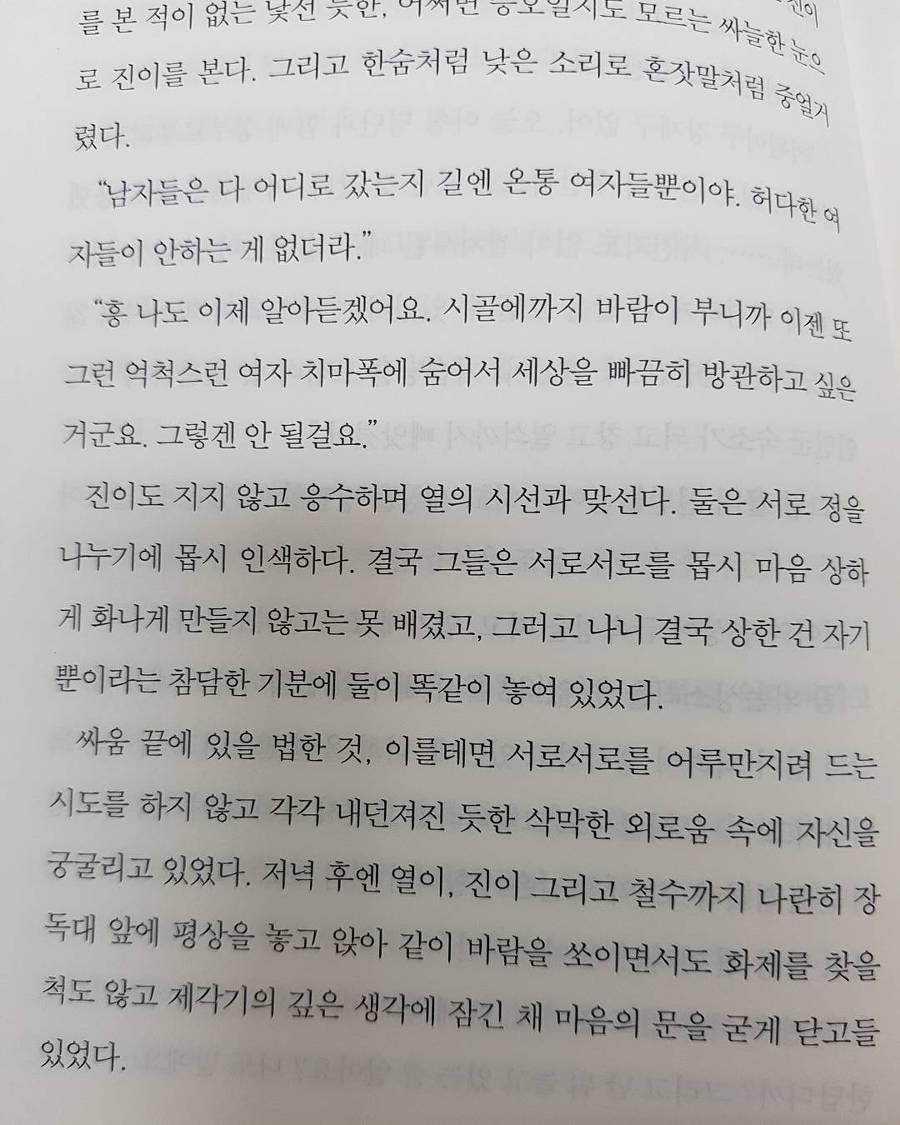
I'll end this brief reflection by including the part that left a deep impression - the quarrel between Ha-jin and Ha-yeol.
Comments 0
No comments yet. Be the first.