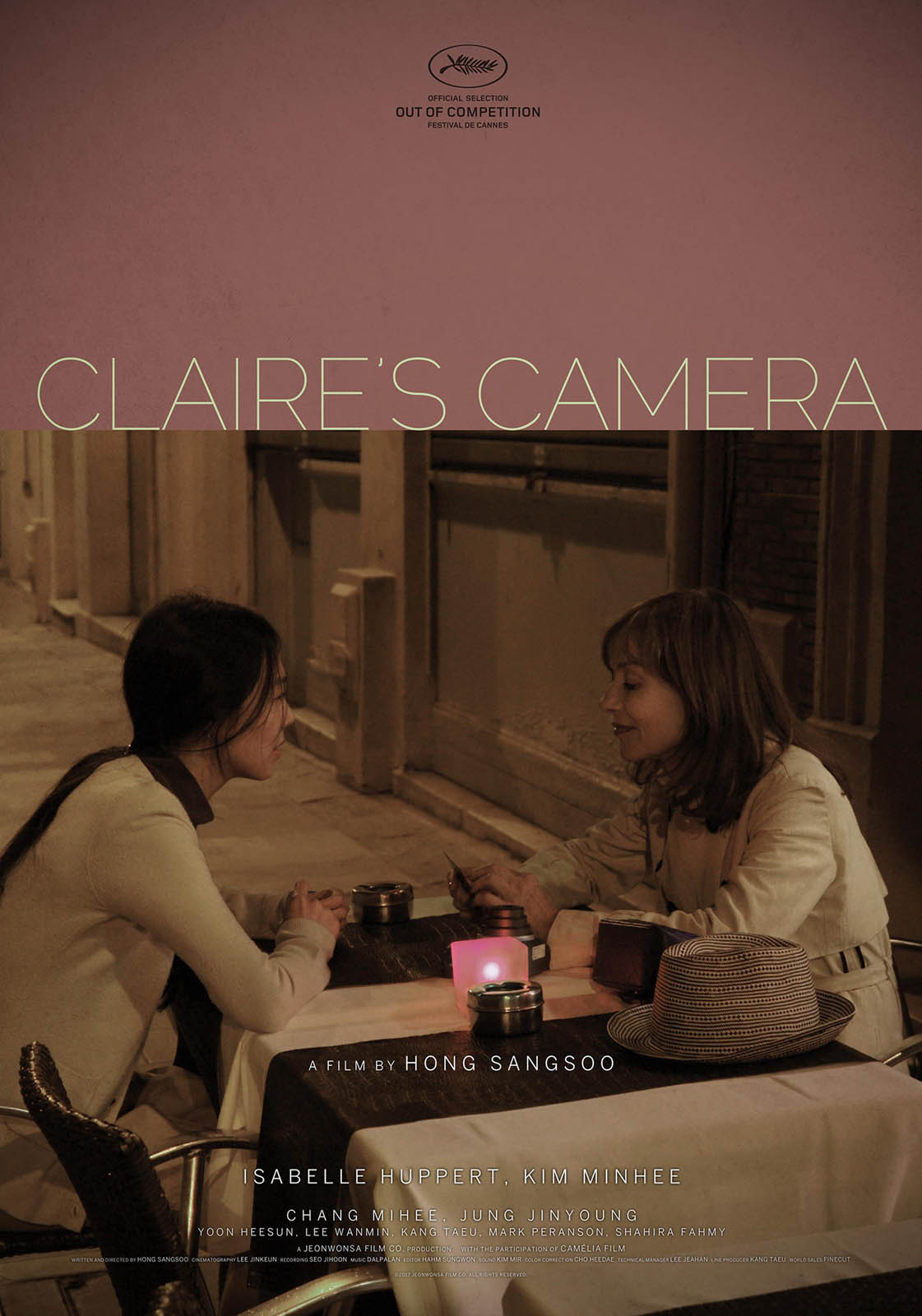
There was a holiday tucked into this weekend. Maybe that's why, but the people who'd been studying together around me said they were going traveling. They were going traveling, and the feeling I felt was some kind of unidentifiable envy. Why is my schedule packed right through the weekend with no break....haha. As it happened, my study sessions took up, if not every morning, then the mornings of Tuesday/Wednesday/Friday, and on the two weekend days I work at an academy. Spending one week after another with no time here and there, lately I think I'd been getting a little worn down by each of my days. So, thinking maybe doing even something a little different would make me feel better, I at least watched a movie.
You might ask why a Hong Sang-soo film of all things, whether I'm a fan of Hong Sang-soo films, and I can say that I'm not a 'fan' of Hong Sang-soo's films but that I am interested. I have little interest in films like 'Avengers' that are dominating the theaters these days. I have no interest in Marvel's universe, and separate from liking superhero films, I have even less interest in films that don't grapple with anything. The superhero films I liked in the past were Sam Raimi's Spider-Man trilogy and Christopher Nolan's Dark Knight trilogy, because even those films were deeply interested in how a hero is born and how villains are born. But the Avengers films have no interest for me because the heroes and villains are already set so no inner conflict appears, and as films that, like now, have taken up the position of outright 'popular cinema,' I have even less interest.
Hong Sang-soo's films are well known for being shot with improvised scripts. I have no real way of knowing whether that was the case with this work too. But a lot of it gives the feeling that it probably is. Also, there was an ease, which is a part I like as well. At least when I watch a Hong Sang-soo film, my eyes are less tired and my ears are less tired. It doesn't smash things and it doesn't dazzle the eyes. Rather, there are lines that seem hard to hear unless you watch with focus, and mostly I watch the film going back and forth between ease and concentration. With a bit of curiosity, watching scenes that are hard to understand unless you relate each moment to the preceding scenes or predict the scenes to come. So when I watch a film, I definitely end up watching it with a pen. Today too, like before, I watched the film taking notes. Not in a notebook, but on my Galaxy Note FE.
--
0) Synopsis: This film has a simple plot. Man-hee (Kim Min-hee) and the film director So Wan-soo (Jung Jin-young), who came along with Man-hee's company boss to the Cannes Film Festival to sell films, were in a romantic relationship, and because Man-hee made love with So Wan-soo after a drinking session, the boss fires Man-hee. And because of her cheap plane ticket, Man-hee spends her remaining time on the beaches and in the city of Cannes, where she meets Claire and talks with her.
1) The typicality of Hong Sang-soo's films: I'm not sure whether I can call it a typical feature of Hong Sang-soo's films, but in the 'pouring out of one's heart' that appears in many Hong Sang-soo films, there is always alcohol. I've never seen or looked up an interview where Hong Sang-soo gave a reason for why this alcohol appears or talked about it as a narrative technique, so I don't really know, but my personal thought, drawing a conclusion based on the films I've seen so far (Right Now, Wrong Then; On the Beach at Night Alone; The Day After; Yourself and Yours; Claire's Camera), is that it could be seen as a device for bringing out words that had been inside one's heart. It's not that they 'intended to say' the words that were in their hearts. That is, I felt the characters weren't trying to say 'those words' until they drank. But the moment they drank, the characters would bring up the stories. And it was a very important story, related to someone who was listening. In this film there was only a single scene of drinking. It was a drinking session between the company boss and the director So, and in that setting So 'wraps up' his relationship with the boss. So asks her to trust his judgment, saying that wrapping things up like this and meeting only as business is the way the relationship can last. This scene also appears the same way in the flashback of the conversation between Man-hee and the boss in the first half of the film, where the company boss asks Man-hee to trust her judgment and makes the audience think about the scene where she decided that Man-hee's innocence doesn't also guarantee honesty and that because of this they couldn't work together. And this conversation between the boss and Man-hee appears at a setting where they talk over coffee, not over drinks.
Through this, I came to think that everything in Hong Sang-soo's films - conversations at drinking sessions or cafes or restaurants or on the streets - brings in much of what makes up the film's narrativity. Unlike Before Sunrise, Before Sunset, or Midnight, where conversation was almost everything, the 'conversation' in Hong Sang-soo's films includes scenes that have some effect on the story to come or add explanation to the story presented earlier. This film, too, gives the feeling that many things - the conversation at the cafe, the conversation at the drinking session in the Chinese restaurant, the conversation between Claire and Man-hee on the beach, the conversation at the lodging where Man-hee stays - go beyond making up the film's content and influence one another. This film, and his earlier films too.
2) The meaning of taking photos with a camera: 'Claire,' who was teaching in France and came to the Cannes Film Festival following a friend, is a person who observes the change of her subjects through taking photos. What meaning she places on these observations is unknown. The only 'reason' Claire mentioned was that she thought she could change her subject through taking photos, because she felt this 'being able to change' something to be precious and felt great value in it. I felt this 'act of taking photos' by Claire to be strange. But I didn't understand it as utterly impossible the way So Wan-soo or the company boss did. I'm on the side that believes in people's possibility of change. And I'm on the side that thinks, in order to raise that possibility of change, we have to believe that they can change. Claire seemed to substitute 'observing the other for a long time, or taking photos' for this belief, and I'm merely doing it by showing various reactions (feedback).
The scene where Claire says of herself that she's 'sensitive' is certainly a scene that, in Korea, you'd be likely to find odd. In fact, when someone says they're 'sensitive,' I think there exists a social custom in Korea where, unless those people are 'artists,' it's usually not well accepted. But these people define one another within the film as 'artists.' The context in which Claire and Man-hee, talking on the beach, make remarks like 'you're an artist,' 'I want to be an artist,' 'you're an artist,' tells us that she and Man-hee, and on a larger scale all people, are 'artists' in the small parts of life. Our own song, our own poem, our own photo, and so on - we all have various parts that we could call 'artist.' It's just that if you show those things to others publicly and gain recognition you become a popular artist, and if not, it merely exists as 'personal art' rather than popular art.
I think people may have various reactions to Claire taking photos. The reactions of the company boss and director So, reacting that it's strange, that how could taking a photo change a person, I could guess represent extremely ordinary people. But I'm on the side that, beyond the concept of changing by taking a photo, places value on the effort to change something. Probably nothing changes immediately just from taking a photo. But the 'me' after the photo is taken is no longer the same as the me at the moment the photo was taken. Strictly speaking, this is because the past and present cannot coexist, and because of that, essentially the 'me' - whether as matter or as spirit - shows a little, a very little, change. But whether this is a universal idea is a point that bears some pondering.
3) The experiment Hong Sang-soo's films show: among the series of Hong Sang-soo films I recently watched - Right Now, Wrong Then; Yourself and Yours; On the Beach at Night Alone; The Day After - except for 'On the Beach at Night Alone,' the rest were all films that showed some degree of experimentation. One of the features of Hong Sang-soo's films I haven't mentioned yet is exactly the shifting of 'structure'; he doesn't always develop the narrative plainly. He always shows some degree of transformation. It's too long to mention his earlier films, so I should mention only this one briefly.
This film first shows Man-hee, having been 'fired' from her company, wandering the streets alone, and then shows a flashback of how she got fired. And rather than recalling it of her own will, it begins as Man-hee, while walking around Cannes, meets a former coworker from her company. As Man-hee explains to her junior coworker why she came to leave the company, the scene leads into that day's 'cafe chat.' The company boss tells Man-hee to quit, and Man-hee takes a commemorative photo together to mark all their time working together. After that the flashback ends, and there's a scene of the company boss and director So talking by the sea, and Man-hee, walking the seaside alone, meets a student of director So. The director's student also talks about 'honesty,' saying 'you have to be honest to make films well,' and saying that you don't have to be mature to make films. Meanwhile, director So and Claire meet for the first time at a cafe, and the two are connected as Claire takes So's photo. After that they stop by a library and read a poem in French together, and Claire, the company boss, and director So have a drinking session. They talk for a long while here, and then there's the director's remark, after Claire leaves, that they should wrap up their relationship as a man and woman, the scene where Claire photographs Man-hee walking alone and they grow closer, and the scenes where the romantic relationship between So Wan-soo and the company boss ends through their drinking session. Once the film starts off this way, at some point it becomes hard to judge whether this is a 'flashback' or a continued part from a point connected to the story that started at the beginning. But the way I felt, I didn't think such judgment or distinction was essential. As I watched, I felt that whether the time-point of a particular scene was past or present wasn't an enormously important part, so judgment wasn't really necessary. This cinematic feature - where the narrative unfolds without problem even if you don't make that judgment - is an experiment shown in Hong Sang-soo's films and at the same time a feature seen in his recent five films.
4) Claire: at first I wondered what kind of character Claire was, but in my view Claire serves as a not-quite-narrator narrator in this film. After the parts where director So criticizes Man-hee for wearing short shorts, asking why she wants to expose herself like this instead of living as the pretty self she is, Man-hee ends up crying, and Claire photographs even that scene. As if this too is wishing for change. Of course, exposing such an expectation of change can sometimes be a burden. Man-hee too says 'Don't take photo' to Claire, who is photographing her crying figure. This is just my thought, but I think Man-hee, by having her figure captured in a photo, got an opportunity to momentarily 'objectify' herself.
My life isn't like Claire's life, but I'd like to pursue change like Claire. And the yellow trench coat Claire wore was so pretty, I'd say. It's by no means that I envy that trench coat. It's just that Claire's fashion seemed the most splendid in the film. Whereas Man-hee was a plain beauty.
5) In closing: love isn't eternal either, and a person's 'honest' side isn't eternal either. And the 'me' after being photographed is clearly different from the 'me' before being photographed. And the ones who recognize that difference would be 'me' myself, and, if anyone, those who see me 'sensitively,' and those who trust my judgment.
It makes me newly curious what story he'll tell in his next film. I even wonder whether I too should pick up a Polaroid camera and live like Claire. But I probably won't, because I don't take much interest in the world and I'm relatively indifferent to other people too - all the more so.
In an age when it's hard to be honest, I doubt change is anywhere easy. But change should be possible.
Comments 0
No comments yet. Be the first.