
Sun's transit period: vernal equinox - Cheongmyeong - Gogu (around March 21 to around April 20)
Have we not all one father?
Has not one God created us?
- Malachi 2:10
1. Introduction
The name Aries, the Ram, connects to Ammon (or Amun), the ram-headed Egyptian god meaning 'the hidden one.' This grotesque-looking god was the ruler of the invisible wind, was called the one who exists within all things, and was regarded as the soul presiding over all phenomena of this world. Because this god Ammon was a symbol of the phallus, an embodiment of the power that maintains procreation and fertilization, erection, and the continuity of creative life, the Greeks associated him with Zeus, the creator and their own God.
The supernatural procreative power that this Egyptian ram-headed god possesses develops into the fact that Aries holds something more than merely the aggressive temperament commonly spoken of in ordinary astrology. The form of this god symbolizes the power inherent in the phallus, but it is unrelated to sex divided into male and female. This is because Ammon is the first creative spirit that gave birth to the phenomenal world. This dynamic power has, from the very outset, no 'reason.' That is the pure attribute of Aries. It is just the same as the phallic power being the innate attribute of Egypt's Ammon, Greece's Zeus, and the scriptural Yahweh.
Zeus, Djeus, in ancient Indo-European means 'the light of the sky,' so Zeus is the one who brightens, the daimon of lightning, illumination, and awakening.
The stance of not shrinking from dangerous situations in order to prove one's manhood is a characteristic temperament of Aries, and it applies to Aries-born women as well as Aries-born men. This is because the confrontation with the 'Terrible Father' or the search for the inner creative 'true' father is not limited to men alone. This Golden Fleece itself, the emblem of 'inner' and personal values, is, as we have already understood, an 'invisible' god in the form of a beast. Its guardian, King Aeëtes, is half-divine and, as a sorcerer, a cut above Pelias. He is the archetype of the 'Terrible Father,' and Pelias is the more human aspect.
I have often seen Aries people placed in situations where they cannot help but carve out their own lives under a violent and oppressive father who harms his child's life, and I felt that this is not merely a matter within a story but a kind of fate. Such fathers often excessively criticize and suppress the child's innate disposition, or try to castrate the child by blocking the child's independence and originality. A similar situation seems to be given to Aries-born women as well. Here too the father is no less autocratic and strict than in the case of the man, and the husband she unconsciously chooses likewise does not permit her an independent life. The image of the 'Terrible Father' can reappear even after childhood has passed, in the form of a public figure or a superior existing in the professional world. Or it may appear packaged as a tyrannical lover or a masculine rival to be competed against for a 'prize.' This pattern is mythic and is an image that an Aries person inevitably experiences. Here the 'father' exists at once as an obstacle and an important foothold for growth.
The following is the story of Jason, the figure who most generally represents the characteristics of Aries. It's a bit long, but I think it might be a little more approachable for anyone who has read a Greek and Roman mythology comic book even once in childhood. After all, the pictures come back to memory vividly.^^
---
2. Myth - The Story of Jason
Jason is the son of Aeson, who was king of Iolcus, a city of Thessaly. However, Aeson has his throne seized by his half-brother (異父兄弟) Pelias. Aeson demands that Pelias return the throne when his son Jason comes of age. After that, Jason left Thessaly and was entrusted to Chiron to be raised. Pelias, who became king of Iolcus, receives a warning from the Delphic oracle to beware of a man of the house of Aeson wearing a sandal on only one foot. Jason, having come of age, while returning to Iolcus to reclaim his father's kingdom, encounters Hera disguised as an old woman. While crossing the swollen Anauros River at the old woman's request, the current was so swift that one of Jason's sandals was washed away. Jason appeared before Pelias wearing just one sandal and claimed that he, as the son of Aeson, was the rightful heir to the throne.
Seeing Jason appear wearing only one sandal, Pelias recalled the oracle and grew wary of Jason. Yet, since he couldn't very well execute his own nephew, he proposed to Jason that he would return the throne if Jason went to the eastern wasteland of Colchis and brought back the 'Golden Fleece.' In truth, he hoped Jason would die before getting his hands on it.
The brave and adventurous Jason readily accepted his uncle's proposal and had a great ship built that could carry fifty men. When the ship was completed, it was named the 'Argo' after Argus, who built it. Jason recruited young men, and among them were those who would later make their names as heroes of Greece, such as Heracles, Theseus, Orpheus, and Nestor.
:: The Golden Fleece
Long ago in Thessaly there lived a king named Athamas and his queen. Between them they had one boy and one girl. After a while, King Athamas grew tired of his wife, divorced her, and took another woman. The queen, worried that her son and daughter would be mistreated by their stepmother, decided to send them far away. Hermes, taking pity on her, gave her a ram that had the 'Golden Fleece.' The ram carried the children on its back, leapt into the air, and began to fly toward the east.
While crossing a certain strait, the girl fell into the sea and died. The ram continued flying, carrying the boy Phrixus, and arrived at a kingdom called Colchis. The king there, Aeëtes, welcomed them warmly, and Phrixus offered the ram to Zeus and gave the 'Golden Fleece' to Aeëtes. The king placed it in a grove dedicated to the gods and had it guarded by a sleepless dragon.
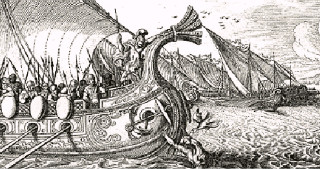
:: The Argonauts
The Argo, having begun its voyage, met the sage Phineus (the blind prophet) and received instruction on the course ahead. They were to pass through the Euxine Sea, at whose entrance there were two islands made of rock; these islands floated on the surface of the water, swaying about and colliding with each other, so that anything caught between them would be shattered. Phineus told them the method of passing through this strait. First they released a single dove. When the dove flew between the rocks, the two rocky islands moved and collided. But the dove barely passed through the rocks safely. Soon the Argo too seized the opportunity when the islands collided and drew apart, and rowed with all their might. Their ship was grazed a little at the stern but passed through safely. The Argo finally landed in the kingdom of Colchis.
Jason demanded that King Aeëtes return the Golden Fleece. The king then made a new proposal, promising to hand over the Golden Fleece if Jason would yoke to a plow two fire-breathing bulls with bronze feet and sow the teeth of the dragon that King Cadmus had slain. Jason accepted the conditions.
Medea, the daughter of the Colchian king, saw Jason, fell in love with him, and helped him. Jason promised to marry the sorceress Medea, and with her help was able to obtain a magic charm.
When the day of the decisive battle came, many people gathered. When the bronze-footed bull came charging in, breathing fire from its nostrils, that fire burned up the grasses along the path. There was a sound like molten iron seething in a furnace, and smoke arose like when water is poured over quicklime. Jason bravely advanced toward the bull. Paying no heed to the fire-breathing snorts, he spoke to it, calmed the bull's rage, boldly stroked its neck with his hand, and then deftly slipped the yoke over it and made it pull the plow.
Next he sowed the dragon's teeth and covered them with earth. Then at once a band of soldiers sprang out from within and rushed at Jason, who had sown the dragon's teeth. Jason, using the magic Medea had taught him, took a stone in his hand and threw it into the midst of the enemies. Then they at once turned their weapons against their own side and began to fight. At last the enemies vanished without a single one left, and the Greeks cheered for their hero. To find the Golden Fleece, he sprinkled the magic potion Medea had given him on the dragon. The dragon, smelling the potion, closed its great round eyes, fell over on its side, and sank into a deep sleep.
After getting the fleece in hand, Jason, leading his friends and Medea, quickly returned to Thessaly. On the way back they passed by the island of the Sirens, and at that time Orpheus sang a song more beautiful than the Sirens'. Then everyone's ears turned solely toward Orpheus, and thanks to that the Sirens' song could not even be heard, so they were able to pass through safely. When the whole company had arrived safely, Jason delivered the fleece to Pelias and dedicated the Argo to Poseidon.
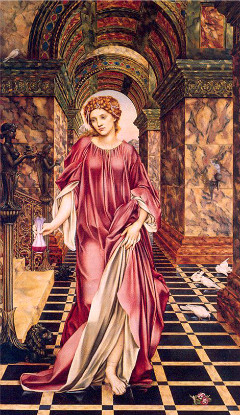
:: Medea
Although he found the Golden Fleece and returned home, Pelias had already killed his father Aeson. Learning that Pelias had no intention of handing over the throne, Jason takes revenge on Pelias with Medea's help. Medea began to coax Pelias's daughters, telling them that she knew the secret method of making their father young again. Seeing Medea cut an old ram into pieces, put it into boiling water, and pull it out as a young lamb, Pelias's daughters chopped their father into small pieces and boiled him in boiling water. After the king died, Jason was able to reclaim his father's kingdom but did not become king. It is said that he became king of Corinth, which Aeëtes had once ruled, together with Medea, or that he was driven out of Iolcus for the crime of killing Pelias and went to Creon, king of Corinth. Jason lived in Corinth with Medea for ten years.
One day, ten years later, talk arose of a marriage with Glauce, the daughter of King Creon. Thinking that marrying Glauce would give him great influence in Corinth, Jason divorced Medea, and Creon banished Medea from Corinth. Medea, unable to bear her rage and grief, resolved to take revenge on Jason, who had abandoned her, and tried to prevent his marriage. Medea devised a meticulous plan, killed Creon and Glauce, and even killed the children born between her and Jason, then fled to Athens on a chariot drawn by winged serpents.
After that, Jason continued on a downward path, and when he had grown old and feeble, he ultimately died, struck on the head by a timber that fell from his own rotting ship.
Jason's miserable end cannot necessarily be seen as applying directly to the fate of Aries people. But there is certainly some problem there. The point that a young hero who fights the 'Terrible Father' as a symbol of the past in order to bestow a new order must reject his own inner feminine self in order to marry the social power he has already experienced is an ironic fact in a myth that carries a subtle tragicomic nuance. Hidden here is the mysterious identity that exists between the hero and his enemy. Because, by the end of the story, Jason himself ultimately becomes the 'Terrible Father' and, through his own nemesis, brings about the death of his children. On an inner level, this tragic ending behind the glorious story may perhaps be inevitable for the Aries-born before a new cycle begins and a new quest for a new Golden Fleece arises. Much may be shattered before the Aries-born rises up from his own collapse and pursues another challenge. As a mother or father rather than as a son or daughter suffering under an autocratic father, the Aries-born may come to realize that within the same myth the roles have reversed—that the children rebel against their own tyranny.
-----
3. Summary
As we proceed forward through the zodiac, we will again (within the myths of Leo and Capricorn) see the drama between father and child. The dimension we meet here, in this first sign, is the first struggle for freedom, and here only one god can exist. If several other gods were to share his work, the autocratic sovereignty of Zeus, Ammon, and Yahweh would become meaningless. Likewise, for the Aries person there can be, and must be, no god other than one. Because his struggle is a struggle with the god who is the Father, the Aries person must be thoroughly conscious of what he is doing and needs to respect his opponent. In other words, he must not merely rage but be reverent. Just as when Jason abandoned Medea and coveted the throne of Corinth, if he displays arrogance, his glorious deeds will surely come to nothing. Through the encounter with the 'Terrible Father,' he acquires individuality and inner 'authority.' Thereby he becomes able to exercise the responsibility of the kingship he won by fighting. Without such a struggle, he can only remain forever his father's son. He forever only throws stones through the window from outside in rebellion, and cannot enter that place where the Golden Fleece, the essence of his own masculine energy, is hidden.
Comments 0
No comments yet. Be the first.