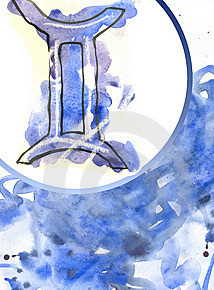
'
Sun transit period Soman - Mangjong - Haji (around May 21 to around June 20)
I fought with my mate,
fought with the enemy within,
until both sides collapsed in exhaustion......
- Bob Dylan -
1. Introduction
The being called twins seems to contain some supernatural meaning. We know biologically how identical twins come to be, but looking at two people who feel like one person yet truly are not, we experience both confusion and wonder. Later on we will examine the twins of myth and Hermes, who has the temperament of the twins.
-----
2. Myth
<Zethus and Amphion>
The myth of Zethus and Amphion, the least known of the Gemini myths, is the story of the twins born between Zeus and Antiope. Zethus was a strong, energetic, excellent warrior, but Amphion was a master of instrumental performance who inherited the skill of the lyre from Hermes. Zethus looked down on Amphion's feminine pursuits, but Amphion ardently asserted the value of art and intellect. From this story we can easily see that the basic task of Gemini is the opposition and conflict between relativities.
<Castor and Pollux>
Castor and Pollux are far better known than Zethus and Amphion, because they are used as the names of the two fixed stars that make up the constellation Gemini in the sky of the twins. They are the children born to Leda, wife of the Spartan king Tyndareus. Leda is famous for laying two eggs; from each of the two eggs came twins, two of them children of Zeus, and two of them children of Tyndareus. Among them, Castor and Pollux were twins, and when these two twins fought with the other twins, Castor was killed. Pollux, unable to bear the grief of losing his brother, begged his father Zeus either to bring his brother back to life or to take his own life. Zeus took pity on this and had the two of them take turns, spending one day on Olympus and one day in Hades. Thus the twins are also connected to the matter of periodically experiencing opposite things in alternation.
The fact that traditional astrology commonly says Gemini people have a fickle nature and that their minds repeatedly swing from elation to dejection is not unrelated to this myth. The mind bound to a material world that must accept powerlessness and death as its fate, yet rising toward the world of the deathless soul—the myth vividly shows the struggle between the two.
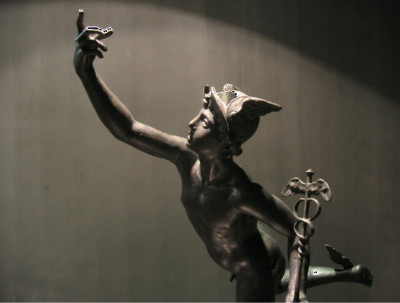
<Hermes>
Hermes holds duality within himself. He embodies the flickering of light and darkness that is the symbol of Gemini. Hermes is Zeus's cleverest son, born of Zeus's union with the nymph Maia, who signifies a goddess of the night. It is said that when Zeus united with Maia, they met in a dark cave beneath the cover of night. Hermes was a master of lies and theft, a carrier of dreams, a wanderer of the night.
Hermes can travel at will to the heavens, the underworld, and all the worlds of the earth in between. Among the many gods, only he holds no specially assigned 'station.' He always lingers at junctures or in in-between regions.
-----
3. Summary
Gemini people certainly experience the 'tricks of fate.' But that is due to the characteristics their own soul possesses. The creative talent unique to Hermes can be clearly seen even by looking at the great artists of later generations born under Gemini. Wagner, Dante, and Thomas Mann are just the first three who come to mind among them. The struggles with rivals and the troublesome 'incidents' that seem to throw Gemini's path into confusion appear to make them understand more deeply the exquisite duality of life and the secrets held by the god of light and darkness. And without such things, Gemini people would be unable to bear the boredom.
Comments 0
No comments yet. Be the first.