Eros and Thanatos
- Author
- Jo Yong-hun
- Publisher
- Sallim | published 2005-12-15
- Category
- Art/Pop culture
- Book description
- Eros and Thanatos, which examines the aesthetics of love appearing in literature and painting...
The book's title is Eros and Thanatos, and well... the reason I suddenly switched genres from the world-literature collection to an art book is that I couldn't finish 'Anna Karenina'!!! Because I never returned Anna Karenina Vol. 3, I couldn't borrow the book even today. In the end, leaving behind 'Sophie's Choice,' which ended in 'suicide,' I had to find something else, and I thought of books like 'Do You Like Brahms,' 'Notre-Dame de Paris,' 'Crime and Punishment,' and 'The Brothers Karamazov.' But these books were an awkward length for me to read right then, and though I flipped a few pages of 'Sense and Sensibility' which I'd borrowed, I couldn't focus or get into it, so I inevitably borrowed a different book.
Eros and Thanatos can be put another way as 'love and death.' Considering the assumption that the happiest emotion a person can have, 'love,' and that everyone is ultimately heading toward 'death,' I could feel — as I'd read in Tolstoy's 'Anna Karenina' — that even in the moment of love, death is approaching moment by moment. Take Konstantin Levin: he falls in love and marries Kitty, but before long his brother Nikolai Levin reaches the very brink of death, and after meeting his brother and watching him meet death by his side, a complex layering is created.
The Eros and Thanatos this book speaks of isn't the love and death shown in 'Anna Karenina'; it says the extreme of love can ultimately lead to death. The author's ability to explain Eros and Thanatos one by one through works like 'Judith' (there are very many works titled Judith), 'Samson and Delilah,' 'Narcissus,' and 'Danaë' is impressive, but considering that the term and origin of Eros and Thanatos themselves derive from Greco-Roman myth and Latin, one might think this is a bit hard to apply to Asian myth. But Korean classical novels like 'The Tale of Sukyeong Nangja' or 'The Tale of Unyeong' also generally went as far as cases where one could fall in 'love' and reach death, so in a way this could be called a history common to all humanity.
One impressive part was the story of 'Munch.' This book briefly sheds light on Munch's life and tells the story of the 'femme fatale' for him.
He recalled his childhood as days of pillows, sickbeds, and blankets. So his confession — "I experienced death from the moment I was born. A true birth, that is, the existence called death, awaits me again" — is by no means an exaggeration. As if that weren't enough, he exposed extreme persecution-consciousness, saying he had genetically inherited the two most fearsome enemies of man: tuberculosis and mental illness.
The repeated death experiences of childhood may naturally have strengthened his intimacy with death, perhaps weakening its terror and intensity. But how good it would be if, in facing death, that dreadful fear could ease. Rather, death loitered about him and often tormented him. He could only become the protagonist of an unfortunate fate who had to gain insight into life by gazing at — no, by facing head-on — death. And the deaths of his beloved mother and sister became the occasion that imprinted 'woman' as a gloomy name evoking death. To leap a little: woman was, to him, an object of love and at the same time a kind of terror evoking death. Eros and Thanatos — that is precisely it.
His first experience with a woman was Mrs. Heiberg, three years older, who had a strongly bohemian disposition. An older married woman — and a fierce bohemian at that — known as the wife of a naval surgeon, she was a free-spirited woman who supported the bohemian movement. That she was Munch's first love seems to foretell that his affections would not be smooth, that his view of women would inevitably be warped from the start. She led him into the world of physical sensuality rather than the flutter or curiosity of first love, and induced somewhat dissolute affairs.
Munch submitted to her strong allure to the point of wanting to give even his life to her. He was enthralled. She possessed a charm of such strong toxicity that it could paralyze all of Munch's senses. Against her sensual stimulation charging at him from all directions, Munch, a novice at love, was helpless. Conversely, she, who enjoyed free love, failed to quench her thirst for love from Munch, a beginner at love. It was obvious that this hunger and thirst of love would make her crave new objects.
Is Munch falling into a 'femme fatale' from the very start fate's prank? Considering that her paintings are mostly of despairing, suffering situations, 'Eros' was to him no different from a shortcut leading to 'Thanatos.' If the desire to live and the wish to love bring death, pain, and grief, this lets us predict to some degree that Munch's future would be quite unhappy. Munch, who became unhappy by once loving a bohemian and another time meeting someone who loved him too ardently, surely didn't want to end up that way either, but it's just pitiable.
The 'Danaë' story was also very interesting. The Danaë who appears in Greek myth was a woman fated to be locked in a tower where she could meet no one. There's one man who takes interest in such a Danaë, and that's Zeus. (Ah, how does Zeus charm and meet so many women...) Danaë was a woman locked in a tower with no way to release any of her desires. The one who took interest in her was a god, and Zeus transforms into 'light' and unites sexually with Danaë.
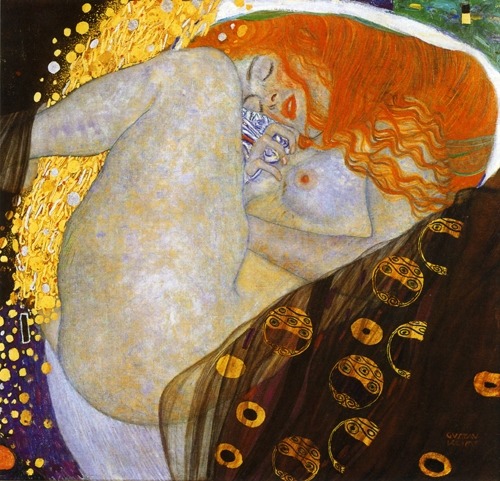
Danaë, surrounded by golden light and wearing an ecstatic expression — this work is by Gustav Klimt. Through her hands, expression, and high-raised thigh, you can see at a glance that she's communing with Zeus, but this at the same time leaves a 'Thanatos' element for her. She could meet no one in the tower, so if the daughter's belly swelled and she became pregnant, how on earth would this be explained? So Danaë's father Acrisius sends Danaë back to the sea with her son.
It's true that myth stories always fascinate me. This time too, but I couldn't avoid, throughout the reading, the slightly untethered feeling at the book's start. Yet as paintings I'd seen now and then in my Introduction to Western Art class appeared, and the lessons about them came to mind, and the myths surfaced, I think that's why I read it. Good.
Comments 0
No comments yet. Be the first.