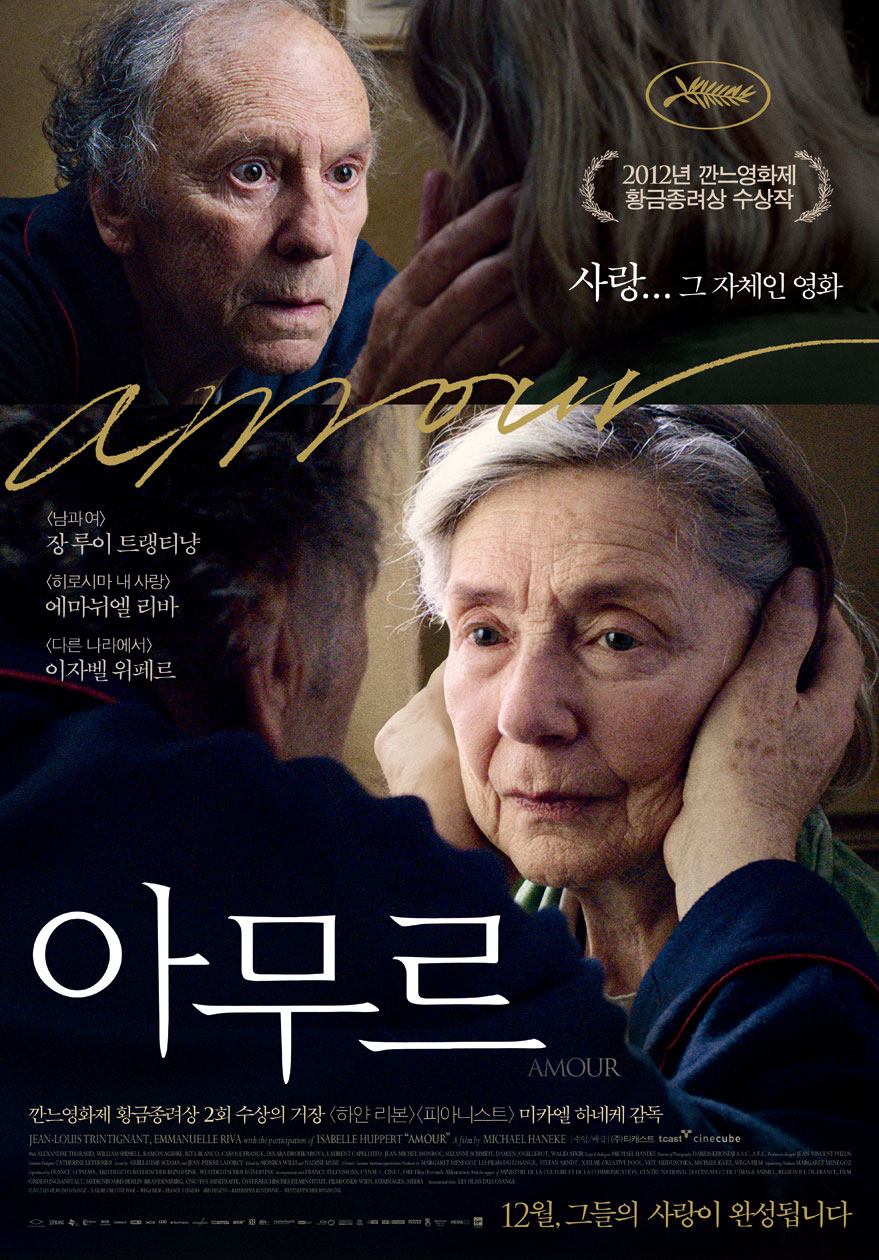
Amour (2012)
Love
8.3
- Director
- Michael Haneke
- Cast
- Jean-Louis Trintignant, Emmanuelle Riva, Isabelle Huppert, Alexandre Tharaud, William Shimell
- Info
- Drama | France, Austria, Germany | 127 min | 2012-12-19
Even though about two months have passed since I saw the film, I don't think I'll be able to forget it; it was calm, the music kept to a minimum, made up purely of a human story without scene transitions or CG. What's more, it isn't the kind of 'young people's' or 'middle-aged' story you see so often, but a story of 'old age.' I once saw a story of old age in Clint Eastwood's 'Gran Torino,' and beyond that I can't really recall any. To translate a story of old age into film, I think one needs 'wisdom' and 'years of experience.' It seems a young director would fall somewhat short in telling a story of old age. I believe a masterpiece only emerges when one has actually grown old and tells the story of old age firsthand. Director Michael Haneke is in fact 'old' himself now, and I think it's right to see this film as a vessel for holding his own story and thoughts.
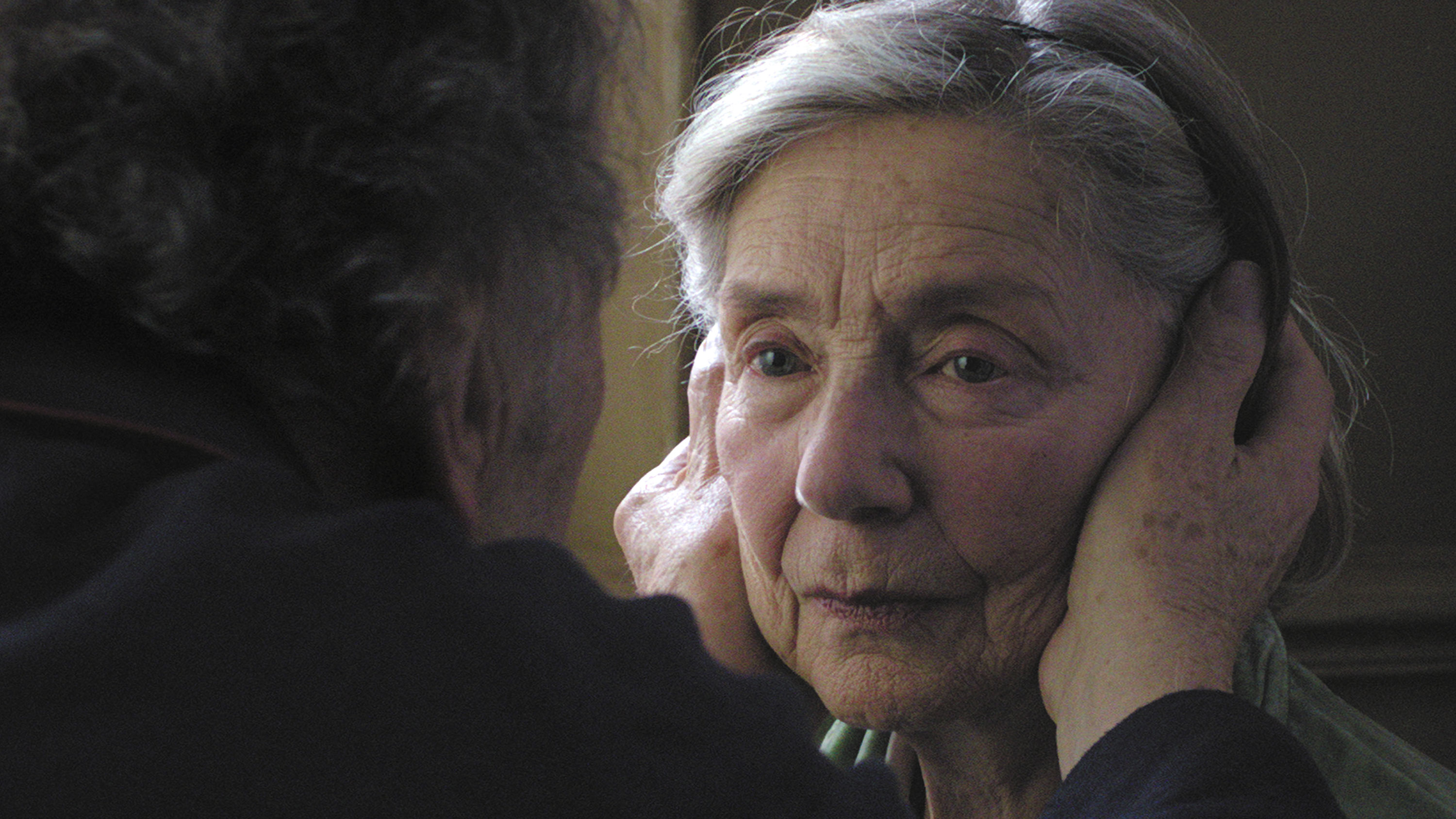
If I were to pick the keywords for understanding this film, one would be 'death' and the other 'love.' It captures the conflict, anguish, worry, and everyday life of a couple facing 'death' in the presence of 'love.' Using a stroke, which could be called a rather common subject, director Michael Haneke has Anne gradually fall ill and grow frail, while Georges, with minimal help, begins to care for the wife he has spent his whole life with since marriage. It is meeting death with love. The beginning of the film shows someone's death, and the police come to the house where that death is, and we see the death of 'Anne.' Flowers are arranged around her, and her expression is very peaceful. In a house where the suffering is over and she no longer has to struggle, Anne simply lies there with her eyes closed. After that, having gone to a concert performance, the morning after returning home, while eating breakfast, the scene like the one above takes place. Even when Georges speaks, she cannot understand, and she simply stops still. As if time had stopped. What the film poster signifies is exactly this 'stroke,' and because of this illness that brings death closer, the question of in what form 'love' appears. Bewildered by his wife's sudden unresponsiveness, Georges soon wipes Anne's forehead with a wet towel, but there was no reaction at all. Then for a moment Anne returns to normal, and he realizes that she does not remember what just happened. So he goes to the hospital and finds out that Anne has had a stroke. And that from now on this will happen more and more often.
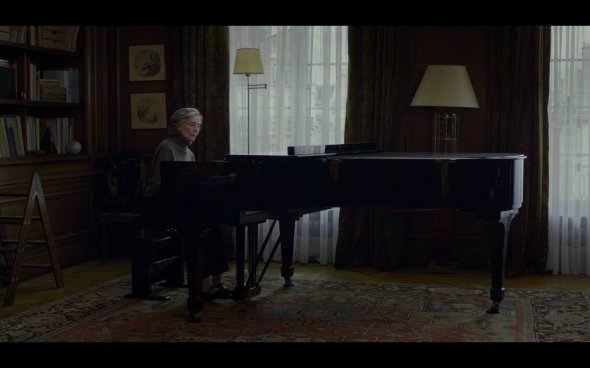
The way the director unpacks death is very simple and something we can encounter in daily life, yet at the same time it is miserable and sad. The emotions Georges felt while playing music and watching his wife seated at the piano must have been very varied and complex. The moment I saw that scene, I thought Anne was playing the piano. That's because the film tells us she used to be a music teacher. But my girlfriend, watching beside me, said it was more likely the husband had put on music and was listening to it, and that turned out to be true. Watching Anne, who can no longer make music, Georges cannot show his regret and simply feels how time has passed, and that Anne can no longer make music.
Even at this point Anne's condition was still okay, but I found it hard to keep my eyes open watching her condition gradually worsen. And watching Georges, who does his best for such an Anne yet grows only more exhausted, my heart ached for him too. When you fall ill in old age, it isn't only the sick one who suffers. The partner who has spent all that time together suffers as well. After living with someone for decades, watching that person remember nothing and merely suffer in pain must be terribly hard. I think that, watching Anne's suffering, Georges in the end wanted to give her 'comfort' and 'peace' by providing her an eternal sleep.
While watching this film with my girlfriend, she told me that films similar to this one usually end with one killing the other. I don't want to talk about death even in this film. But there's no denying that the director painted his own vision of the future through this film. A film is the worldview and thoughts of the director who makes it. The director decides what content to express and how, from within those thoughts and values, and since 'Amour' brings the love of old age to a close with death, I don't think many words are needed. It is a film that is easily understood yet gives much to think about.
In the future, I don't want to be living without an occupation. Even in old age I want to keep busy with something. Only, not with farming, but with activities centered on lecturing. Or writing. I want to do things that can be of help to someone right up until I die. That is my dream and my future. By doing so I will gain vitality in life and taste happiness. It may still be a very distant future, but this film played a part in letting me sketch that picture a little. And it's also somewhat strange that in that future my girlfriend is there as my wife.
Comments 0
No comments yet. Be the first.