I remember that the first time I read the work The Sorrows of Young Werther was in my second year of high school. Back then, in an era when studying for the college entrance exam was no fun, I was hooked on melodrama films, and at the time a certain celebrity took their own life, and the name of the book that was going around in connection with that was precisely 'The Sorrows of Young Werther.' The so-called 'Werther effect,' a chain-suicide effect, was the topic of the moment, and because various suicide cases that proved this effect were occurring, I came to take an interest in this book.
The story of this book is simply the love story of 'Werther' and 'Lotte.' The only problem is that the situation 'Werther' and 'Lotte' find themselves in is one where they love each other but cannot marry, and in Lotte's case, toward the final part she was already in a situation with another man, which 'Werther' comes to confirm with his own eyes, and Werther, defeated in the love rivalry with Albert, shoots himself with a pistol and makes the extreme choice of 'death.'
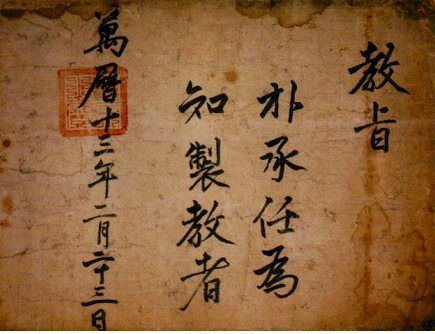
Enough about the plot—I intend to look at this story by dividing it into three aspects. First, I'd like to talk briefly about the 'letter form.' Personally, if asked to pick the most meaningful piece of Korean-literary source material from the Joseon period, I'd choose the 'naeganche' (inner-letter style) writings of the court women. Some people may counter, asking why on earth the story of Joseon-era naeganche comes up out of nowhere. But this 'letter form' is a kind of 'historical source' through which one can grasp the very linguistic structure of German literature of the time, its sentence structure, expressive methods, and various other characteristics. It may not help in understanding German literature, but I didn't expect that this kind of 'letter form' would take on new meaning for me these days as I'm reading A Comprehensive History of Korean Literature. I was able to feel in this work the kind of 'value' that you could gain when looking, 100 or 200 years from now, at the letters being sent these days.

Second, this work depicts a typical 'love triangle.' This 'love triangle' is not simply a structure where the winner gains love and the loser loses love. I think the 'love triangle' is something like a kind of duel ritual handed down from long ago. If you treat the love triangle by confining it to the theme of 'love,' it becomes a rather meaningless theme, but if you connect it to a theme like 'the acquisition of royal power,' the story becomes different. To take as an example the story of the Roman emperor 'Augustus' and 'Antony,' who was one of his rivals: these two were competitors fighting over the power of Rome, and this part is just like the situation in which Werther and Albert compete over 'Lotte.' Also, the situation in which 'Augustus' and 'Antony' confronted each other was not always one of them battling each other. Even when they were waging a silent war against each other, they would inquire after each other's well-being, but it wasn't really inquiring after well-being, and they would send reinforcements, but it wasn't really sending reinforcements. The relationship between Albert and Werther seemed to be like that too. Because, until Albert and Lotte married in the final part, the two men were continuing an invisible war.
Third, the work that made me agonize once again over whether love is really a problem serious enough to drive a person to death is precisely this one. Personally, I have never experienced this kind of 'passionate love.' I have dated, and my first kiss is long in the past, but if you ask me whether I've ever had a 'passionate love' and during that time thought only of that person, I would say without a shred of doubt, 'No, I haven't.' I was neither devoted enough nor passionate enough to stake my life on the people I've loved up to now. It's because I didn't feel any reason to, nor was it something I had to do. Yet the protagonist 'Werther' chooses 'suicide.' Why is that? Why does the protagonist make the extreme choice of 'suicide'? Was the saying 'love is destiny' already widespread among the public back then too? Or did Werther choose suicide out of the thought that he had been defeated in winning love? Which is the correct interpretation, there's no way to know other than from the author 'Goethe,' but I'm extremely negative about this ending. Among the melodrama novels I've read, there were also bleak novels like 'Norwegian Wood.' But I think the bleakness felt in 'The Sorrows of Young Werther' and the wistfulness felt in 'Norwegian Wood' were somehow different. The protagonist being 'Werther' and Werther committing suicide is on a different level from the heroine 'Naoko' of 'Norwegian Wood' committing suicide. Werther's suicide signifies the end of the novel and at the same time the end of Werther's life, whereas Naoko's suicide signified Watanabe's growth and foreshadowed another beginning.

It's not that I dislike this novel's ending because I wanted a happy ending. I dislike this novel's ending because there's no way to know what the author 'Goethe' was thinking when he wrote this novel's conclusion. I couldn't shake the feeling that he was building something up and then, getting a little bored, tried to end it early.
The novel 'The Sorrows of Young Werther' is a work well known for the Werther effect, and the thought most people have after reading this novel is often just 'Ah.... what a sad love it was....' and they leave it at that, but I seem to feel something a bit different, which even makes me suspect that maybe I'm the strange one. Still, remembering that this too can be one opinion, I'll bring this review to a close.
Comments 0
No comments yet. Be the first.