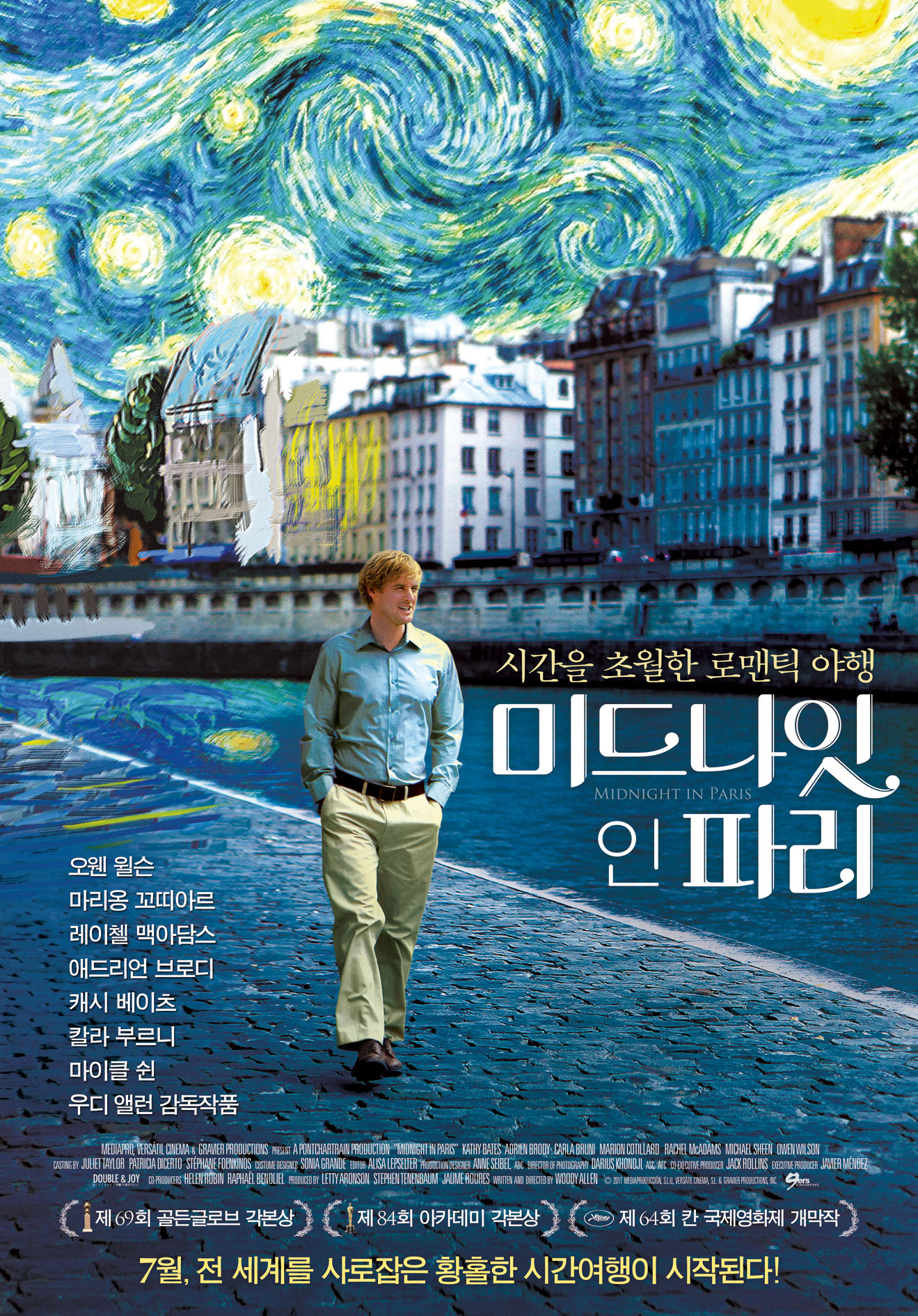
Midnight in Paris (2012)
Midnight in Paris
7.9
- Director
- Woody Allen
- Cast
- Owen Wilson, Marion Cotillard, Rachel McAdams, Adrien Brody, Carla Bruni
- Info
- Comedy, Fantasy, Romance/Melodrama | USA, Spain | 94 min | 2012-07-05
The ability to unfold a story is important, but what story it is based on is also important. This story had an excellent foundation, and I think the screenwriter who unfolded it was remarkable too. How did they think to feature an old classic Peugeot..... I can only think everything is remarkable. So now let me begin the real discussion of the film in earnest.
The protagonist 'Gil' is a Hollywood screenwriter who has come on a trip to Paris with his fiancee Inez and Inez's parents. In this city of 'Paris,' Gil yearns for the past. The past here is not simply the 'past' in a temporal sense. It is a 'past' with narrativity, possessing all the senses of time and space that can be seen in a novel. A past as a single spacetime, that is. How exactly did he come to perceive this past? Inez and Gil seem, for one thing, not to suit each other well. Even if Gil is successful in Hollywood, well, it seems the choice of fiancee wasn't decided so successfully. They seem to match well on trivial things, but on big matters they don't match well and so experience conflict. And above all, Inez perceives the city of 'Paris' as a place to sightsee briefly, but Gil does not. Gil makes 'Paris' his ideal. And not the present Paris but the past Paris at that.
Let me briefly tell a story I read recently. I recall reading the part about 'national literature' while reading a paper on Milan Kundera, and the content was this. Milan Kundera was born in the Czech lands, but after seeking exile from the Czech lands, he worked not in Czech but in French. Yet Kundera belongs neither to Czech national literature nor to French national literature. This is also a statement that he was not faithful to the ethnicity and history of either, and it is because his works possess an artistic quality and world that make it hard for either literary world to carelessly claim he belongs to theirs. He aimed for 'Bohemian' literature and for European literature. But the importance regarding 'Paris' was recorded in the paper: before the 20th century, Paris was regarded as a city of artists. Various people did artistic work in Paris. Because it was such a charming city, Gil the screenwriter too seems to have wanted to feel the romance of this city while searching for his true life as a novelist. But Inez fell for 'glamour' rather than romance, so these two were depicted as a mismatched relationship from the start.
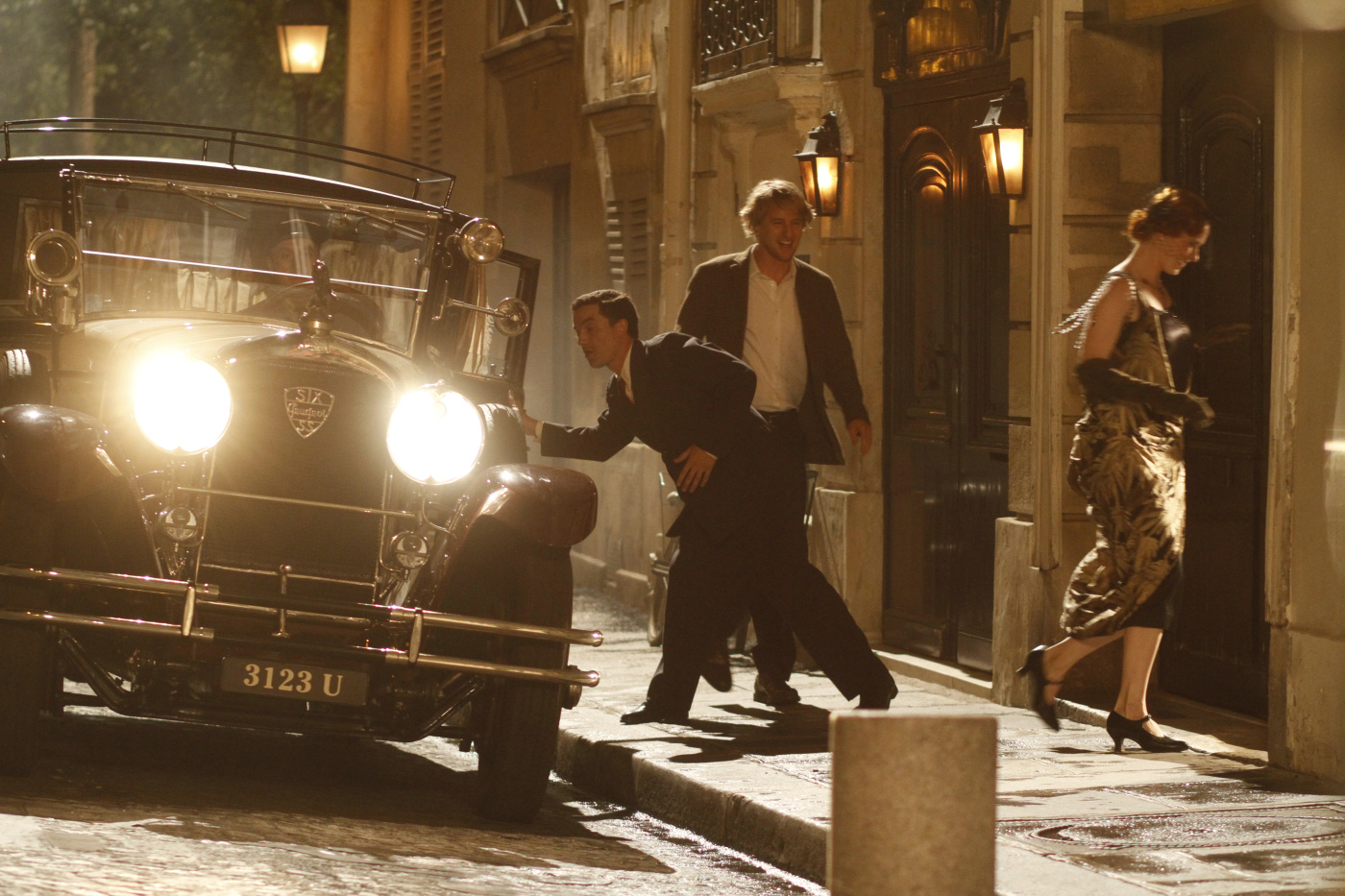
Continuing the above story, riding the classic Peugeot seen in this picture, Gil travels back to the 1920s. (It's an absurd 'fantasy,' but this fantasy can be said to be the very heart of this film.) In the car he meets Mrs. Fitzgerald, and then at the bar they enter together he meets Ernest Hemingway. Because Gil was a novelist and an aspiring writer, having met Hemingway, whom he respected, he continues a dazed series of encounters after meeting the Fitzgeralds. After that day, returning to the room he talks with Inez, and saying she wouldn't believe him if he said he'd met Fitzgerald, Hemingway, and Cole Porter, Inez comes to feel her husband is strange. The next day at midnight, wanting to ride the classic Peugeot together with Inez, he goes to the street with her that night, but Inez, unable to bear it, takes a taxi back first. In the end, Gil, again left alone, rides the classic Peugeot with Hemingway and comes to meet Gertrude Stein, Picasso, and Adriana.
To Gil, who continues his encounters with the people he admired and thought remarkable by riding the classic Peugeot every midnight and crossing into the past, 'Adriana' is a fantastical woman; Gil falls for this woman at first sight, but because he has a fiancee he cannot express his feelings all at once. Yet listening to Hemingway's story, he agonizes over his current relationship. Hemingway says that even just for the moment of sleeping with the person one loves, one should be able to escape the 'fear of death'; Gil thinks for a moment and then, since he loves Inez and she is his fiancee whom he will soon marry and so must love, yet does not think he is happy enough in bed to forget the fear of death. At the same time he thinks of Adriana. She, a woman as charming as her, he thinks of as the most beautiful woman who could make him forget his fear of death.
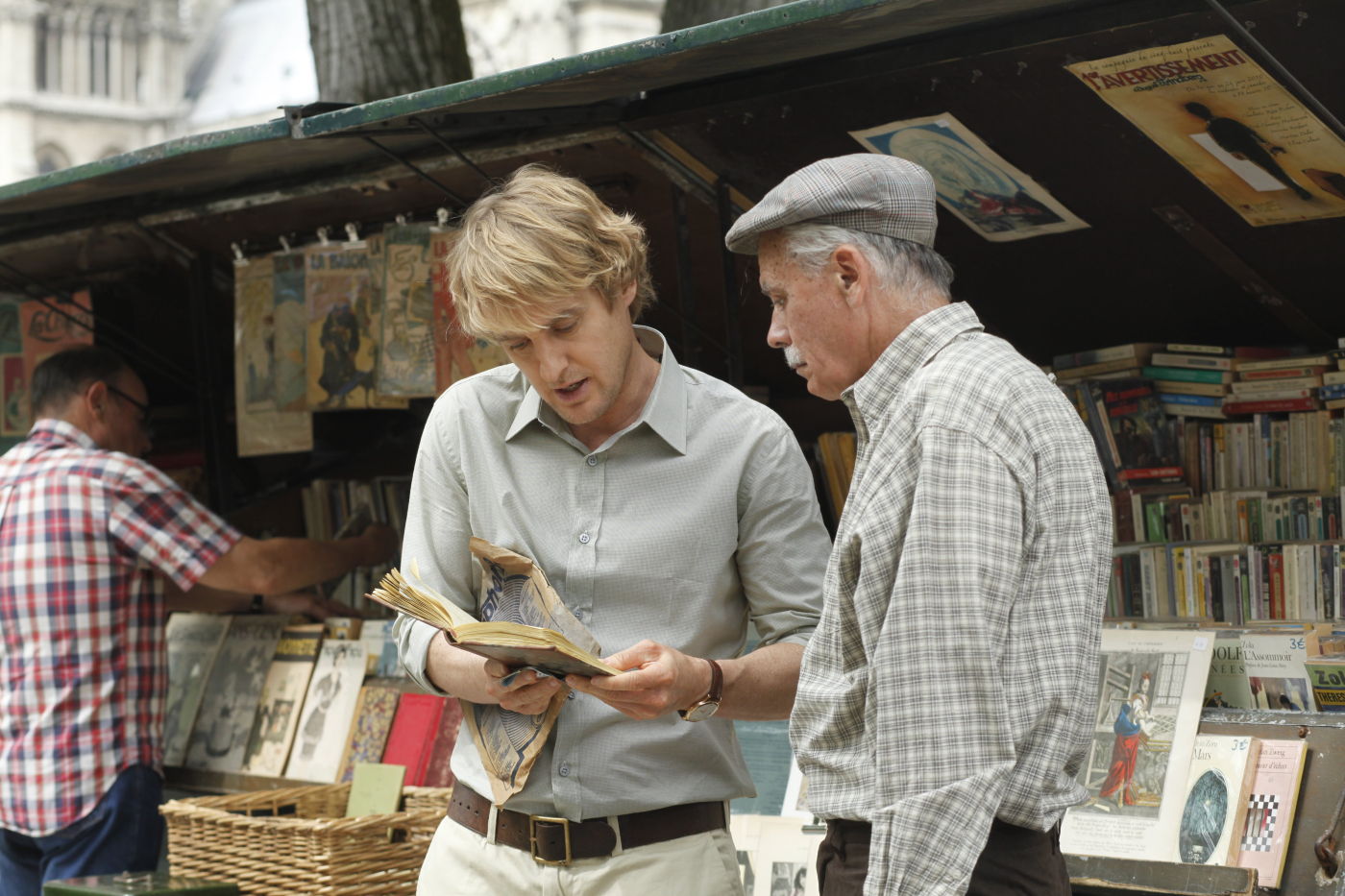
As in the scene above, Gil buys and reads an essay Adriana wrote after returning to the present. But what do you know-it's in French so he can't read a word of it, so he pays someone to interpret the essay collection into English. In doing so, he realizes that Adriana, too, fell for him at first sight, and that the name of the man she fell for is precisely his own name, 'Gil.' As Gil falls more and more for Adriana like this, he agonizes over just whom he loves, and goes to the park where Rodin's sculpture 'The Thinker' is and asks the curator. Whether one can love two women at the same time, that is. Rodin was like that. He had his own wife, but also loved 'Camille Claudel,' whom he met after growing older. (This is a fact I felt when I went to the Rodin exhibition.) Rodin's sculptures had many works dealing with the theme of love, and whenever I saw works like 'First Love' among them, I felt this man's love was remarkable. Watching Rodin, who loved two people at once, Gil thinks. That he loves Adriana.
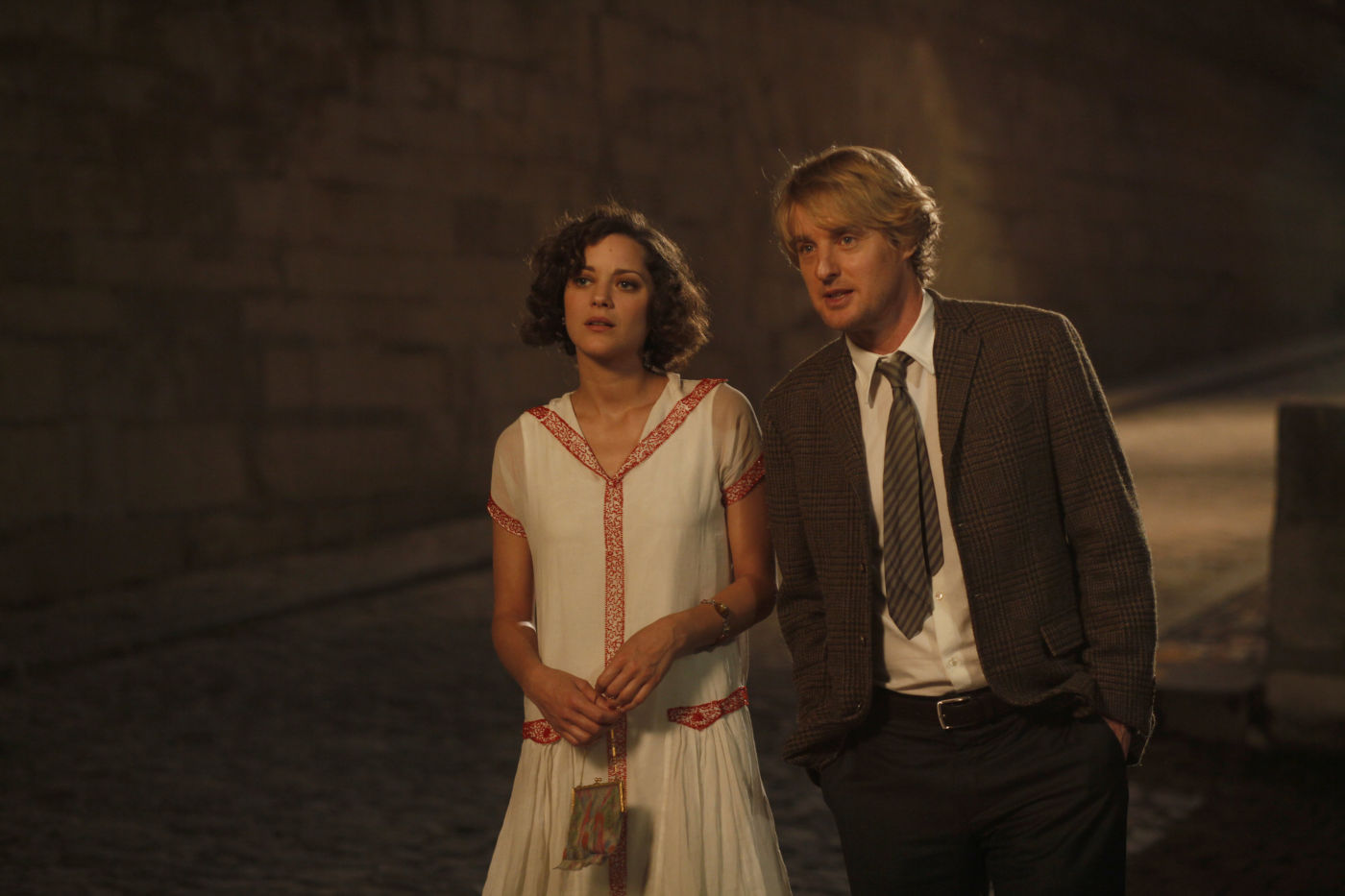
What a well-matched pair, aren't they? I still remember what Adriana said to Gil when she first read Gil's writing. She said she really loved his writing..... I think Adriana, with these words, implicitly expressed that she felt love for Gil. But Gil, at that time, because of his thoughts about Inez, would have found it hard to carelessly place Adriana in his heart. Of course, even this has the point that their relationship breaks down at their final moment.
Their relationship lay in the fact that both placed the 'golden age' in the past rather than their own present. To be specific, Gil thought of the golden age as the era in which Adriana lived, and Adriana thought of an even earlier era as the golden age-the 19th century, with Gauguin and Degas, the era of Maxim's restaurant. And so Gil thinks. That the 'golden age' may indeed lie in the past, but one must not think the past is better and try to stay in the past. And so Adriana, who wants to remain in the 19th century, and Gil, who returns to the present to fulfill his dream, part ways.
The 'draft' he shows to Gertrude Stein tells, at each and every moment, of Gil's life and the state of that life. When he was agonizing with guilt over Inez, it told him 'Do not dwell in defeatism'; when he met Dali and Bunuel and came to think about surrealism, it told him there was a feeling of fantasism in it; and at the last moment when he no longer dates Inez and at the same time thinks he should remain in Paris, it tells him that the protagonist's wife is having an affair. Here, saying the protagonist refers to himself, he protests to Inez, asking whether she isn't having an affair. Since Inez had long since continued meeting her college peer Paul and crushed even Gil's wish to sleep together, if I were Gil, I'd be likely to think such a thing too. She says she'll spend several days traveling together, she goes out first saying she has to have lunch, and even when he asks to walk the night streets together she goes off to sleep first saying she's tired.... I seem to have taken only the man's side too much, but I've only spoken my honest feelings. I think the city of 'Paris' is a 'city of romance.' Just from the film, it's full of romance. The appearance of Shakespeare and Company, the riverside that appeared in Before Sunset, even the night streets he walked with Adriana-everything is beautiful.
Watching the film, I came to think about just how faithful I am to the present. Am I really faithful to the present? Am I not acting like Adriana, who yearns for past glory? It's not that Adriana is bad. It's just that I want to live like Gil. I think Gil, who at the end of the film declares he'll remain in Paris and breaks off the engagement, is right. Some immediately visible success is important too, but if the chance to try doing what one wants to do is given, isn't doing that also important? It's not something one can easily do, after all. In that sense, the scene at the end of the film of meeting 'Gabrielle,' the young woman who sold Cole Porter records, and walking together through rainy nighttime Paris added to the film's romance and made me very glad and happy.
Woody Allen's Midnight in Paris, who even now continues steady creative activity with vigorous productivity-anticipating the future 'city' works he will create, I close this piece.
Comments 0
No comments yet. Be the first.