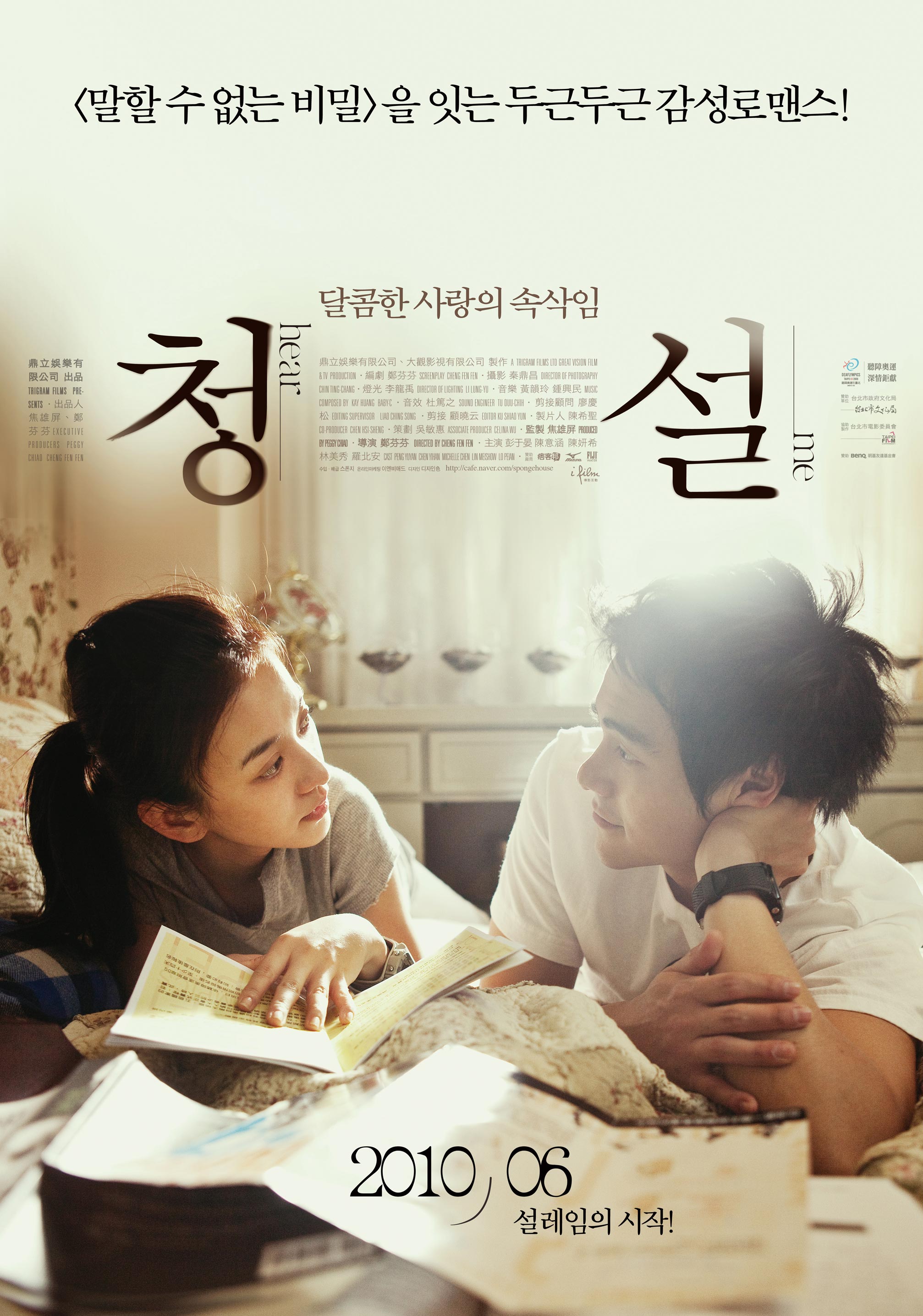
Hear Me (2010)
Hear Me
9
- Director
- Cheng Fen-fen
- Cast
- Eddie Peng, Ivy Chen, Michelle Chen, Lawrence Ko, Lin Mei-shiu
- Info
- Romance/Melodrama | Taiwan | 109 min | 2010-06-17
I wonder around what age one first becomes aware of the thing called 'sign language.' I came to know it as an elementary school student when I watched a performance of singing a song with sign language. A conversation done not with words but with the 'hands' must be hard to do, but watching the actors in this film do it so 'skillfully' (with tremendous practice behind it), I think the highlight of the film 'Hear Me,' which makes you feel a surging urge to learn 'sign language' too, is precisely this 'sign language.' I mean, when I first watched this film back then (it was 2-3 years ago), it made me wonder whether learning sign language could let you have such a beautiful love too.
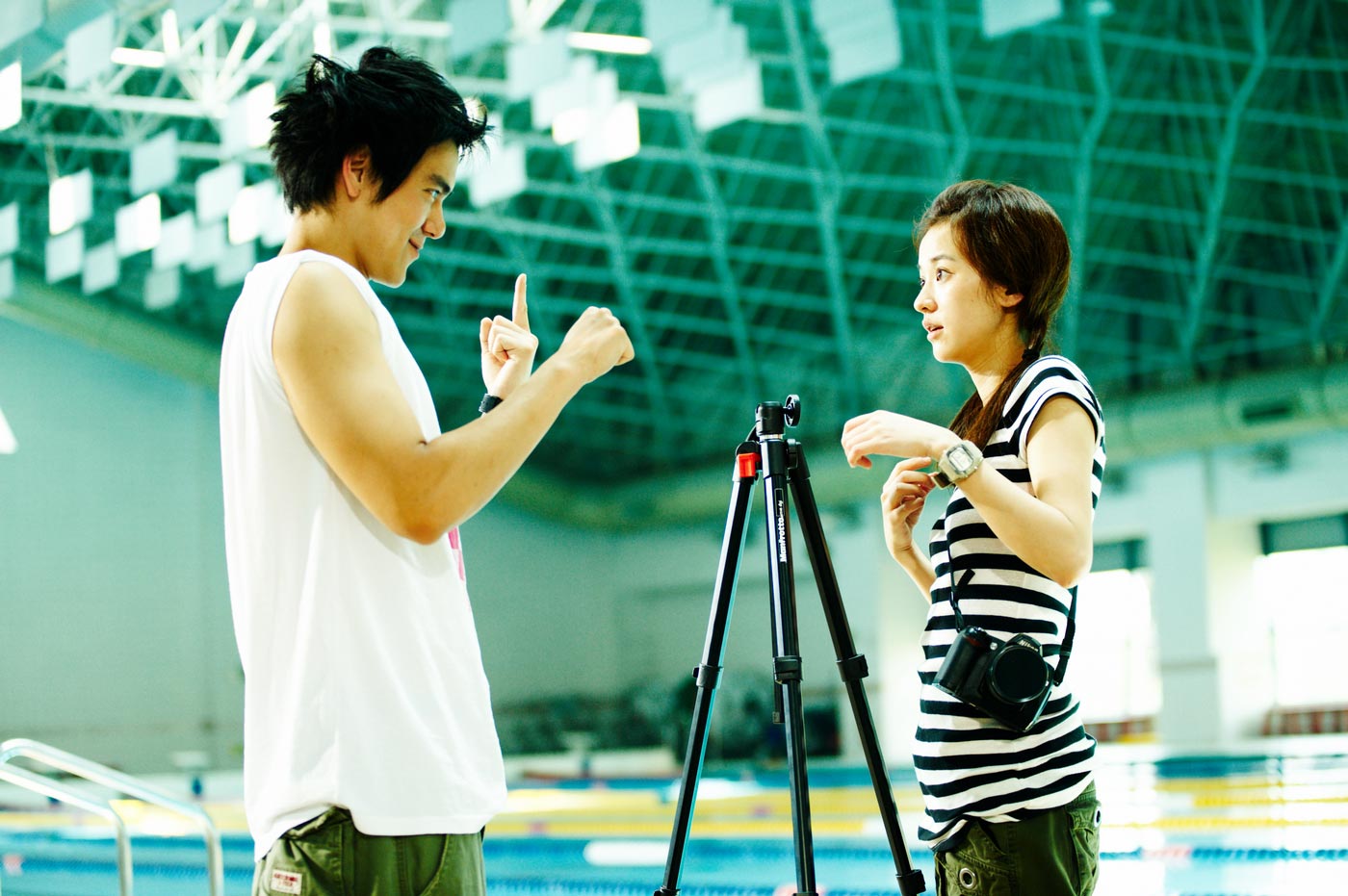
The film begins with the first meeting of Tian-kuo (the boy) and Yang-yang (the younger sister) when Tian-kuo goes to the swimming pool to deliver lunchboxes. Just how good a person this young man's university professor must have been for him to follow so well the suggestion to learn that professor's sign language—seeing that everyone in the swimming pool is using 'sign language,' he too finds the person he came to deliver a lunchbox to and opens a conversation in 'sign language.' Yang-yang answers it, and as she runs off to pay for the lunchbox, Tian-kuo watches and says she's like a 'water bird,' and their relationship begins. As Yang-yang first tries to ride off on her motorcycle to earn money, she falls because of the people around enjoying extreme sports and injures her hand and arm; Tian-kuo sees this, takes her to the hospital, and asks her to give him her 'messenger ID.' The two start conversing through the messenger only some time later, but as they frequently run into each other in reality, Tian-kuo and Yang-yang talk in 'sign language.' The most important thing in the film is that the two begin their relationship not with a conversation that has 'sound' but with a conversation done by hand.
As the name 'Hear Me' suggests, 'sound' is needed to hear one's story, but here, if the basis is a conversation done not with 'sound' but with the 'hands,' it would be a 'conversation done by seeing.' In that case, sound is unnecessary. Perhaps because of that, when sign language is used, no sound at all is heard in the film. It seems they intentionally removed all sound and deliberately left only the sign language. At first, I also turned up the volume out of frustration, wondering whether this was really a film, whether the sound was missing, but it was set up so that no sound came out at all. The thought that it was made so the audience could 'empathize' with the protagonists came to me, and I thought the director's consideration was truly deep. If other surrounding sounds were heard while only the figure 'signing' appeared, it might feel natural from the standpoint of an ordinary person, but to a person with a hearing impairment there's nothing as unnatural as this. Isn't a scene where nothing is heard and only things are seen, yet there is 'sound,' something wrong?
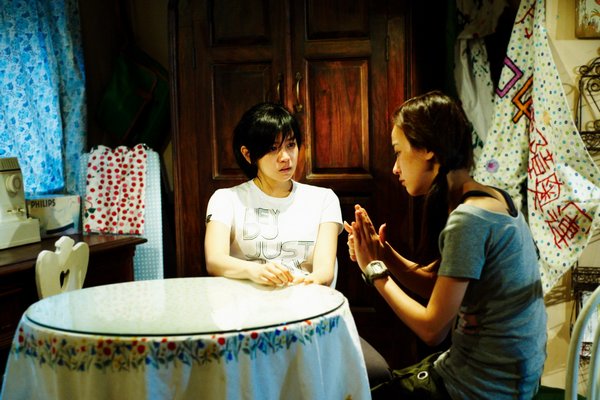
Both Gi-hwan-hyung and the junior named Park Sang-hyeon said the 'older sister' was prettier in this film, but I definitely concluded that the 'charming' one was the younger sister. The younger sister cherishes and loves her older sister more than anyone, and she's the character in this film who best understands what meaning the value of 'sacrifice' carries. In the practical aspects of Yang-yang's life and in her way of thinking, you could tell that almost everything is in consideration of her older sister. A 'studio'-type room is a structure that doesn't fit if you wanted your own space, but she chose it because her older sister can't hear anything and so needs to be able to see everything at once; whether it's letting her see through a 'red light' that can express sound in place of it when the doorbell is pressed, or the scene where Yang-yang comes home late and apologizes while saying that her sister got hurt—every single thing is in thought of her sister. I don't know whether there's a younger sibling in the world who thinks of an older sibling this much. Among the people around me, I don't think there was anyone who thought of an older sister, older brother, to this degree, and inwardly I was even envious of the relationship between the two, and it was beautiful that 'Yang-yang' was at the center of it.

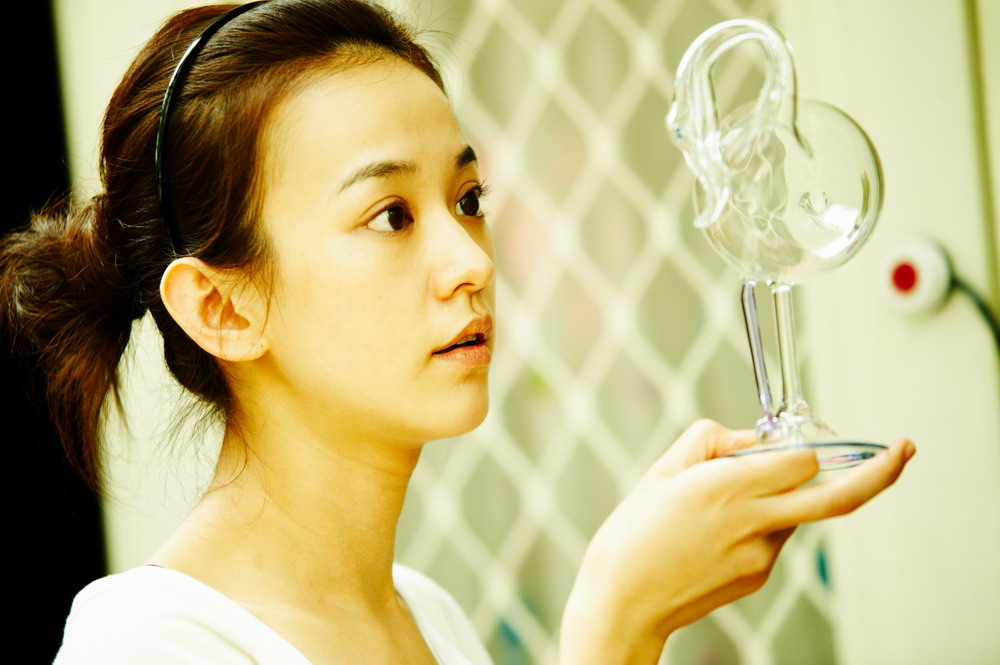
If asked to pick the highlight of the film, what I could choose is Tian-kuo's way of expressing love. To put it nicely, it's truly pure; to put it badly, the timing is slightly off and there are quite a few things that fall a little short of a woman's heart—like the part where he sent a text saying he had to plant a 'tree' to save the water bird, that is, the part where he indirectly tells Yang-yang to take care of 'her own' life too; honestly, I thought, what man could pull off such a 'pure' event like this. Whether it's the director's idea or the writer's idea, this scene where Tian-kuo dresses up as a tree and waits the whole time in front of Yang-yang's house is probably a scene where Tian-kuo becomes quite pitiable. Still, the 'water bird'-shaped piggy bank that Tian-kuo gave Yang-yang seems to have helped a lot. I still recall the part where, later, Yang-yang invites Tian-kuo to her house and, showing him a glass jar filled with coins, says 'every time I thought of you I put in a coin, and that's how I ended up buying this many,' and through that you come to know how often Yang-yang had been thinking of him.
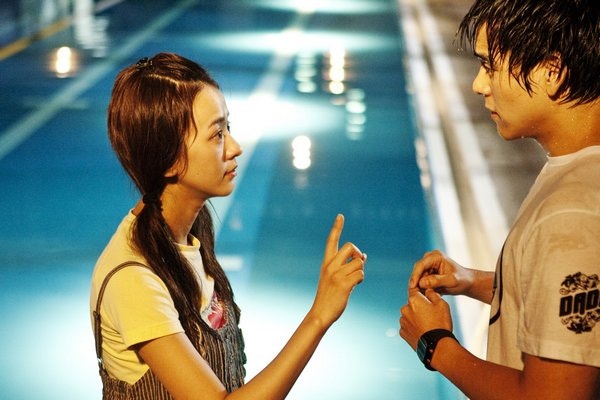
My goodness, this 'coincidence' where Tian-kuo goes to the swimming pool that just happened to be open and meets Yang-yang who was there is beautiful. Tian-kuo had thought Yang-yang couldn't speak, and Yang-yang had thought Tian-kuo couldn't speak, but the fact that both of them can actually speak is something neither of them knows until the film ends. As Tian-kuo speaks to Yang-yang, Tian-kuo spoke thinking Yang-yang wouldn't be able to hear, but wouldn't Yang-yang have been very grateful to Tian-kuo, who thought of her? Because he seemed to be the first person besides her father to take care of her—who always only takes care of her sister—this much. The two's feelings probably became certain at the swimming pool. Since the place where they first met was the swimming pool, and the place where they could finally gain 'certainty' about each other was the swimming pool too.
To me it was a film I can truly call beautiful. The 'heart' was beautiful and the 'scenes' were beautiful. It was also fascinating that the film unfolds without any especially tremendous sound effects. I'd like to recommend it to you, who are weary of blockbusters.
Comments 0
No comments yet. Be the first.