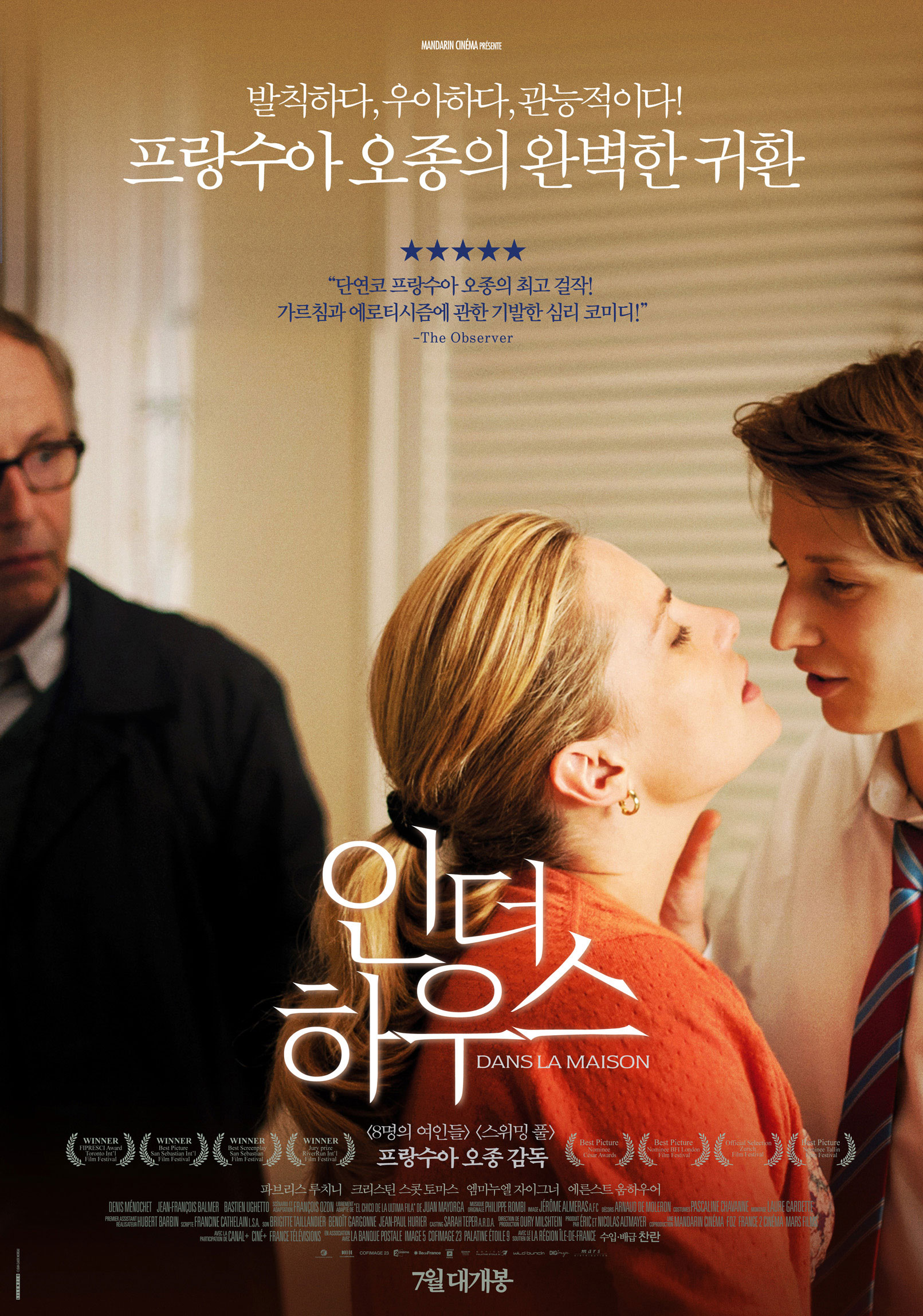
In the House (2013)
In the House
8.7
- Director
- Francois Ozon
- Cast
- Fabrice Luchini, Kristin Scott Thomas, Ernst Umhauer, Emmanuelle Seigner, Denis Menochet
- Info
- Thriller | France | 105 min | 2013-07-04
For the first time in a while I went to the Gwangju Theater to watch a film. I had no memory of properly watching a film recently, so I wanted to watch at least this one, and as it happened, that day at the Gwangju Theater my high-school English teacher 'Bae Jong-tae' was right there. He was a teacher who occasionally told us movie stories-there were tales of spending all day in the cinema watching nothing but films, and stories of famous works like Amadeus. To say a word about his classes: you could call them 'student-led' classes, where we were given an English passage, spent about 20-30 minutes interpreting it ourselves first, then several students presented it, and the teacher gave the explanation. Students who failed to interpret properly were severely punished, but in its own way it was a cool class. Such a teacher's taste in films was diverse, and that day this work too seemed to be one of the films within his taste. Does coincidence make a story? Before watching this film, I had watched the 'Lust, Caution' episode of 'the good movie' at home, and if 'Lust, Caution' is a film that produces the negative results of destruction and desire, then this film, I think, is one that shows that 'desire' destroys but the end can lead into an unknown 'affirmation.'
The story strayed a bit, but setting other things aside, this French film director Francois Ozon does seem fairly famous in his own way. As for French films, I have no memory of having seen any but 'The Chorus.' Hmm... or is it? Did I watch something else? No. I certainly have no memory of having seen anything but 'The Chorus.' But this distinctive French language doesn't sound bad. Perhaps because French was often heard in 'Midnight in Paris,' which I saw recently, it seems to have become a 'language' no longer awkward to me. The genre is thriller, and the content can be explained as cheeky peeping and, at the same time, turning the things peeped at into a novel. It was mostly composed of scenes one could call 'bold,' but it doesn't seem to have intended to talk about socially unacceptable desire and the gaps within a seemingly perfect family. These are merely things shown in the story; in fact, I suspect it was made to blur the distinction between 'imagination' and 'reality' that emerges through the conversations between student and teacher, and to make the audience guess at it.
It seems it wasn't only me who found Ernst, who played Claude Garcia, handsome; the appeal of this young man's face stems, I think, from the angular Western 'face' that Asians find hard to have. A very beautifully shaped nose is this young man's strength, and because of it, his speaking comes across as very challenging. And I think this is the greatest charm point. To be able to tell one's own story without ever being overwhelmed by the other's energy-that is precisely the most basic way 'Claude Garcia' comes to treat his teacher 'Germain.'

Teaching how to write a novel is the main content of this film, and when writing his novel, Claude writes based on the 'reality' he has seen and what he has done. Of course, a novel is said to be a plot that unfolds in the process of a human interacting with their environment (perhaps I can say this because I've been reading Understanding the Novel lately), but this film fundamentally does not aim to speak through 'realism,' formalism, structuralism, or postmodernism. Claude's novel can be said to be his own story and something that projects his own desire. He merely transferred it into 'writing,' and before transferring it to writing, transferred it into action. Of course, among the novel's stories that appear in this film, there are also 'lies.' When writing the novel, Claude writes that his friend Rapha 'committed suicide' and hands it to the teacher (Rapha happened to be absent), and at this the teacher calls the house to see whether the student really committed suicide, and hears that he likely can't come today due to a bad 'cold.'

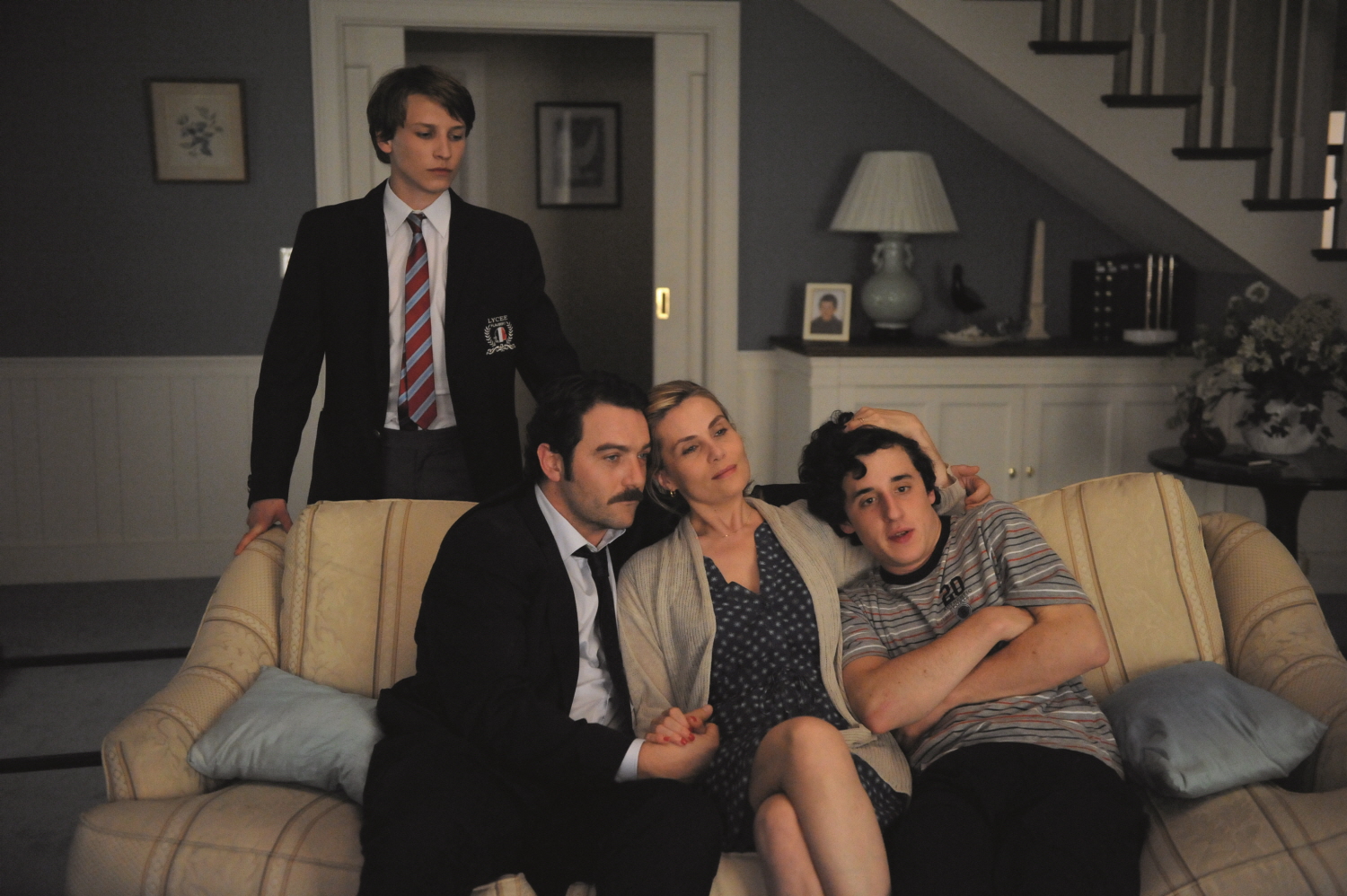
These are scenes from the film in a state where the distinction between 'reality' and 'novel' (the story, the fictional) has become blurred: the left scene is the part where Claude writes in his novel that he kisses Esther, and Germain, without asking whether this is 'fact' or merely 'novel,' gives his critique of this scene; the right scene is the one Claude wrapped up as the ending of his novel, saying that because it was a 'harmonious family,' there was no space for him to infiltrate. (Of course, the novel within the film does not end with this scene.)
To Germain, who later lamented that his own past ended without 'talent,' Claude-who, though his immediate craftsmanship may be somewhat lacking, possesses tremendous narrative ability and expressiveness-was surely an object he both envied and wanted to teach. The student ends up stealing a math test in order to gain entry to 'Esther's' house, and later receives expulsion from the school because of this, but I think in those very moments Germain wanted to teach his student everything he could impart. The 'narcissism' of regarding his student's talent as his own appears precisely here. To Germain, who treated Claude like his own child as if it were his own affair, teaching with Claude's 'real'-seeming 'novel' stories seemed more fun than dull, boring classes.

The film's second focus is precisely 'Eros.' I could tell from the very start of the film, from the writing Claude submitted as the result of Germain's assignment: Claude feels Eros toward 'Esther,' the mother of his friend Rapha. The Eros that appears in the passages-the part expressing how an unknown lavender scent flowing from the room embraced him, or the phrase about the 'alien beauty' he feels in Esther trying to hang a curtain on the window-can be called 'desire put into words,' and the visual beauty came from the cut spotlighting the thigh slightly above the knee revealed as Esther lies on the sofa in a skirt. Also, Eros appeared in the sight of her spraying 'perfume.'
Before watching this film, I had no idea at all what kind of 'scene' filmmakers want to express as Eros, but it was after I came to know through watching the 'Lust, Caution' episode of the good movie, by way of Tang Wei spraying perfume on herself, and I realized that scenes with a feeling similar to what I saw then appear quite often in the film 'In the House.' I think the director faithfully made it so that, taking the most basic human desire, it can only be achieved by making it into a 'novel' through a 'taboo setting.' On top of that, Esther does not leave her family at the end. Though she isn't very happy at home, there is something sticky there. Claude probably did not desire love from Esther as a 'woman.' Because Claude has no mother, he has never experienced what 'maternal love' is, and he wanted to receive it through 'Esther,' the unhappy woman within a perfect family. He craved maternal love under the name of Eros, but in the end he could only watch Esther as she moved away.

The last thing that is hard to speak of with certainty is precisely Germain's wife 'Jeanne.' She has been with Germain for a long time but sadly has no child (my guess after watching the whole film is that Germain has a problem with sexual function, or there were miscarriages... the exact reason isn't mentioned so I can't know either, but through the 'hint' at the end of the film that Claude and Jeanne slept together, it's in fact hard to judge that Jeanne has a sexual-function problem). The fact that the gallery she runs was also on the verge of disappearing means the film unfolded in a situation where 'danger' was fundamentally laid down. Also, the fact that throughout the film Germain doesn't feel Jeanne's 'crisis of survival' very desperately could be a hint, if anything... it's a part I'd like to watch again and try to understand if I get the chance next time. One thing: there is the conjecture that Jeanne, too, may have 'loved' Claude to some degree.
I couldn't give up on this film just because it was a thriller, and the result was positive as I'd thought. Throughout, my heart felt like it would tear, but because it wasn't as cruel as 'Blind,' which I saw last time, I could watch it relatively while smiling, and perhaps because my eye for watching films has been much upgraded compared to before, I feel the breadth of what I can understand has also increased. And once again, French classrooms seemed to have an 'unadorned beauty' different from Korean classrooms.
Comments 0
No comments yet. Be the first.