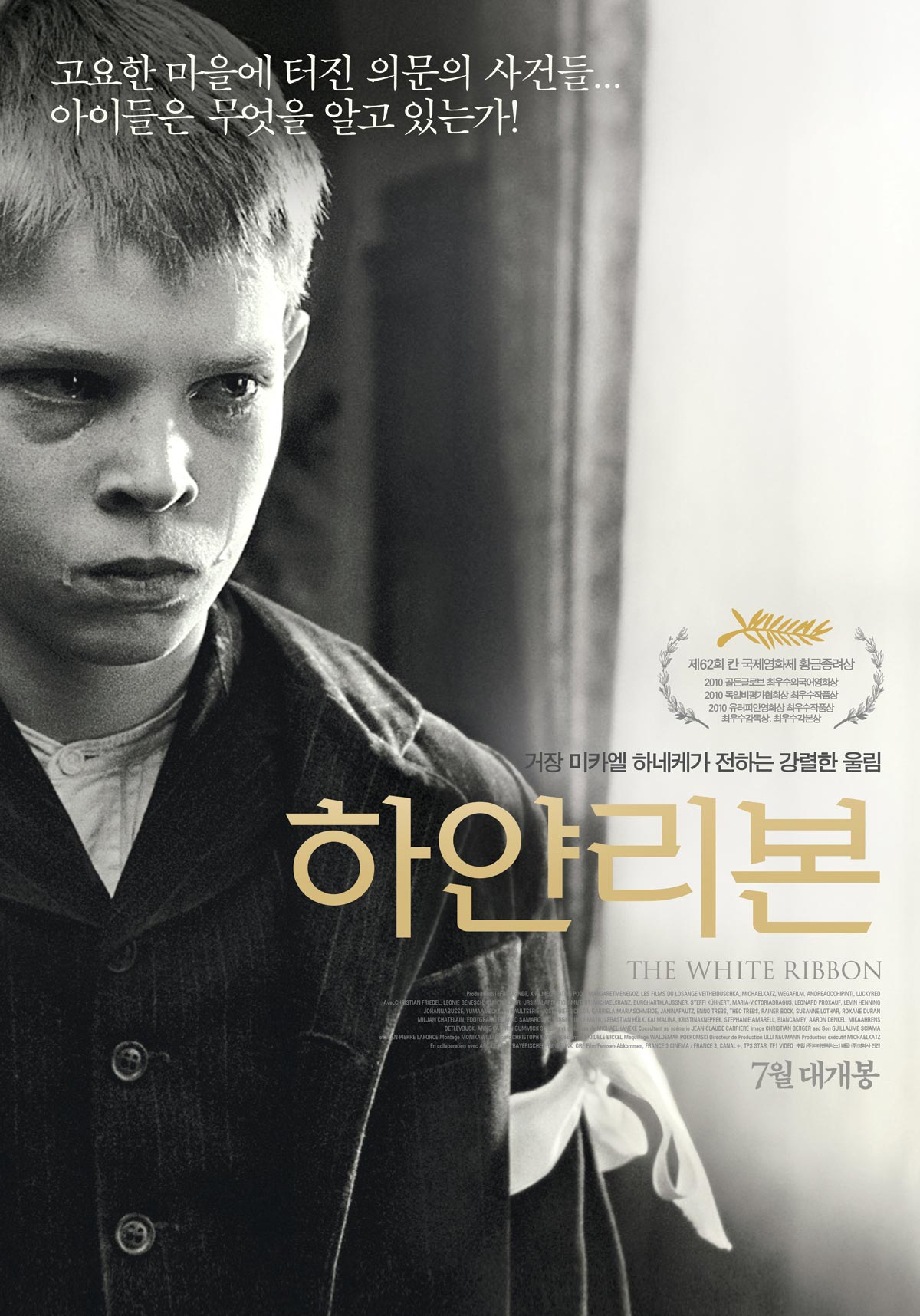
The White Ribbon (2010)
The White Ribbon
7.2
- Director
- Michael Haneke
- Cast
- Christian Friedel, Leonie Benesch, Ernst Jacobi, Ulrich Tukur, Ursina Lardi
- Info
- Thriller | Austria, France, Germany, Italy | 144 min | 2010-07-01
I have a memory of encountering Director Haneke's work before through 'Amour.' I had also heard of a film called 'The Piano Teacher,' based on Elfriede Jelinek's novel 'The Piano Teacher.' Such a Haneke is one of the few 'art directors' sought out at the Cannes Film Festival, solidifying his own creative world and directing style, and he is a director who has done so all along. Haneke makes films using a directing style different from existing Hollywood commercial films, in order not to 'deliver' his story but to 'communicate' it. Today I'd like to talk about that director's 'The White Ribbon' (Das weiße Band), winner of the Palme d'Or at the 2009 Cannes Film Festival.
I hadn't originally intended to watch exactly this film; while reading Hannah Arendt's 'The Origins of Totalitarianism,' this film came up, and since it happened to be a story about the period before 'totalitarianism,' I chose it. The content was difficult and the film was no fun — it really was a difficult, difficult film.
This film uses 'narration' from start to finish. The reason the director put such a 'narrating' device into the film is to use the 'distancing technique.' The distancing technique plays the role of obstructing the audience's complete emotional immersion in the film while at the same time letting them perceive the work 'objectively.' Director Michael Haneke does not want a simple audience that merely accepts the 'film' the director shows. He wants an 'active audience' — that is, an audience that communicates with the maker. But this technique has the downside of making the audience feel the film is different from ordinary films, making it hard to immerse oneself in it. In fact, the other people who watched the film with me did not show only positive reactions to the film's 'narration.' They lamented that the film was already difficult, and the 'commentary' that wasn't really commentary made it even more difficult... (it's my fault for choosing the wrong film..)
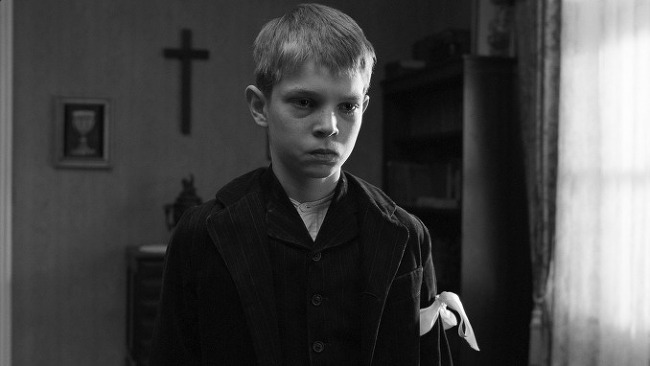
So, let's start by talking about the title. 'The White Ribbon' is an item object that carries 'symbolism.' Because of fashion I kept saying 'item, item,' and it's become a habit, so it horrifies me that it comes out like this. Hahaha.....let's use Korean. Anyway, what this white ribbon symbolizes, put kindly, is 'purity,' and put harshly, you could say it's the coercion of obedience to discipline. What 'the white ribbon' shows in this film is that there's something felt even though it never once mentions the something latent in the children tying on these white ribbons. This film keeps its focus on the 'children' from beginning to end. The consequences of the problems mostly fall on the children.
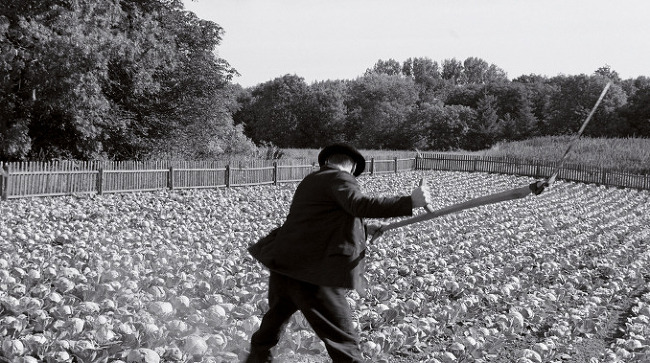
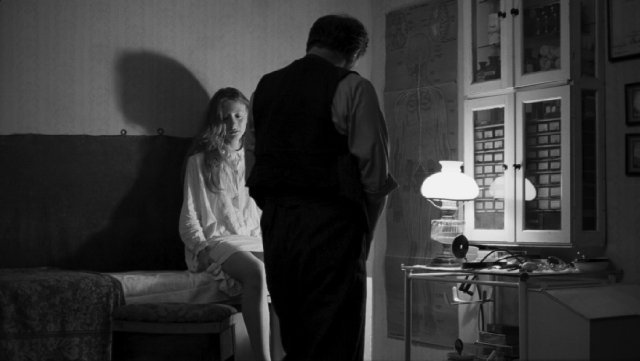
The series of events — the cabbage field being plowed under, a child being beaten by his father, eyes being gouged out and someone being blinded, someone having to go away to recuperate after a severe beating, someone being molested by her father — make it possible to know that an 'implicit' immorality is spread throughout this whole village.
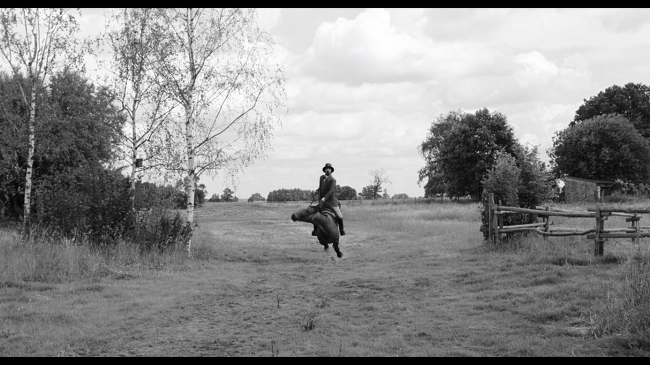
The film begins as the doctor's horse happens to trip over a wire and falls, and unfolds from there. Due to this incident the doctor suffers a serious collarbone injury, and the children come in a group to the house where this doctor lives to pay a 'visit of respects.' But even that greeting begins with throwing a stone at the window. It's truly absurd. On top of that, the doctor's daughter doesn't much welcome those children. Toward the children who came in a group, the narrator says that 'the children, who usually scattered, were gathering together.' The narrator is the teacher. The schoolteacher.
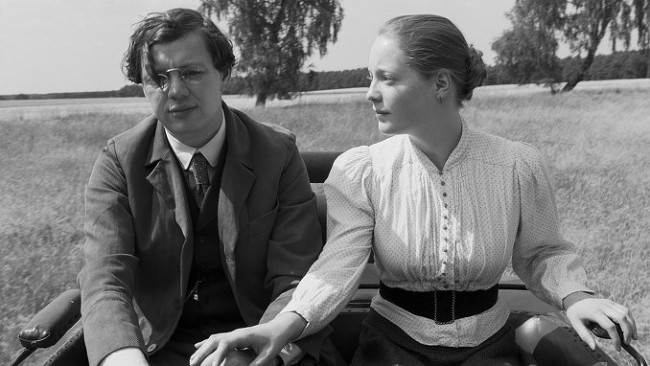
It is the schoolteacher, having grown old, narrating the story of when he was in that region back then. This schoolteacher you see on the left writes, having grown old, while thinking about the 'strange atmosphere' of that village at the time. Through the schoolteacher, we come to view this film with 'distance.' The schoolteacher is not someone who makes tireless efforts to solve this case. But by the end of the film, one ends up asking whether, after all, the 'children' weren't the culprits. We go straight to the 'pastor,' a devout Protestant.
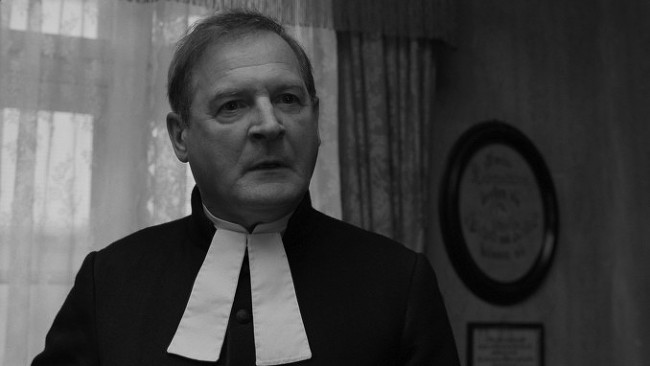
In this film, the father who is a 'pastor' signifies the authority figure and discipline itself. If this father's conduct collapses, there's a strong chance the whole household's ethics, and even the village, could collapse. The reason is simple. Coercing 'obedience' is possible only when one thinks oneself that perfect. The pastor father makes his son Martin obey by telling him that if he 'masturbates' he will die. He forbids his daughter Klara from staying out late playing. It's about thoroughly obeying 'Dad's' words. With a very young child, this shows up like this.
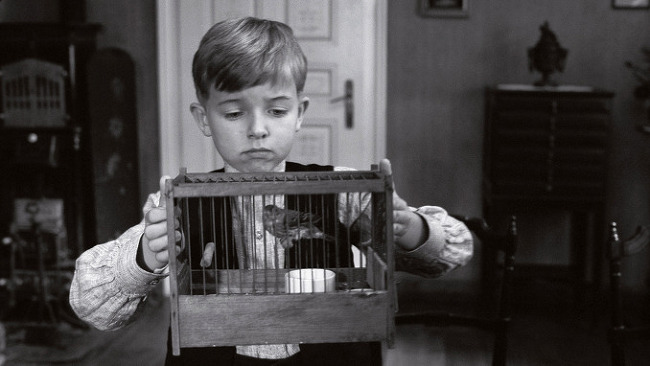
Klara killed Pixie, and since there was no bird, the youngest puts a sparrow — which he had once caught earlier to nurse it — into a birdcage and brings it. And that, too, for 'Father.' One comes to wonder whether this is really right. The film, throughout, speaks about the 'father'-centered patriarchy itself and the education that takes place within it. Eva's home shows a marriage problem, Anna's household the 'molestation problem,' Klara and Martin the problems of 'obedience' and 'chastity,' the baron's house 'indifference' and the supremacy of the husband's power, and the Georg household too shows its problem through the 'flute.'
A Wilhelmine-era society where none of them look happy and there is only unspoken violence, where 'the white ribbon' is enforced — through this film Michael Haneke begins a deep-rooted insight into the 'Nazism' that would bring about World War II. Nazism is an ideology designed to be assented to. Such totalitarianism was supported more by the proletariat than by the bourgeoisie, in particular. The proletariat had already lost hope in reality, and under those circumstances Nazism — which, rather, presented an even more unrealistic alternative — was a very attractive option, and that obedience can be found in 'Protestantism,' the 'historical background.'
In terms of technique, he realized an aesthetic obtained by 'distancing' and by restraining sound. In his recent work 'Amour' too, no sound at all played in the film's opening and ending parts, so I was a bit bewildered. 'Spider-Man,' the film I love most among the films I remember, always put its distinctive opening song at the beginning. (Of course, not Andrew Garfield's Spider-Man, but Tobey Maguire's Spider-Man.) The ending too was wrapped up with an outro, but Michael Haneke was famous from the start for restraining 'sound.' Given that he once considered a career in a music-related field, it seems he agonized a great deal over how best to put in sound.
This film mainly features 'the sound of beating,' 'the sound of music,' 'dialogue,' and 'the sound of mass,' and the sound of beating is never shown on screen but put in as sound through 'the side,' the sound of music under a somehow eerie backdrop, the 'dialogue' both basic and leading the film's narrative well, and the 'mass' realized as a sound that contrasts with the 'sense of dread' that flows, however faintly. I think the director fully displayed his ability. It is very important that things, restrained, come out only when needed. Because background music and 'dialogue' are core parts of how a message is conveyed. Wouldn't putting tense-mood music into a very tense scene versus putting cheerful-mood music be a difference of heaven and earth?
It was certainly hard to understand, but after gathering related materials I feel much better. Michael Haneke's works are worth watching going forward too. Ever since I watched 'Amour' last year, watching this director's works does, after all, bring a feeling that isn't entirely good.
Comments 0
No comments yet. Be the first.