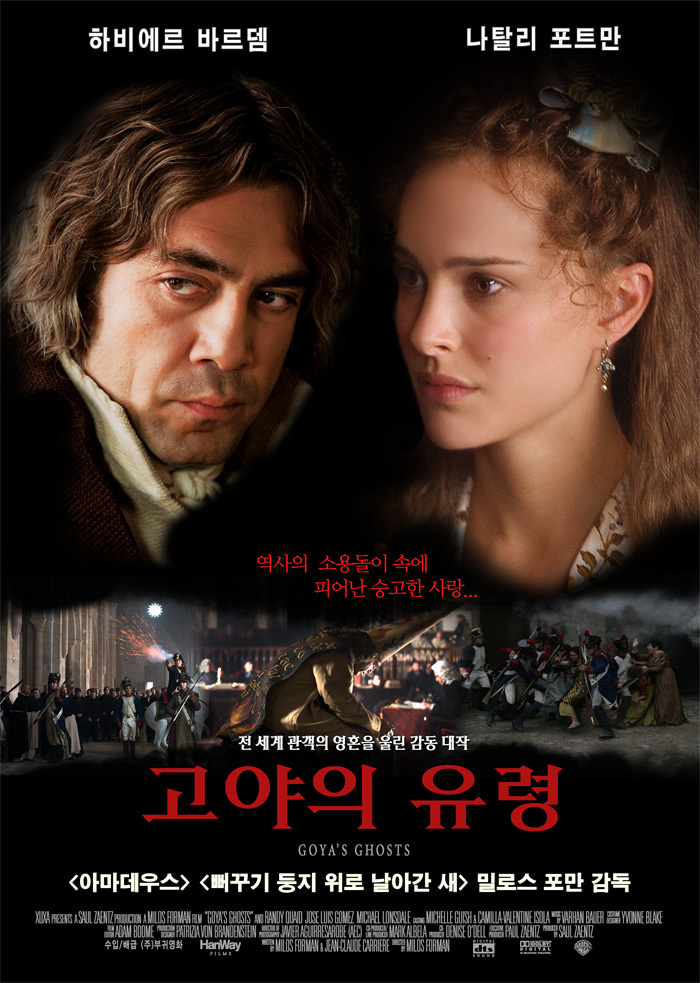
Goya's Ghosts (2008)
Goya's Ghosts
9.1
- Director
- Milos Forman
- Cast
- Javier Bardem, Natalie Portman, Stellan Skarsgard, Randy Quaid, Jose Luis Gomez
- Info
- Drama | Spain, USA | 113 min | 2008-04-03
The film was truly bold and intense. It was indeed a short stretch of time. Two hours was not enough to portray a painter. But in a way, I think this much was more than enough time to tell the story of Goya. For the first time in a long while, truly a long while, I threw my body and soul into the narrative that swept by without pause for 120 minutes and lost myself in the film. Knowing the paintings and having memories of the actors, I somehow felt I could approach the film more easily and understand it faster. With any film, the difference between watching it knowing its 'background' and watching it without is surely tied directly to one's understanding of the film itself.
The film's protagonists consist largely of four people.
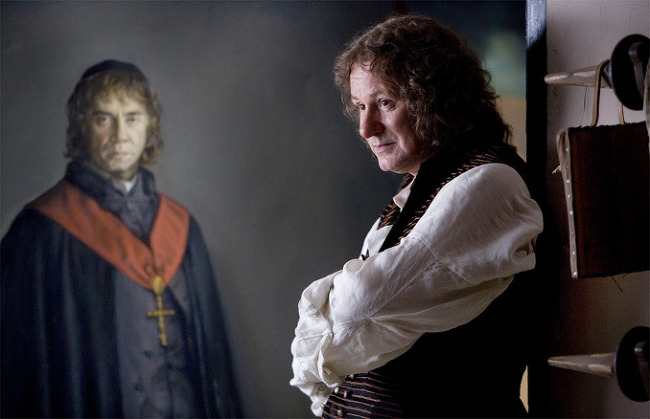
Goya
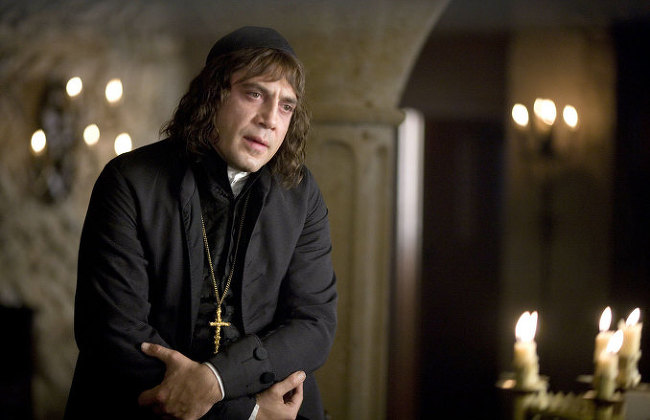
Lorenzo
Goya is the 'speaker,' the 'narrator,' and the 'observer' who carries the film's narrative. He becomes the eyes of the audience. Throughout the film we are made unable to see except through Goya's gaze. Since the very title of the film is 'Goya's Ghosts,' leaving out this Goya makes narrative development impossible. The era spans from before to after the French Revolution. The French Revolution broke out in Paris, France, in 1789, and nine years later, when the wind of revolution swept into Spain as well, and 'father'-that is, the priest Lorenzo-came to Spain as an officer of the revolutionary army, the film's narrative begins to spin urgently. The painting 'The Third of May 1808,' which he painted at the age of 62, can be said to depict the era's extremely complex Spanish situation very sharply.
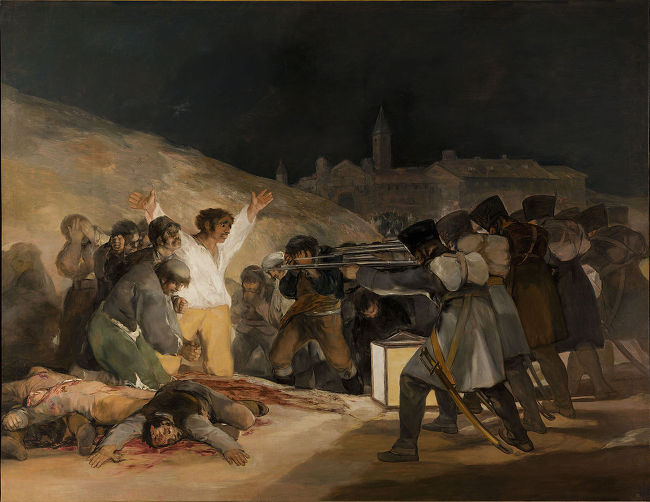
The Third of May 1808, depicting Spain during the French Revolution,
As shown above, the spread of the French Revolution to Spain did not have only a 'positive side.' Of course, the three values of the Declaration of Rights centered on Napoleon-'liberty, equality, fraternity'-contained a very important and great value beyond anything else: that the 'people' and 'citizens,' not the 'king,' are now the center. But that does not mean it was not chaos for Spain. The French Revolution, which arrived never peacefully but accompanied by killing-the violence of the 'French Revolution' as seen by the hearing-impaired Goya can be said to have been expressed as above.
In the film, since the French Revolution abolishes the 'Inquisition,' it frees 'Ines,' who had been imprisoned within it, so it can be seen as half a positive image; but even that-judging from the home Ines goes to and the fact that her whole family is dead-the way the situation of so many people at the time losing family and friends is expressed through the character 'Ines' could be evaluated very highly.
Goya, as a court painter, paints the wife of Charles IV, paints his 'muse' 'Ines,' and paints the priest 'Lorenzo.' But as 'Lorenzo' says, what one sees of oneself and how others see me are different; when the queen sees the portrait he painted of her, her expression hardens and Goya falls into an awkward situation. But as the monarchy collapses due to the revolution and a revolutionary government takes power, he no longer has problems with the 'royal family'; yet the 'French Revolution' he watches after losing his hearing makes him express, through painting, some more inner place, something in the deep abyss of his heart, and provides the groundwork for his series 'The Disasters of War' to emerge.
He captured the inner world of the figures he painted with his distinctive technique. For Goya, who well captured a figure's character and personal traits, his techniques could not but appear in his paintings, and because of this I think he was able to depict well, as in the film, the difference between the self he sees and the 'self that others see.' That is why I believe the film showed the 'awkward situation' (the scene where the queen, angered upon seeing her own portrait, goes inside).
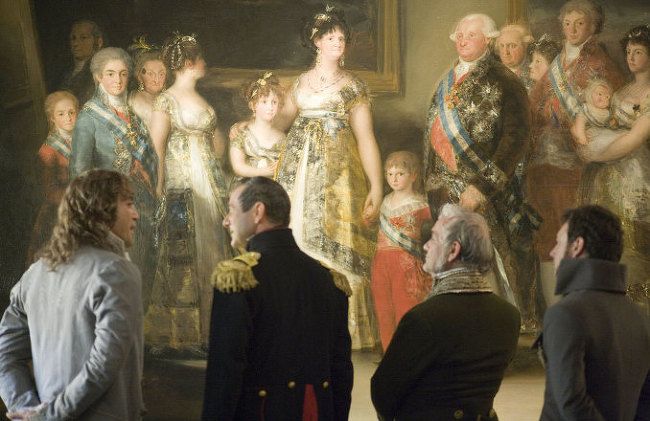
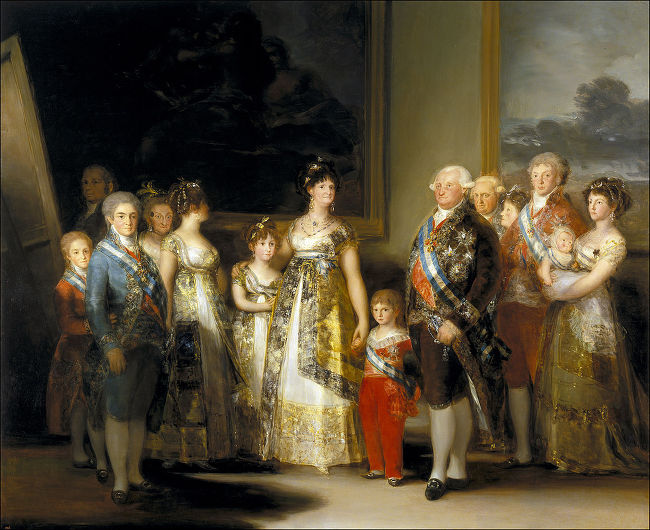
Charles IV and his family
Lorenzo is a figure who is hard to know how to interpret. In the film, in the situation where, by his own hand, he begins rooting out heretics and throwing them into the Inquisition's prison, he caves head-on to the fact that the 'faith' he advocates can be overtaken by 'pain,' and flees to France. Later, he comes back to Spain as an officer of the revolutionary army, and meeting the 'bishop' from whom he had once demanded that 'Ines' be released makes one ponder his fate, both accidental and inevitable.
Lorenzo, who was once a father, a 'priest,' is an 'officer' who still remembers the day he escaped, regarding the claims he had advocated, through a merchant named 'Tomas.' In the past, holding the values of 'religion' and 'God' as supreme, he proposed to remember and later throw into the Inquisition those who say humans are made of atoms, and he calls 'Voltaire's' ideas nonsense. Behind such a man, there was a side that could not restrain his instincts while offering to pray together with Ines. Also, suffering at the hands of Ines's father, he breaks his own word and engraves his signature on a paper stating that religion is absurd nonsense.
What a two-faced figure he is. But I think this properly dug into the 'priests' of the time. Although the Reformation occurred through the 16th-17th centuries, Spain was almost an exception. The regions caught in the whirlwind of the Reformation were those centered on Germany, Austria, and Switzerland, not at all applicable to France and Spain. This can be understood by looking at how, at the end of the 19th century when the Dreyfus Affair occurred, all but one-tenth of France's population was 'Catholic.' Both then and at the time, Catholicism was dominant. Only this 'Catholicism,' having stagnated and stagnated, rotted, and this is destroyed by the rotten priest 'Lorenzo.' Just as Oedipus kills his own father, Lorenzo tears down his own past values and engraves the 'new values'-namely, 'liberty, equality, fraternity'-onto Spanish soil along with blood.
Lorenzo, who dreams of a new world by reason through 'Voltaire' and 'Rousseau,' ultimately, along with the 'restoration of the monarchy' by Wellington, does not yield even to the Spanish bishop's words that he would be taken back if he repented, and chooses death. Before corrupted religion, Lorenzo himself was a 'changed' religious man, but in the end, through the act of keeping his own convictions, he himself shows that a society ruled no longer by 'religion' but by 'reason' has arrived.
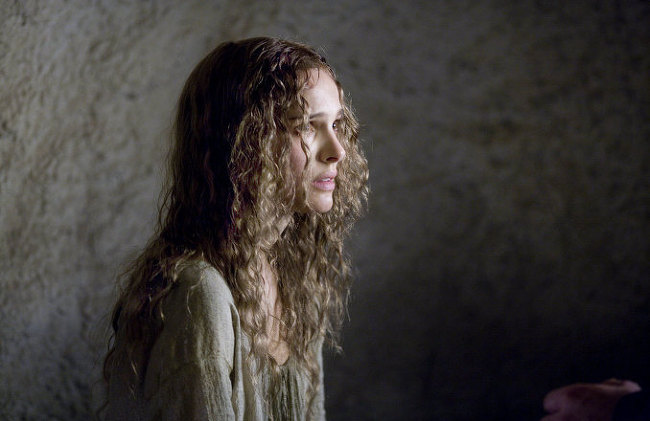
Ines
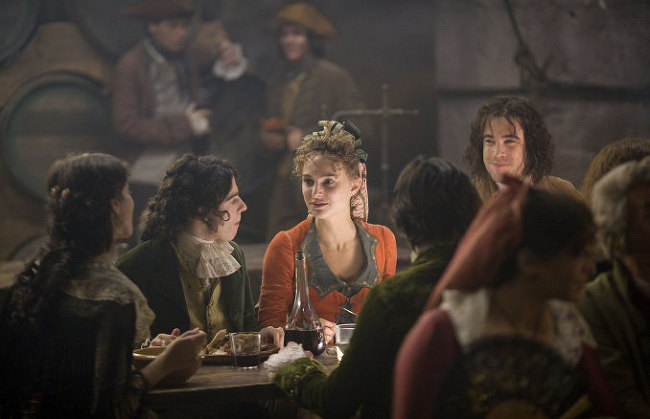
Alicia
Ines and Alicia are in a mother-daughter relationship, but in the film Natalie Portman handled both roles alone. (Truly, every work Natalie Portman appears in makes me think she is amazing each time I watch, and makes me deeply doubt where the limits of her ability lie. I think I can now distinguish how she differs from Keira Knightley.) From 'Leon' to 'V for Vendetta' to 'Black Swan'-of course this work falls between those-in any case, Natalie Portman's acting is truly remarkable. Watching the film with my mother, I thought 'Ines' looked like Natalie Portman and asked my mother if that actress wasn't Natalie Portman; my mother said she didn't think so, but she was right-it was. It is indeed Natalie Portman.
Goya, saying he is currently painting a 'witch' as he looks at Ines-Ines is a 'muse' to Goya, but after confessing under 'torture' that she believed in Judaism, she is imprisoned in the Inquisition. To get her out, the Tomas family tries various avenues but fails again and again. In the end, as mentioned above, Ines is freed from prison by the French revolutionary army, and she confesses to Goya that all that remains to her is her daughter.
Goya, having met Lorenzo who arrived with the revolution, asks whether he remembers 'Ines' and strives in every direction to find 'Alicia,' the daughter of Ines and Lorenzo. But in the end Lorenzo, fearing 'Alicia' would harm his career, keeps the two apart, prevents them from meeting, and Alicia makes a British officer her husband and leaves.
For the first time in a while, this film made me think about how the more background knowledge one has about a film, the broader one's understanding becomes. Lately my interest in art had been growing again, and through this film it was also good to think, apart from the 'Impressionist' works that had been on my mind recently, about the works of 17th- and 18th-century painters like Velazquez and Goya. I also realized that watching a 'period piece' may be more rewarding than watching a 'fantasy' one knows nothing about, and the director's framing, sharply depicting the inner world, was good too.
Comments 0
No comments yet. Be the first.