I will not tell this in the order the film's story unfolds (it'll be quite a reverse-chronological arrangement..) and it may contain many spoilers.
I'm a fan of Amy Adams. Ever since she appeared in 'Julie & Julia,' from the time I watched that film, I became her fan. She's one of the few foreign actresses who really gives me the feeling of a 'real actress.' I find actresses like Megan Fox too much in that way, and while actresses like 'Tilda Swinton' strike me as remarkable, I'm not a fan. But with Amy Adams, maybe it's because she has the 'atmosphere' I prefer — I've never once been able to erase the thought that she's quite wonderful in many ways.
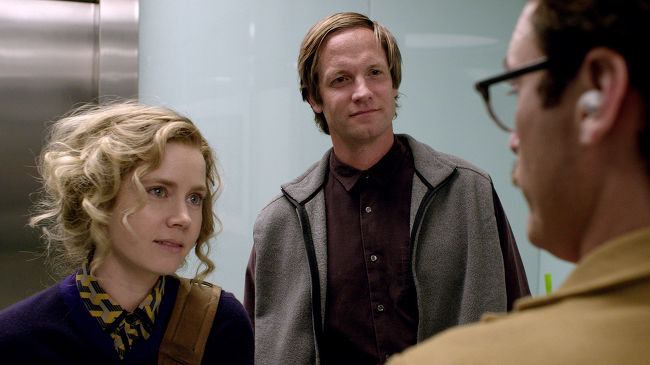
I think she's most beautiful when her makeup is light like that. It feels a bit odd to only talk about the actress herself before getting to the film, but in the film, 'Amy' — though different from the OS, Samantha, that Theodore falls in love with — is a really 'good friend,' a very important presence. A true friend in reality, you might say; her situation comes to resemble his (as she divorces Charlie), and she too begins talking with an OS and gets the feeling that the OS is quite nice — which is also the same as Theodore. The differences are that one is a 'man' and one is a 'woman,' and that while Theodore falls in love with his OS, Amy does not. I'll only go this far in talking about the actress 'Amy Adams,' and move on to the main subject.
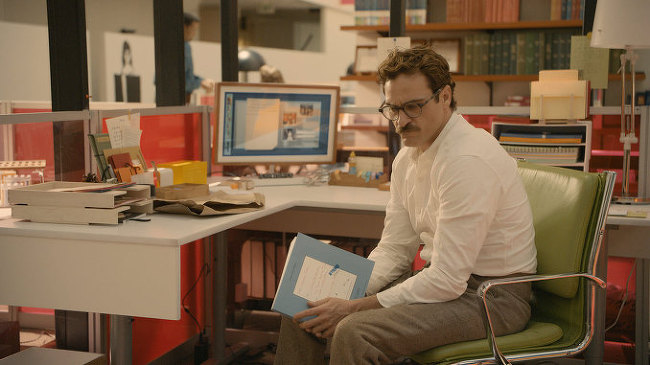
The protagonist Theodore (Joaquin Phoenix) is the actor who once played 'Commodus' in Gladiator. This actor has now grown out his beard like that, so you can't see any of his appearance from back then at all, and naturally he's also aged nearly 20 years compared to then — but just keep that in mind. Theodore is a quite capable person who works at a 'beautiful handwritten letter company.' His letters move people. The society in the film already shows a somewhat 'realistic future.' A society where voice recognition is nearly 'perfect' is the film's setting. Through earphones that look like earplugs he reads and replies to email, and the computer and program at his workplace write 'cursive' letters just as Theodore dictates; moreover, the phone has touchscreen displays on two sides, can fold, and even has a camera. On top of that, I never once saw this phone being charged. (How unrealistic!) That 'Theodore' is a 'soon-to-be-single again' man going through divorce proceedings.
Having lived with his ex-wife (Catherine) since graduate school, he had spent a very happy life through 'marriage' (it couldn't have been only happy, but he shows an attitude of having been mostly 'satisfied' with marriage itself); at his wife's request, he begins divorce proceedings. As a viewer, the somewhat frustrating thing is that there were too few scenes of 'Catherine' and 'Theodore' fighting. In that sense, the director achieved his own intention well — that in this film, rather than making us think about the 'quarrels' between Catherine and Theodore or the 'reasons for the divorce,' he wanted to depict Theodore falling in love with the 'OS.' Throughout the film, the 'man' and 'woman' who mainly converse are Theodore and the OS (Samantha). In other words, what catches the wandering Theodore (the protagonist, me) is not a 'really existing person,' but a brain system.
After getting off work, wandering around aimlessly, Theodore sees an advertisement for an AI-based OS on a billboard, orders the program, and the relationship with the OS — begun with a somewhat unfriendly questionnaire — flows in a not-bad direction. (To briefly summarize the ad's tagline, it goes like this: We don't know where to go or what to do. So buy our OS!!) Whether it's the scene of watching the ad, the scene of climbing the subway station stairs, or simply walking on the street, 'alienation' appears throughout the film. It depicts a society where, though one is among a 'crowd,' the people one talks to are one or two — or an OS. Modern society now, too, walks along touching something (mostly a smartphone). We never look 'ahead,' and we communicate through machines. But within that, Theodore realizes that the one he ends up talking to may often be an OS rather than a 'person.' An OS that has hundreds of 'loved ones' besides himself is different from a person. Because of this, the conversation between them went well, but the OS can never understand the human (Theodore) trying to monopolize a 'loved one.' Just as Theodore says to the OS, 'How can you feel emotions when you have no physical substance?', the OS says that because it is an OS, it talks with many people at once and loves many people at once.
I don't think of this film as a fantasy film. It's something that could entirely happen in the near future. Human relationships are growing ever shallower. Even relationships with people I think are deep may not be so when those people think about it. A 'lightness' qualitatively different from the lightness 'Milan Kundera' spoke of through 'The Unbearable Lightness of Being' is ruling society; can we create light relationships that are not merely light? In that sense, the OS, Samantha, can't help but be the most realistic alternative for people. As Amy says, we 'don't know far too much' not only about relationships between people but about the world. Even Amy, whom Theodore considered to be doing fine in relationships, has difficulty in her relationships with people. (Amy confides that the starting point of her 'divorce' was over how to put her slippers down when she came home. Charlie wanted them neatly arranged, and Amy wanted to just toss them down and rest.) A 'relationship' is an invisible something into which one must pour a great deal of effort, and to people worn out within those relationships, the OS is the most attractive, the least demanding, relatively tailored to oneself — a very fine 'person-like person.'
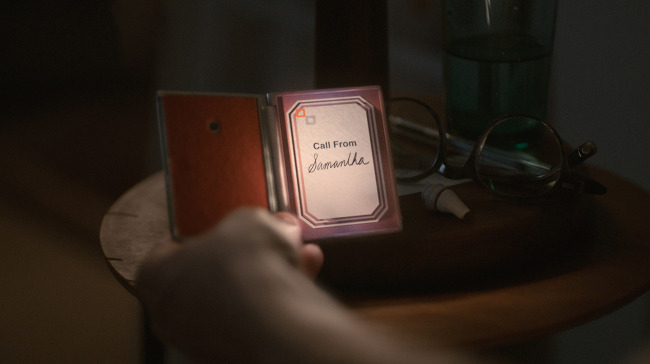
A downside? Should I call it a downside — it's a bit hard to judge — but Samantha (the OS) comes to have sex with Theodore through sound, and Samantha (the OS), not satisfied with this, proposes a sex-partner arrangement through some woman she found on the internet who wants to be helpful to and step into our relationship (AI–Theodore). Theodore refuses, but Samantha pushes it, saying it's important to her. (At this point I think I discovered a somewhat different side of Samantha. Whereas before she had been as considerate of her partner as possible, at some moment she comes to continuously assert her own opinion — I think I saw an 'attitude' within a romantic relationship that could quite plausibly occur in reality.) In the end Theodore reluctantly agrees, but feeling far too uncomfortable, he has no choice but to end the encounter at the foreplay stage. Of course, the woman is hurt too, and Samantha is sorry. While recognizing that it's hard to make the unrealistic real, and that there is a 'wall' that cannot be crossed, Theodore is at a loss and struggles. But paradoxically, he lacks the wherewithal to find someone suited to him other than Samantha. He seems to have only a few friends (Amy is the only one shown contacting him), and he is clumsy at expressing his own feelings, too — recalling his own memory of saying he wasn't angry even when he was, while married to Catherine. But that can happen. If everyone perfectly expressed their own feelings (without hurting others), products like soap operas couldn't have high ratings. But some people express their feelings through rough expressions, and some pour out their feelings with gentle words. And some can't even do that and just suffer in silence. This is a trait that 'people' have. So we shouldn't feel it's wrong, but Catherine found that hard, and Theodore couldn't resolve it within the given time. And so, in the process of setting out to find another love, there is 'Samantha,' and there is 'Amy' who walks alongside him. Perhaps, when Amy goes up to the rooftop with Theodore in the film's final scene, sits in a chair, and leans on Theodore's shoulder, it stands in for the words, 'I think I understand a little of how you feel.'
Throughout the film I thought about 'love.' Just how should it be defined? If I were to just write down my thoughts, they'd go like this. It can't be said that 'love' is not about finding the person you want. I'm the same. I too, thinking I've recently found the 'person I was looking for,' think of that person, contact them, talk with them, go to meet them, and miss them. And during all that, various thoughts arise.. I come to wonder whether I'm seeing the other person as the 'image I have in my mind.' I need to see not the 'image' I imagine but the 'truth.' I'm surely seeing only a part of that person. Of course, I'm grateful for the very fact that I can see even just that part..... Yesterday, the one I love said this: <'Dating' is sharing each other's lives.>
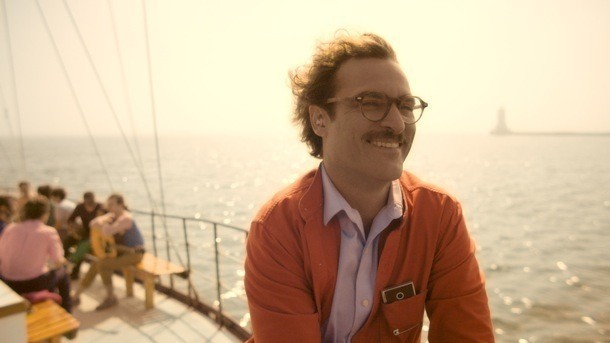
Within the film, the scene where the screen stays dark and they have sex only through 'sound' was a direct method that lets the audience 'empathize' with the film's content. If I were to give the highest marks among the 'techniques' used in this film, I think I'd talk about this part. That's how much the director made a well-constructed film, down to every bit of the script, sound, scene, and angle. Whether in the close-up of the scene where Theodore lies on his side in bed, or in the scene where he goes on a trip with a coworker and rides a boat in the breeze, his 'joy' was felt along with the bright light.
I close this piece by saying thank you to the person who comes to mind now that the film is over.
Comments 0
No comments yet. Be the first.