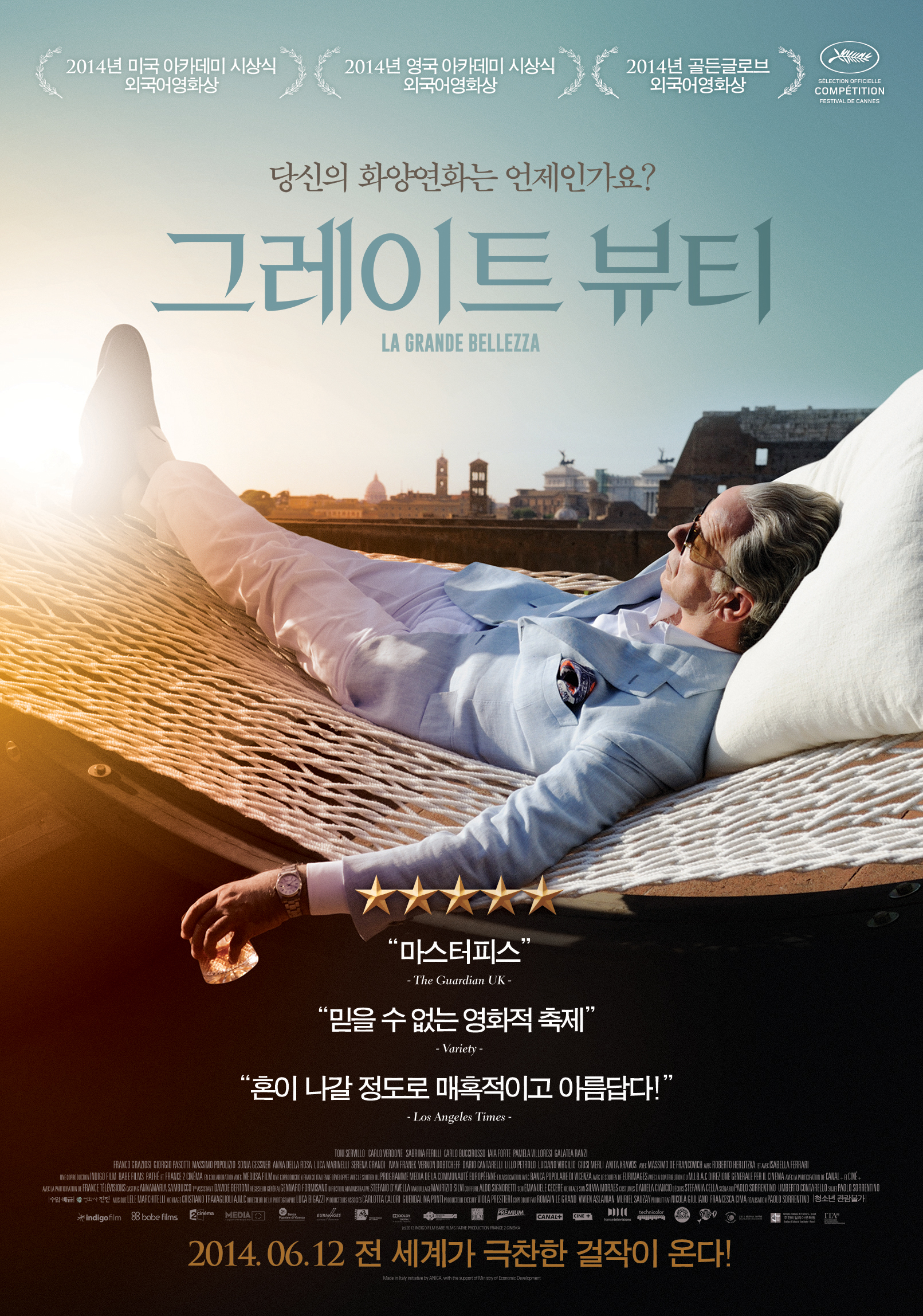
The Great Beauty (2014)
The Great Beauty
7.5
- Director
- Paolo Sorrentino
- Cast
- Toni Servillo, Sabrina Ferilli, Serena Grandi, Isabella Ferrari, Carlo Verdone
- Info
- Drama | Italy, France | 141 min | 2014-06-12
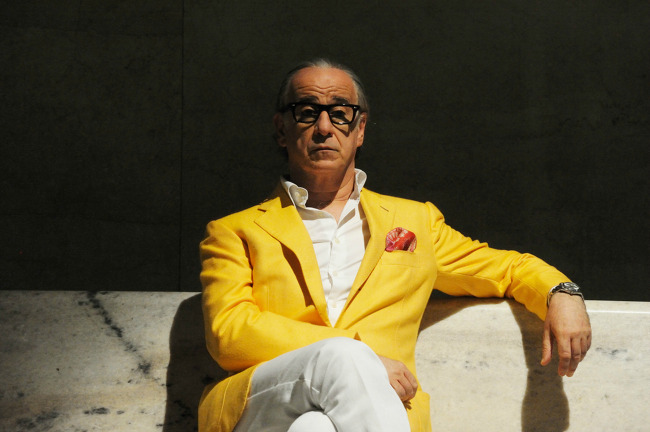
The imagery was so dazzling. The thought that came to me in the opening was that this film had set out, from beginning to end, to drive home an image of 'extravagance.' Of course the director succeeded at this, and I think he laid out a fine environment in which to speak about the great beauty—La grande bellezza—that stands in contrast to this 'extravagance' and 'splendor.' The protagonist who carries this story forward is none other than 'Jep Gambardella.' From start to finish, everything unfolds from his point of view. Jep (from here on I'll refer to him simply as 'Jep') belongs to the very uppermost of the upper class. After rising to fame in the Italian literary world with his novel 'The Human Apparatus,' he never wrote another single novel, and he begins his story by recalling the 'thing he loves most' that he pursues.
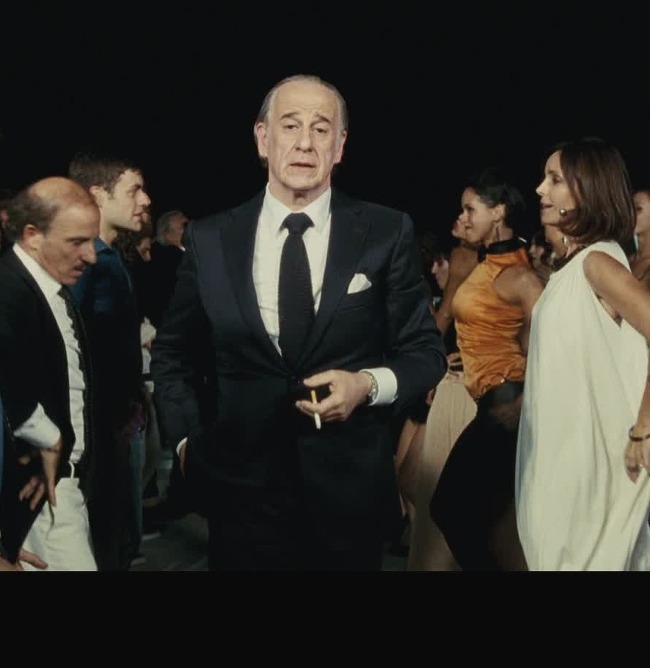
The film raises its curtain with this scene of Jep smoking a cigarette at a party. Jep's fundamental preoccupation was always directly tied to 'life.' The meditation on 'life' and 'death' runs through the entire film. The preoccupation one must never let go of from beginning to end while watching this film is presented right there in the 'opening.' The meditation on death, 'the smell of an old man's house'—these are things Jep talks and thinks about throughout the film. He likes not women but the smell of an old man's house, yet in one corner of his memory remains the memory of his first love, 'Elisa.' The teenage memory of nearly kissing Elisa on the seashore has become, ever since he began thinking about 'beauty,' the most beautiful moment of all.
The reason the film shows at its very start a passage from Céline's 'Journey to the End of the Night' is precisely that it suggests 'life' itself is a fiction. The phrase about the transience of life is exactly the kind that applies here. To begin by throwing out the notion that 'all of life is a fiction like a novel, a journey toward death' is to tell the same story of the 'lightness of life' I felt when reading The Unbearable Lightness of Being. The film speaks of a life without regret, yet a life that cannot help being a 'fiction,' and one whose end is 'death.'
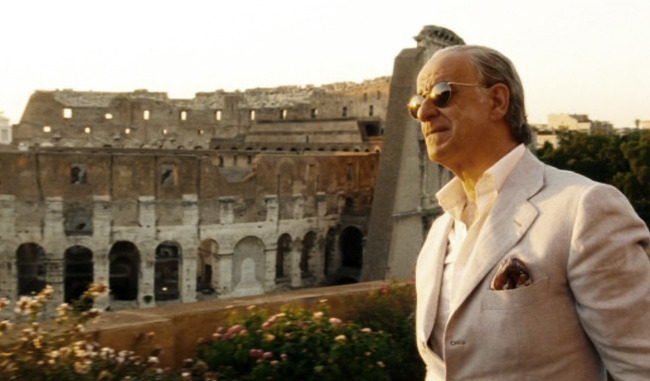
The film is divided into scenes of Jep's monologue as he strolls through the city, and scenes of dancing. The scene above is the part where he strolls through the city, and below is the scene where he dances with a woman at a party. Does Jep dance with these women because he has so much money? I don't think so. This much anyone can understand. People with a lot of money don't look at others through the lens of 'money.' Rather, they look at the person purely as a person. No matter how much money that person has or how much charity they've done, they look at and talk about the person's life itself. And thinking how rather insignificant he himself is, Jep says that 'we must console one another.'
There are a great many parties—the party celebrating Jep's birthday, parties hosted by Jep's friends, and so on—but each time it seemed Jep's purpose was not so much to attend the 'party' as to search for something else. As a line in the film puts it, in the heart of 'Jep,' who attends every party there is, there seemed to be a preoccupation and a thirst for 'beauty.'
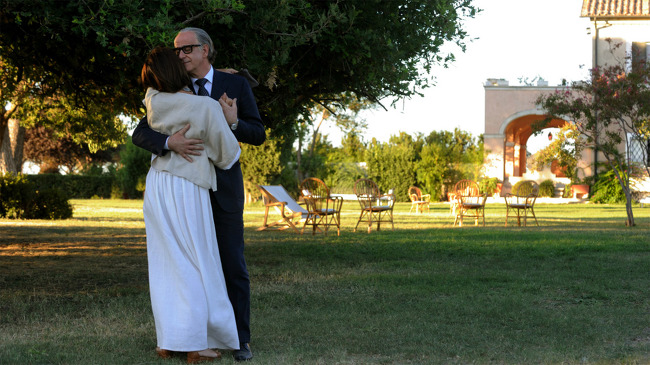
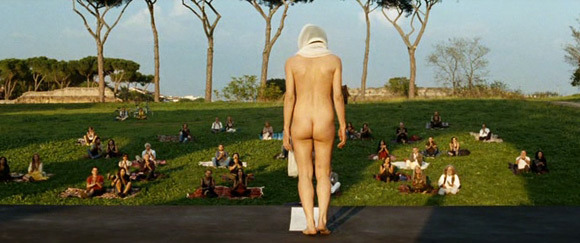
The reason Jep goes to the performance of a performance artist (the naked woman in the photo above is the artist) to talk about performance art, and to interview her about what kind of person she is and what she thinks, is that Jep is a 'celebrity' and a capable one. But even he begins to brood when he hears that 'Elisa,' his first love, has died—and when the story he hears from that first love's husband is that the 'husband' was merely a good companion, and that the person she loved her whole life was 'Jep.'
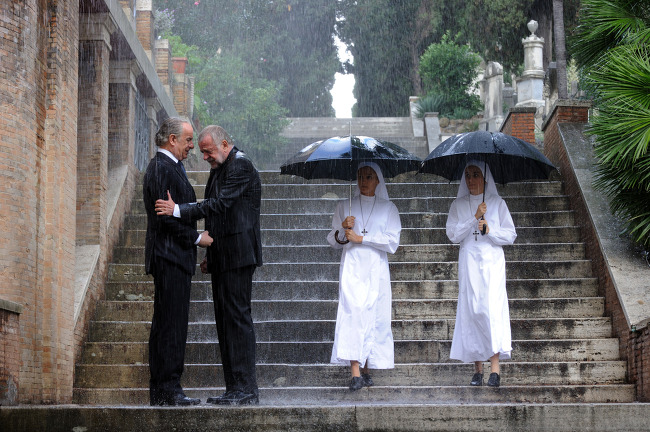
Beginning with Elisa's death, the people around Jep begin to die off one by one. An acquaintance's son, suffering from mental illness, chooses death himself (which is why the line comes up that a funeral hall is a 'social space'—and Jep even demonstrates, in person and with utterly perfect acting, how to behave at a funeral to 'Ramona,' who is trying to become a stripper in her forties). Ramona too eventually meets her death. Thus, facing one by one the facts that life ends in death after all, Jep begins to follow thought after thought.
It is not because he is at an age where one would brood over death this much. He is a man who, in life, has at any rate experienced all sorts of things that can be experienced through 'money.' Even though it isn't in the scenes I've included here, the scene at the 'plastic surgery specialty clinic' where even the nun seen below receives a procedure was downright shocking. The cosmetic surgeon alternates between various tools, performing procedures and operations on the areas each client needs, and right beside them they're tallying up how many euros it came to—and that strange nun who frequents the place too—everything of Rome is shown through 'Jep's' eyes. And in doing so, he realizes the meaninglessness of all things, and thinks about death, the end of life, and beauty, the flower of life.
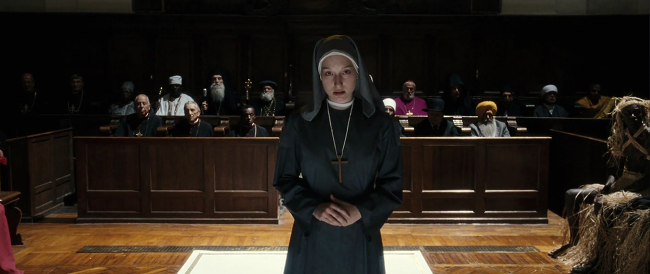
When word spreads that a saintly woman has come, even the nylon nun who pours money into visible beauty comes to see this holy woman, and behind her, on the left, sits a cardinal who fails to live a truthful life, while on the right sit figures from other religious circles—that scene made me think a great deal. The thought was: do the people who brood over what 'death' truly is really behave like that? But I already know the answer. Those people are ones who do not even try to find an answer to death, nor do they brood over it. Beyond the fact that people with status and money have gathered just to touch the hand of a 'famous person' once, I could feel nothing else. Is it that the wealthier people are, the less they brood over life the way 'Jep' does? Perhaps that's more comfortable. But I agree with Jep's way of thinking and his way of living, and I think one ought to live that way. 'Beauty' (and at the same time, brooding over death)—isn't it something not eternal, yet something one wants to experience at least once?
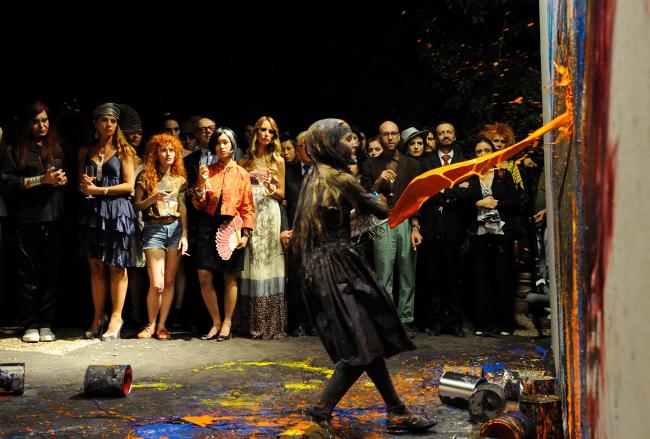
The party-goers who watch, with cigarettes and liquor and silence, the children wailing as they paint—no, as they express their own pain—stand in contrast to Jep and 'the forty-something stripper' Ramona. Ramona, watching this girl, leaves her seat because it is too sad. It must be because she felt the emotion of a child grieving over a situation in which she has to paint by force, with no joy at all and against her will. The parents, who came to earn money through the child's painting, kept forcing the child to paint, and even took her friends away from her; the painting she produces was indeed a color filled with sorrow. The fact that she covers herself in every color and ends up covered in black paint, and that the purpose of that painting is the hollow thing called 'money'—I felt this was truly a part that pricks at the spirit of the times. The audience thinks they are merely watching 'art,' but what lies behind it is very far from art. The director sharply pinpoints the people who, not knowing that even such a splendid painting is, in the end, a child's wailing, immerse themselves in and focus only on the dazzling colors visible on the surface.
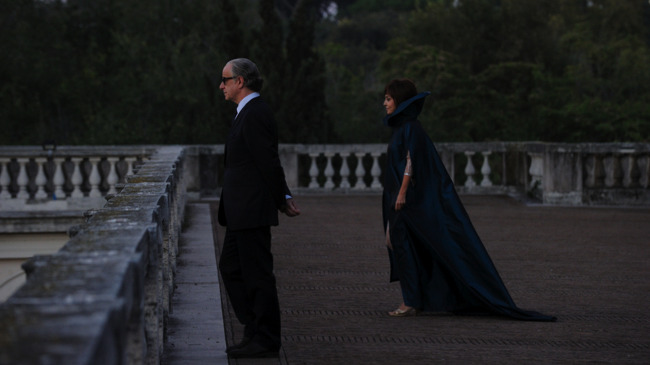
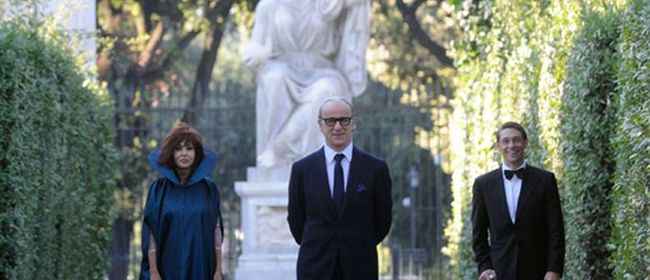
Apart from the film's content, I'd like to say that the scene of wandering through the garden of the Order with Ramona was the 'best' in the film. I didn't even know that such a place actually exists, so for a place not often opened to the public to appear like this through a film was truly magnificent. In particular, Ramona's heart changing as she gazes at these old works of art must have become a source of vitality for 'Jep.' Only for a moment, of course.
That young man who reddened his own body and finally took his own life concluded what sort of life he wished to live by choosing death early, and Ramona too brings her life to a close through death. But the holy woman still goes on living, asking herself questions and striving to find answers. Isn't there a need to brood and think about the meaning of life, which she tries to find even as she climbs the stairs? It must be a problem to ponder not just once but many times.
Just as the giraffe cannot be seen yet its sound is heard, the meditation on 'death' cannot be erased. It is something one must carry all one's life, and at the same time an utterly necessary act. And what can be found within that 'fiction of life' is precisely the value called beauty, and Jep merely found that beauty in 'Elisa,' whom he met in the youth of his teenage years.
What might the beauty or the death that I now know, or that I am now searching for, be like?
Comments 0
No comments yet. Be the first.