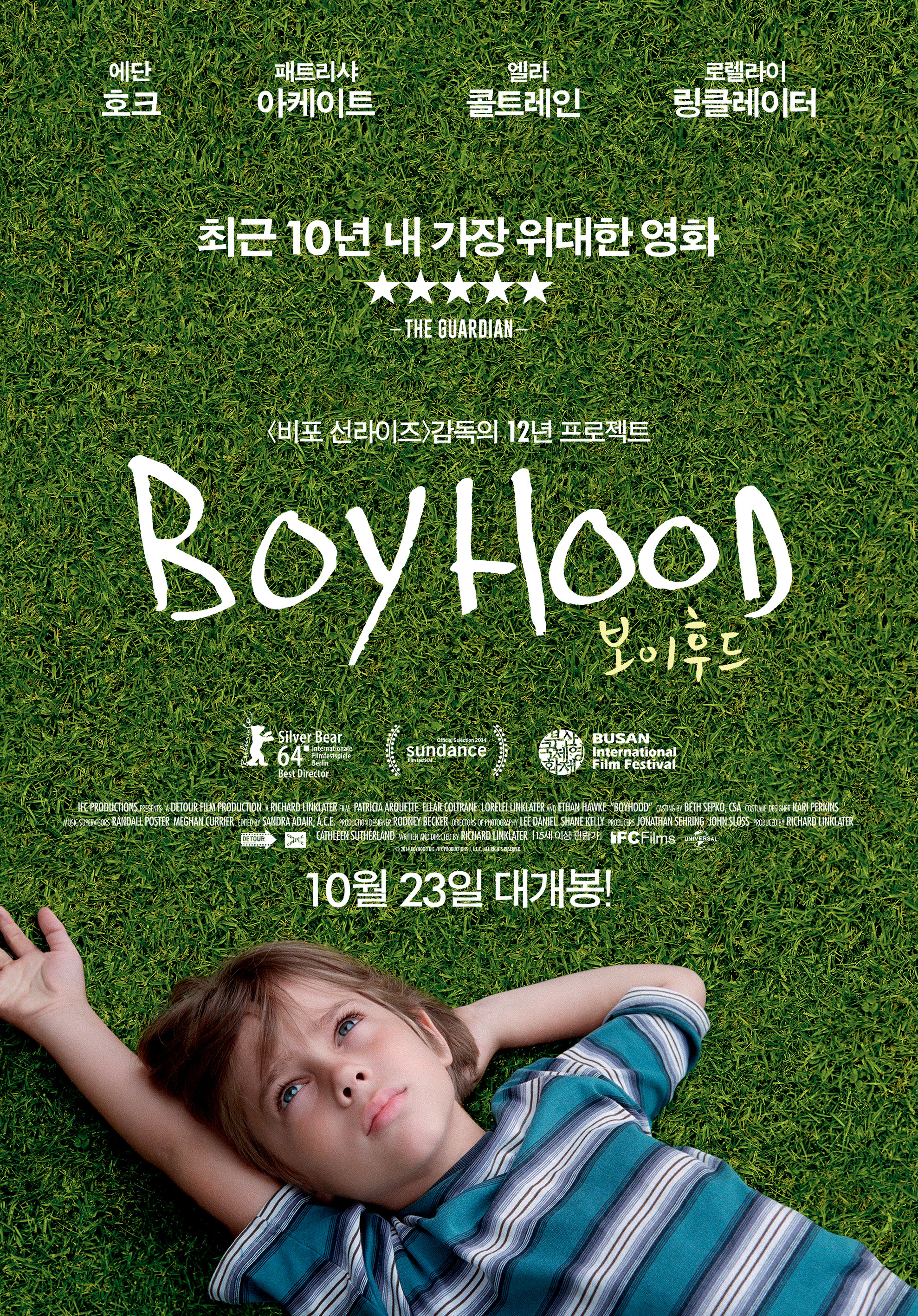
Boyhood (2014)
Boyhood
8.7
- Director
- Richard Linklater
- Cast
- Ellar Coltrane, Ethan Hawke, Patricia Arquette, Lorelei Linklater, Elijah Smith
- Info
- Drama | USA | 165 min | 2014-10-23
Before we begin. (I recommend reading this after you've finished watching the film. This is a film you absolutely must see!)
People talk to one another about what makes a good film. These days, Christopher Nolan's 'Interstellar' is one of those in the conversation. But I still haven't seen that film. Still, I found the answer to the question of what makes a good film in this one. Richard Linklater showed <just what kind of film is truly fresh and sensuous, a reflection of 'life,' and one that portrays it>. And he did so over more than two hours without a moment of boredom. The film for the review I'm writing today, having found a masterpiece for the first time in a while, is 'Boyhood'.
The director Richard Linklater is the filmmaker behind 'Before Sunrise / Before Sunset / Before Midnight,' which you've probably heard of at least once. These three works are famous for having been made at ten-year intervals. Ten years after Before Sunrise was made he shot Before Sunset, and another ten years after that he shot Before Midnight. Richard Linklater, who had shot films in an unprecedented serial format, made one more film in a similar form, and that is precisely this work, 'Boyhood'. This time I'd like to analyze the film in terms of 'technique' and 'content,' and wrap up with some asides and an overall verdict.
1. Technique
(1) Camera angles
Those who have seen Before Sunrise or Before Sunset are implicitly aware that Richard Linklater's framing basically does not capture large-scale shots. Richard Linklater is famous from the start for not taking shots with very wide angles. He fundamentally makes the best use of the close-up shot, and seems to even like it most of all. Considering that most scenes come out as bust shots, his close-ups are surely the natural method. I pondered for a while just why he uses close-ups like this, and the conclusion, as expected, was simple. It seems to be in order to show the characters' emotions, psychology, and expressions through close-ups, and to let the audience feel them.
In 'Boyhood' too, this director's signature cinematic technique continually appears. Even in the scene from Mason's childhood where he buries a dead bird, the director picks out Mason's expression, which seems steeped in sorrow, and even inside the car as the father, Mason, and Samantha drive together through the city, the director uses close-ups of faces to show their subtle inner states. When the father asks Samantha what her school life is like, when he asks what kind of art piece it is, and even when Mason Jr. turns around and asks his father a question, the director shows all of those expressions through close-ups. I'd like to call this series of 'techniques' a quality unique to Richard Linklater. Of course other directors are great too, but he basically seems to be very good at building a bridge that lets the audience share in what the 'people' in the film are thinking and what emotions they're feeling.
(2) The actors
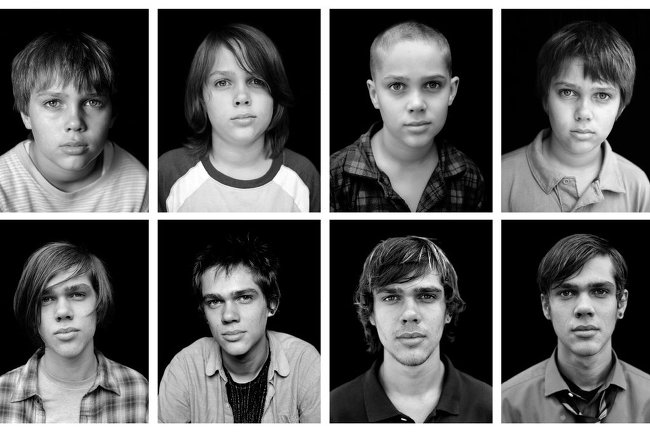
Above all, the most singular thing that occupies a major place in this film is that the main characters truly grow up. When Samantha sings 'oops i didn't again,' I started off thinking, how does such a little kid know all the choreography and the song, but as both Samantha and Mason are seen gradually growing up, I thought it was truly remarkable. It was reality itself, beyond any comparison to Park Hae-il dressing up as an aged 'old man' in 'Eungyo.' That feeling of aging myself as the main characters age—you could perhaps feel this if you binge-watched Harry Potter, but Harry Potter has a runtime of about two hours per installment from the start, so it would be too exhausting; in that sense, I think this film let you watch the growing-up process very comfortably. Especially!! The 'traces of time' visible on Ethan Hawke—who was still handsome when young—when he shows up at Mason's graduation came across to me almost painfully, yet the realism achieved this way is perhaps a kind of 'realness' that's hard to see in today's film industry where CG has become mainstream. That must be why even Nolan grows his own cornfields and builds and blows up a hospital building, and why Tom Cruise runs and flies himself without using a stuntman.
2. Content
(1) Subject matter
As film critic Lee Dong-jin said, films that illuminate this kind of 'life' have precedents in documentary cinema. In the case of feature films too, a few people cited Harry Potter as an example, but I think Harry Potter and this film are fundamentally films with different 'frameworks.' It's not simply because Harry Potter shot eight films over ten years and this film shot a single film over twelve years. The Harry Potter series is a film in which a 'narrative' exists. At its base lies the story, told over seven years, of the protagonist Harry Potter's journey until he removes 'Voldemort,' the axis of evil in the wizarding world. Because of this, the protagonist 'Harry Potter' is set on a storyline that follows the journey of coming to know Voldemort and completely removing him. But 'Boyhood' is not like that. There is no plot in this film. Mason starts from his elementary-school years, when he can't properly resolve any conflict at all. Even through the process of growing older and breaking up with Sheena, he didn't live his life in order to show the story of marrying the 'serious' Sheena. In other words, the main story of this film is 'life' itself. Anyone's life can become a film, and although this feature film takes Mason as its example, it actually shows the fact that the life of every single person is itself a 'film.' That's why everyone's life has its own narrative and its own 'film'-like parts.
I still remember it. I recall that back in my university days, when I struck up and ended a relationship with someone, I said that the whole process was like a film. (People who know me personally will probably remember which story this is just from me saying this much.) The reason we can say 'my life was like a film' is basically because our lives are unpredictable and made up of our own narratives. Of course there are goals, but very few people live their lives solely to fulfill those goals. Children who live only with the goal of 'I'm going to get into Seoul National University' from their first year of elementary school are pitiful children. We grow up by experiencing countless events and by meeting and clashing with all sorts of people. And that very life comes across to each individual as a 'film.' That's why this film is fresh yet brings in the most ordinary thing, and because it's the most ordinary, it lets anyone reflect on 'what was my life like' after watching it. This feeling is different from Harry Potter.
(2) Events
This film is extremely realistic, yet unrealistic. First, the reason it can be called realistic is that major events appear in the film. The 9/11 attacks, President Bush's tenure and the Gulf War, President Barack Obama's election campaign, protests by Black people—events of great importance in America's modern history appear. Within this history, the main characters exist as members of history. In other words, everyone is a member of history. I, too, remember the late former President Roh Moo-hyun campaigning in the presidential election. I wasn't doing anything in particular, but I too came to think he was a really decent person while watching his 'Sangnoksu' commercial. I wasn't such a fervent fan as to kiss President Barack Obama like the woman in the film, but both I and that woman, and Mason and Samantha and Mason's father, have all lived such lives.
But this film is also unrealistic. It must be the director's intent, but it doesn't show stories of anyone dying. As Mason grows up he must surely have experienced the death of someone around him at least once, but this film, as much as possible, doesn't show aspects that could be resolved in such a negative way. Of course there are a few things one might consider negative. For example, the scene in childhood where his mother and her boyfriend fight; the scene where his mother, back in school, makes a date with the professor Tom; the scene where Tom reveals his alcoholic side at the dinner table; the scene where the mother is hit by Tom; the scene of watching the mother show interest in a former-soldier student—there are several. Yet I think in the end these are not events big enough to shake Mason Jr. to his roots. It was through those very events that he was able to grow. That's why Mason Jr. no longer asks his father whether he'll live with his mother again, expresses disappointment instead toward the father who breaks his promise to hand down the car, and even receives a Bible and goes to church together to hear the homily.
To sum up, Richard Linklater does not divide and present, for Mason in the film, events that seem likely to affect his life and events that don't seem to. Every event affects his life little by little. Our lives are like that too. All events affect us. Setting aside whether they're joyful, sad, or grim, they affect us in truly varied ways. That's why this film is very realistic and makes the audience recall their own lives.
3. Asides and overall verdict
I watched this film twice. This is the first time I've ever seen a film twice in the theater. Under no circumstances had I ever watched a film twice in the theater. So if you ask why on earth I saw this film twice, the biggest reason was that the film was so 'long.' The film was good, but because it was so long I couldn't remember it all. I'd also downloaded and listened to the soundtrack, but there were only a few parts where I could properly remember where and what music played, which was part of it too. Watching it again that way, it really was great. The first time I went with my girlfriend, the second with a lifelong friend, and although I paid for the tickets both times, it wasn't a waste and I was truly glad. (The people I watched with were glad too, which made me even gladder.)
The boy did not grow up a fool, and through this film we were able to learn how an individual becomes an 'individual.' It was a really fine experience. When the film ended, I was reminded of the content in the film The Great Beauty where someone held an exhibition of their own photographs. In the film, it's said to be a photo exhibition made by the father of the character holding it, who took one photo a day himself. Watching those changes, the protagonist 'Jep' too came to think about the beauty of youth, but I'm really glad that this film isn't talking about that kind of 'transience' but truly showed 'life' itself. I suppose I should say it makes me wish that, if I ever have a child, I'll take a photo once a year.
If the director made one called 'adulthood,' it would probably end up centered on grim content, but if he made it that way I'd watch it again.
Comments 0
No comments yet. Be the first.