I never thought I'd use the word 'comrade.' In truth, many things fall under what I never thought of, but this concept of 'comrade' in particular was unfamiliar to me. To give a close example, 'comrade' appears in One Piece. The concept of 'comrade' that appears in One Piece is quite impressive. The 'comrade' Luffy speaks of is an object to be protected and trusted to the end. Luffy seems to show a kind of 'comradeship' that probably surpasses most 'love,' and it's something I couldn't easily do. Protecting a comrade even at the cost of giving up everything of myself is a very hard thing. At least by my standards. Of course I'd like to learn it. At any rate, what I want to say is that there, even if not the 'comrade' Luffy speaks of, I gained 'comrades' of my own.
One of the biggest reasons I came back to Korea early was that the difference between paid staff (support workers) and volunteers wasn't that big. Apart from support workers, the difference in duties from other people was quite considerable. But the ones we worked with the most and the longest were the support workers, and because of that I personally didn't feel a difference. Even so, because a 'hierarchy' existed, volunteers had to help the support workers. So it was very hard to build something like a 'bond' with the support workers, should I say.. that's how it was. So I think comradeship couldn't help but arise among the volunteers themselves. The only people who could understand a volunteer's situation were volunteers.
In this post I'll write about the things I did with these friends and comrades. Among them, 'eating meals' — actually that was one of the happiest things, so I settled on this.
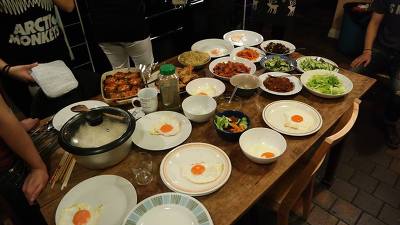
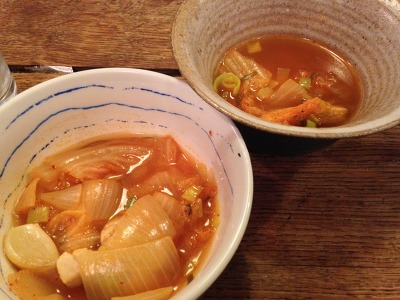
- The bibimbap on the left is what I served before leaving; if you look closely there are many dishes besides bibimbap. On the right is kimchi stew -
1. Meals
They say 'eating' is the most basic of basics; solving that 'eating' wasn't an easy thing. Eating food that suited my taste was a very, very difficult thing. If I write down the basic foods I ate there, it goes like this.
1) Bolognese pasta (penne/spaghetti)
2) Mashed potatoes and sausages, plus salad
3) Fish and chips
4) Chicken curry + rice
5) Stir-fried lamb dish + rice
6) Pork steak with boiled vegetables and gravy
7) Cheese toast
8) Chili con carne + rice
9) Chicken nuggets + chips
10) Beans & toast
11) Bacon + mashed potatoes + salad
*For reference, chips (Chips) refers to fried potatoes.. think of French fried potatoes and that's right.
Next, to give examples of desserts,
1) Apple crumble
2) Banana cake
3) Lemon cake
4) Velvet cake
5) Chocolate cake
6) Pie
7) Mashed and boiled apple + custard
8) Ice cream.
Now, the easy menus here will generally be easy to spot. The easy menus are Fish & chips, Beans and toast, chicken nuggets & chips, and sausages with mashed potatoes are very easy too. These menus are mostly ones that end with heating 'frozen food' in the oven; the first few times are fine, but later on they're foods that are too disappointing. They weren't much to my preference. I liked old-fashioned methods. That is, I liked foods made by cutting or mincing and boiling or stir-frying each ingredient one by one. In a word, 'foods that take a lot of effort.' Among the labor-intensive foods, the ones I ate often are these.
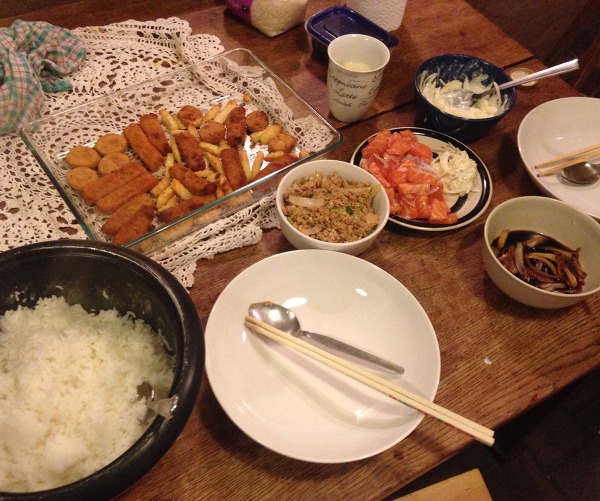
- Chicken nuggets, potato chips, fish head, stir-fried tuna, salmon sashimi, two kinds of pickled onions - that day the main dish was the 'salmon dish' of an older guy who'd bought salmon from outside.
1) Salad based on oriental dressing (tomato, lettuce, some unidentified greens, onion, carrot, celery, cucumber, paprika)
2) Cream pasta with bacon, paprika, onion, mushrooms
3) Meat-based stir-fry dish (onion and paprika are essential; carrot, broccoli, potato depending on that day's ingredients)
4) Oven roast based on soy-sauce seasoning (mainly chicken thighs and drumsticks) (based on garlic, soy sauce, vinegar, honey)
5) Bibimbap, which I made exactly 3 times
6) Pork stir-fry rice bowl made by slicing steak-cut pork
7) A dish topping hash browns with cheese and chicken breast - a dish I saw on a refrigerator-cooking show
8) Grilled meat with a side dish (grated apple and knife-cut stir-fried mushrooms + dark-beer sauce)
9) Fried eggs...
Among them, eggs are what I think I ate most often. Because eggs were the easiest-to-obtain and easiest-to-access 'protein,' I ate eggs often, and the vegetables picked from the vegetable patch (a Garden too large to call a patch) were truly the freshest vegetables, number one. I still remember the carrots and tomatoes. Sadly, I never had the chance to bring back garlic, kabocha squash, cabbage, green onions, and the like so I couldn't use them, but if I had, they'd probably have stayed in my memory more.
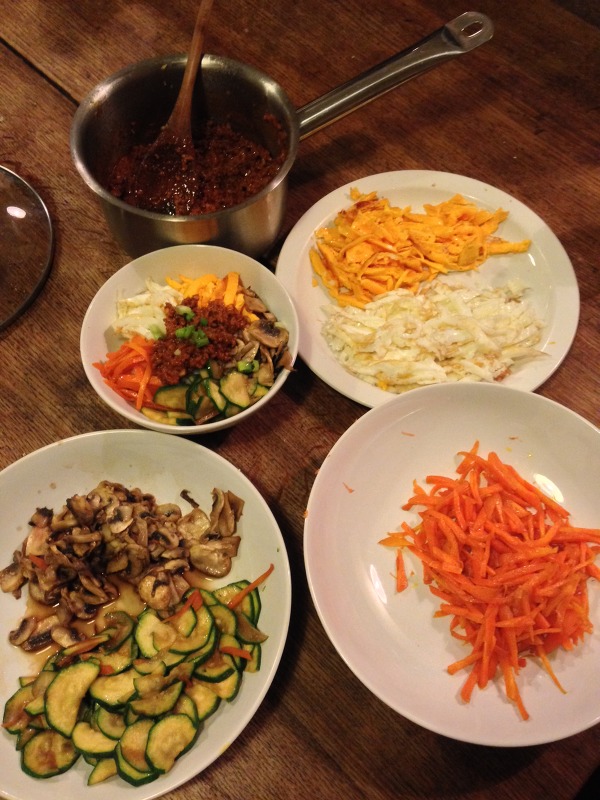
The reasons I preferred labor-intensive foods are these.
1) 'Cooking' is a quite rewarding thing. To do that rewarding cooking, I had to make food that takes a lot of effort and uses each ingredient one by one, and with frozen food and ingredients that come from a 'can' there was no way I could try doing this.
2) The taste of 'frozen food' and 'canned' food was too monotonous. I disliked that. I wanted to make a very small change. That was cooking.
3) Labor-intensive food is a hassle, but it's just right for comrades to spend time together and help each other.
4) Through lots of practice, I wanted to do well at it again when I went back to Korea.
2. Travel
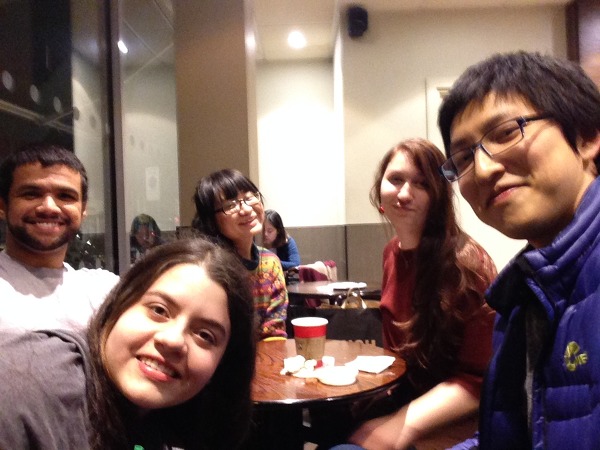
- Inside a Starbucks near London Victoria Coach station; from the left, William, Camila, April (Ma Jing), Alice, and me. - First day of winter vacation (2015/12/19)
We did, after all, go traveling with comrades. Hmm, when you work, like-minded people are bound to come along. In my case, one friend from Brazil, one friend from Colombia, and one older guy and one friend from Korea got along well. There are so many things we did together — the trip where we first went to London together and rode bikes around, the days we went to Liverpool together and walked around and drank and cooked, the memories of taking the bus together to Paris and wandering downtown Paris, going to a park and a cathedral in Barcelona — and at Christmas, no less — attending Mass together and spending time, going into Santiago Bernabéu in Madrid and watching a match, and so on.
When you travel like this, since you inevitably come to 'consider' the other person, you end up choosing itineraries that take others into account rather than itineraries thinking only of myself, and when it seems like we'll have to use a lot of public transit, we talk it over and naturally reach an agreement on whether to use a lot of public transit. But that negotiation process, maybe because they were things I often did while working before, wasn't difficult. With a partner you trust and follow, the discussions were quite reasonable, I'd say; generally we agonized over the 'cheapest transit,' the 'most comfortable transit,' and the 'most convenient transit.' Mostly the side seeking something cheap-ish yet convenient was in the majority. We couldn't even dream of expensive options. Especially since the Europe of the time that photo was taken was the very Peak of Peak season, even at the end of October when we started booking tickets, the ticket prices were already no joke..
Traveling with friends is quite a good thing. There could be many reasons, but to organize them it goes like this.
1) It's very good for discussing the trip among people who met together.
2) It's easy to add in individual tastes.
3) Safety can be guaranteed a bit more. (Even so, it was a shame that one comrade's wallet got stolen.)
4) Boredom can be relieved a little.
5) When eating food or buying ingredients to cook, the burden of quantity is less. (Even if you buy a lot, there's someone to eat it all.)
6) Trips of various concepts, mobilizing each individual's knowledge, are intermixed.
- What this means is, I tended to be very interested in art, history, and literature, so for instance when we went to Notre-Dame Cathedral, I'd talk about the novel 'Notre-Dame de Paris,' or seeing the statues of Goya and Velázquez in front of Spain's Prado Museum, I'd briefly say that these people are Spain's national painters so they're worthy of this. Other people too told what they knew during the trip, so I benefited a bit, I'd say; William knew Spanish, so during the Spain trip together there was no big difficulty communicating, and Camila, whenever I was going through depression over interpersonal problems, often told me to cheer up even during the trip. The words to think of the travel destination still ring vivid.
7) You can add a bit more flexibility in booking lodging. It'll be quick to understand if you consider that when several people stay, Airbnb is rather more convenient.
If I think of the not-good points,
1) I walked too much, so the others had a bit of a hard time.
- I naturally walk a lot. I think I walked about 6 hours a day. Of course, since I'm human too, I don't do the foolish thing of walking 6 hours straight. After walking about 2 hours I get tired, so I'd go into a café for a cup of tea, then walk again and have a cup of tea, walking that way. As a result I went to a lot of cafés. In cities where we bought ingredients to cook, the 'coffee money' seems to have cost more than the ingredient money. I drank so much coffee..
2) You have to pay a little attention to food.
- Actually, I tend not to pay much attention to food at travel destinations, but when there's absolutely no place to eat I go into an expensive place. Of course, most of the time it ends with just a sandwich. That's the problem. It's awkward to eat just a sandwich myself because I want to. Maybe because I was worrying that it might not fill me up while searching for a restaurant, it was quite hard to find a suitable 'place worth eating at.'
Other than this, there's nothing.
The fact that the older guy who came traveling together in Barcelona had his wallet stolen is still an infuriating matter. Due to a moment's carelessness and letting our guard down..... actually up until that day I hadn't even thought about it. I'd gone around without worrying about such things at all, but actually getting hit, anger surged up.
Coming back after going into iCloud to pick photos, the library computer just crashed and it was chaos, but still, reminiscing about old times is a truly fine thing, I think. Comrades and cooking are among the precious assets I gained at Coleg.
Comments 0
No comments yet. Be the first.