0.
In the middle of dinner, a friend asked if I still read books these days. I hadn't been reading at all, but today I read. So I told them I'd read various things.
1.
Georg Simmel was a sociologist who began with psychology and ended with philosophy. The first time I came to know Georg Simmel was, hmm, I remember reading about him in a fashion magazine. A writer wrote a piece quoting a famous remark by Georg Simmel, and that cool remark at the time went like this.
It was the idea that 'people who want to look different from ordinary people pursue and prefer fashion different from theirs through "distinction," but in doing so they too end up belonging to another group called "the other people."' I remember this being a remark that changed my very view of fashion at the time. I too was a 'person trying to look different,' and I had to admit that, by that very fact, I was in yet another group called the 'group that looks different.' That is, true 'distinction' isn't easy. It may even be impossible.
2.
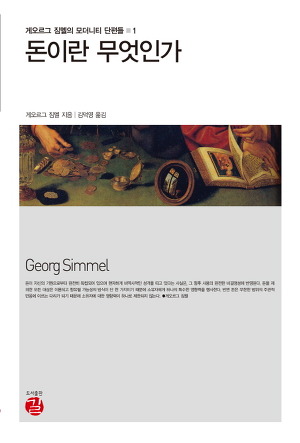
Anyway, I read a book after a long time. If I were to tell how Georg Simmel suddenly popped into my head, that would become a 'contextual essay,' so I'll save that for next time; holding my tired head, I borrowed 3 Georg Simmel books and read only 2 of them selectively. Among them, today I'll write about only a portion of the book 'What Is Money.' The reason I'm writing in parts like this is that the part I read today was quite a part for gaining social insight.
The qualitative aspects of objects lose their psychological significance through the money economy. In other words, people are continually required to evaluate all value by monetary value. This ultimately makes monetary value appear to be the only valid one.
It's because of this part that I'm writing a short piece today. This statement contains nearly all the values of modern society. Even after this part, the parts about the power and influence 'money' holds in society are described in enormous amounts and there are many parts I empathize with, but the root is right here. Namely, that 'money' is made to appear as the only valid thing.
3.
Was the way my father said various things about my younger sibling's behavior a few weeks ago also in the same context.. The standard for all behavior doesn't have to be 'money.' Actually, money is something inevitably necessary in the age of capitalism. But money can't guarantee happiness. It can guarantee the right to lead a minimal life, but that's as far as it goes. 'Happiness' is something I have to find. Simmel wrote this too. That a rise in income doesn't raise happiness, and that the fact that people with fairly high incomes feel depressed represents precisely this phenomenon.
4.
I thought about how far that applies, and it applies to all of daily life. Even to the price of coffee. I drink coffee because I want to drink coffee, and I drink coffee because I like coffee, not because I want to drink it while worrying about how much the coffee costs. To do this, you need an appropriate level of money. That's what I realized today. That 'money' is merely a means and must not become an end. Once I felt this, many things come to mind.
5.
In all of daily life, looking at the price and assigning value—actually there was no need to do that at all... Because of the price I hesitate and waver over this value. They say it happens because money is limited, but this is truly a regrettable thing even as I feel it about myself. In a situation where money is limited, value judgments about specific things are bound to always occur, but when I recall the memories of money getting in the way of my value judgments about 'what I pursue,' ugh.. it shouldn't have been that way.. If it were simply a situation where I couldn't choose it because I had no money, fine, but otherwise, there are so many moments where I think there was no need for this. From now on I should cut back a bit; if perception changes, behavior can change too. Though learning how to manage money systematically is a separate matter I still need to master.
6.
Next time I think I should write about women's culture, and general culture too. Simmel's view of women's culture was quite impressive. Seeing that the knowledge I heard in education lectures connects to books like this too, it seems education lectures are indeed good.
Comments 0
No comments yet. Be the first.