-1.
As I sit down to write, I'm torn. Whether I should write what I felt, or write that this book is about such-and-such, or whether I should write both.. This is a quite decent essay book, so although the stories in the book were the author's stories, most of the things that come to mind after reading are 'my own narrative.'
0.
These days, really recently, straight through from this past January, there are so many things it would have been good to know back then. The more time passes, the more there are things I missed. When things I thought weren't so at the time, or didn't feel, suddenly go *whoosh* through my mind and make me recall the regrettable points in past events, I would have this thought. Ah, it would have been better if I'd known back then.. they're already things too late to turn back.. and yet I don't think I've ever had regret and rue linger like these days. You could say I'm doing all my regretting about the past seven years of university life these days.. Back then the path wasn't visible and I was only frustrated, and even in those times when I seemed to only cause harm to people, there were always empty, somewhat roomy spaces—my own place and other people's—and I regret the days when I failed to see that.
1.
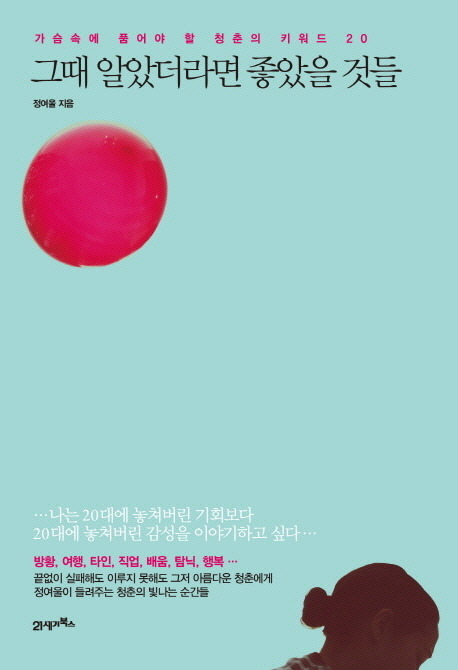
A little while ago I received a book as a gift. I received a book from a friend who'd been close but whom I hadn't met in a long while. Even meeting after a long time, I hadn't thought of a single gift, so I reflected for a moment on why that was, and resolved that next time I'd be sure to bring at least a postcard, and gratefully accepted the gift. Receiving the book as she said it was a decent one among the books she'd read recently, I put it intact in my bag on my way to school, thinking I'd read it after exams were over, and I really read it yesterday on the way to Gwangju. It had been about three weeks since I'd gone home, but the book was something I reread within a day.. Anyway, from the moment I took bus number 513 out of school with the book, to the brief time waiting for the bus at Starbucks, and on the bus heading down to Gwangju—about two hours of reading and I'd finished it. Reading leisure books rather than study reading for the first time in a while, the reading speed was quick, quick, but the content didn't disappear from my mind quickly, quick. That was probably because I had many things I'd thought about.
2. A Simple Content Introduction
Still, I should introduce the book a little—this book has a story of 'rue.' As the author says, even though they were her own stories, there was so much that was universal that, reading it, many things came to mind, which I liked. The author laid out her stories according to the themes she had in mind. Among them was something like 'death,' and something like 'questions' too. There are commonly(?) readable stories about love, stories about friendship, and stories about jobs too. People who want to read selectively could read only specific parts with no real problem, but since this book's division of content between chapters can't be said to be clear, it reads fine even if you just read it all. That's because in the end the 'overarching theme' of this book held the book together well. So I'd also like to recommend reading it from beginning to end without regret.
The two-syllable word written on the cover is the subject of this writing. The reason I feel things connect while not connecting is probably because I do a lot of 'connecting' thinking without wanting to, but actually they're not greatly different themes. Love and friendship are a hair's breadth apart, and
3. My Story
In a sense I'll probably write a piece that holds sorriness and rue about bygone days, but since this writing is my record, I don't mind.
1) I want to say thank you once more to the people who listened to my stories. I want to truly say thank you to everyone who listened to my stories, whether they liked them or not. Among them there were stories they wanted to hear, and there were surely strange stories or bad stories whose point I don't even know, but even those—for me, because you who listened to my stories were good and comfortable, I was able to tell them; for me, being able to tell you my stories was a great honor and blessing and something to be grateful for—I want to say that. And thinking that I should say thank you more often to the many people who'll listen to my stories going forward, too.
2) When I asked my younger cousin about 'what kind of work he'd like to do later,' I wish I'd thrown out a slightly more detailed question. Of course I didn't directly ask my cousin 'do you want to do such-and-such a job later,' but that cousin answered me with a 'job.' Hmm, I wish I'd asked a little differently. Not the 'job' he'd want to do later, but what kinds of things would make him feel happy if he did them, and whether he'd ever thought about what he might try in order to do that work. Next time I should throw out a more concrete question and ditch questions like the kind that simply take a 'job' as the answer.
3) It seems I failed to take an interest in the people around me. As I lived this way and that, I tried somehow to do something for the people who came inside my fence, but I took no interest at all in the people outside it... ah, I regret it. I didn't have to be that way. I didn't have to pass by thinking they weren't my connection. I could have smiled at those people too, asked whether they were having a hard time, and listened for a moment if they had something they couldn't tell anyone. I regret that I didn't.
4) Parents—it's not easy to confide things to my parents. I'll probably keep trying my best not to confide going forward, and if I do end up confiding, I'll look to other people around me. But I should contact them a little more often. Come to think of it, I could always have died—on the plane to the UK, on the plane returning to Korea, and on that day I went to Madrid by train. I'm only alive until now because of luck; traffic accidents happen in many places even in a single day. All I can do is briefly wish 'please be okay' when I'm on the move; I can't make everything turn out as I wish, so the fact that I've lived is truly fortunate. That I've survived until now and write like this is fortunate, and I'm grateful that I can listen to others' stories and, on the other hand, can confide my own stories.
5) I'm glad I found something I can do well or take a little interest in. If studying gets hard, I should at least use that to attach interest to studying again. Since that's one of the decent methods available to me now—it takes a bit of time and requires the effort of digging through books one by one, but even so, it seems like a worthwhile thing to do. It's a little crude, but I don't think anything is as fun as piling up several books and finding material within them to add to my own book.
6) It seems you learn more about love after it ends. As a result you come to think more and more that you should do better next time. Friendship with friends, too—looking back after some time has passed, I recall the things I failed to do better back then. Of course I also recall the good things those people told me. Recently, recently it was really hard, but even so, isn't it thanks to those friends that I can write like this—the fact that I didn't choose 'death,' thinking life would end and I'd be free of all worries, but chose the road of still being alive, is fortunate and something to be grateful for.
4. So I'd Like to Recommend Reading This Book.
The contents in the book are this person's stories, but the story of the reader who will read through this book also has meaning in its own way. 'Reading' starts from there. Finding and assigning my own meaning, looking back and thinking about the things that existed in my life—that seems to be the purpose of reading and the thing itself. And when you get the feeling that you might wander, sway for a while, and before the time comes when you can only think about the 'money' before your eyes and can't see anything else, look around a little more; do that and at some point the thing I wished for might come 'click' to mind or appear, or it might gradually become visible like fog clearing—but all those 'processes' eventually become flesh and bone, don't you think we can come to know that..
Comments 0
No comments yet. Be the first.