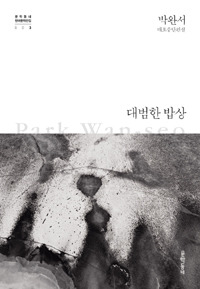
1. Posting after reading a book for the first time in a while(?)
Actually, the very first Munhakdongne Korean Literature Collection book I bought was Shin Kyung-sook's 'The Lone Room,' but whether it was because that novel is a full-length one I couldn't get through, or because I didn't care for Ms. Shin Kyung-sook's distinctive style, that book remained unfinished, and in the end I came back and — instead of buying volume 1, the selected novellas and short stories of author Kim Seung-ok — the book of the late Teacher Park Wan-suh caught my eye. There's a backstory here. Reading a full-length novel requires concentration, absorption, and persistence.. so I tried to buy short-story collections, and among them the authors I knew well (within that collection) were Kim Seung-ok, Park Wan-suh, Kim So-jin, and Choi In-ho; since I'd already read a bit of Teacher Kim Seung-ok's fiction through the Kim Seung-ok literary collection before buying this book, I skipped him and bought Park Wan-suh's and Kim So-jin's books.. anyway, that's the background..
Briefly, I'll just jot down the thematic consciousness of the included works and wrap up.
1) Near the Buddha: Her debut work is known to be 'The Naked Tree,' though I actually haven't read The Naked Tree in full. I just added that since it's her first work, but anyway, separate from 'The Naked Tree,' this book's first work 'Near the Buddha' is a work that shows the figure of a mother and daughter returning from making an offering. The story of 'making an offering' is something I'd read before in Park Kyong-ni's 'The Age of Distrust' too. This too depicts the psychology of 'me' that occurs all the way through the process of making an offering to the Buddha and returning home. It contains a story about the deaths of the father and older brother, and in the end the work concludes with 'my' resolve to bring out what I'd suppressed inside and ensure that at least my mother can experience a 'graceful death.'
2) I Teach Shame: This work sharply depicts the reality of the time through the people surrounding the narrator 'me,' viewed from the perspective of 'me' who divorced twice and married a third time. Watching Gyeong-hee, who makes deliberately 'sophisticated gestures,' and depicting the figure of a mother who pours out resentment at not having been able to make herself a yang-gongju (Western princess / camptown prostitute), it reveals the problems of Korean society in the 50s and 60s.
3) The Pasqueflower of That Brutal Day: A work featuring a 'male narrator,' it concludes that whether old woman or young, in the end everyone — not crone or maiden — was a 'woman.' This work is a bit complex to talk about, but the content itself is simple. It's just that I lack the explanatory power.
4) Three Days of That Autumn: It's the story of the last three days of medical practice of 'me,' an OB-GYN doctor who has made 'abortion' the main business. To be precise there's also more distant past, but anyway the 'three days' here is a work that leaves the wish of the protagonist 'me' to deliver a 'baby' with three days left before ending the medical practice. The guilt packed tightly inside the self that had only killed babies, having performed only abortions for prostitutes her whole life, and at the same time the narrator's wish to deliver a 'baby' being born, are revealed intensely. It's one of the works showing a cross-section of the 'yang-gongju' of that time.
5) Mother's Stake 2: A work that shows the scars of war still haven't ended; rather than describing it otherwise, I recommend reading it. It's the work in which the author's experience of war is best revealed. Reading it about three times, I understand why it received the Yi Sang Literary Award.
6) The Uncle's Medal: With Uncle Neoune as the subject, the observer 'me' carries the story along. Seong-pyo hyung, the family's eldest grandson brought in during the war, at first takes care of the uncle reasonably well, but at some point he wasn't taking care of the uncle, and 'me,' who learns this, visits the uncle and unfolds the story of the past. This too has the scars of war remaining and depicts a society where 'material value' begins to be prioritized.
7) He Knows, I Know, and Only Heaven Knows: Reading this work, I keenly felt that 'women's gossip' existed decades ago too. It shows the human side of 'Seongnam-daek' while revealing the inhuman side of 'Jin-tae's mom' and the inhumanity of Jin-tae's mom's friends, exposing the social reality of the time. By criticizing people who view human relationships only in sexual and material terms, I think it gave an opportunity to think about what value should truly be pursued.
8) The Very Last Thing I Possess: It was the hardest novel to read. It's hard to explain, but this work is one in which the sense of loss of a 'mother who lost her son' stands out. The tangled human relationships with relatives within it also appear.
9) You, So Very Lonely: A story of a situation where 'me,' the 'wife,' goes to and comes back from her son's graduation; in the past she disliked her husband, but watching her husband lying asleep on the bed, she feels that her husband too was a person who had sacrificed himself, and the novel has her feel compassion and love for her husband.
10) The Generous Dining Table: The main content is the story of the narrator's friend, who ends up living with her co-in-law (the other set of in-laws) because of a daughter and son-in-law who left their grandson and granddaughter behind one day. Knowing others' gaze but, while actually caring for the children, showing that such gaze isn't important, it contrasts the narrator 'me,' who lives a life trapped in 'others' gaze,' with the friend who doesn't. And in that the figure of the 'friend' is drawn as a figure to aspire to, this work was truly impressive. Probably because, while I know how difficult a life not trapped in others' gaze is, it aligned with my own desire to realize it.
2. In closing
I should write about Yi Mun-yeol's novella-and-short-story collection this way too. Kim So-jin's collection too.. I think I should write it down like this. I'm glad that, even briefly, through the short stories I could read out the subject matter and thematic consciousness the author dealt with.
Comments 0
No comments yet. Be the first.