1.
Among Kim So-jin's fiction, the work that stays in my memory most is, as expected, 'Bicycle Thief.' Bicycle Thief — somehow my memory of reading this fiction too seems to go back to middle school, but I don't remember this Bicycle Thief well. I only remember it as something like a young-adult novel I read in middle school. It's so regrettable that, apart from the fact that the story really had a 'bicycle thief' in it, I don't remember a single other thing about the content. On top of that, at the time I bought this book, I even searched whether this writer was the same person as Kim So-jin, the author of 'Bicycle Thief,' and bought it going 'ah, that's right'; so I'll end the record of my embarrassment here, and if I were to simply define Kim So-jin's works, I think they could be described as social reality and fathers wrapped in a gloomy hue, and an indescribable warmth. Especially often in Kim So-jin's works, the subject of the 'father' appears frequently. Most writers who frequently bring up fathers have some 'backstory' — a conflict with the father in childhood, a wound, or the father passing away early, and so on — and the writer Kim So-jin too had such a backstory, and it was a case where it surfaced and appeared in the works. The second one, 'gloomy hue,' is a gloom of a slightly different form from Kim Seung-ok's gloomy hue. Kim Seung-ok's gloom was the kind of thing that strangely came to mind together with 'fantasy.' So, keeping in mind that the type and atmosphere of the gloom are a little different, and saying that this writer too has his own hue, I'll briefly introduce the short stories.
2.
The number of works is on the slightly large side, but among them there were no especially long works. Still, the works that stayed in my memory most were 'Dreaming at Gyeongbok Inn' and 'A Brief History (略史) of Shinpunggeun Bakery,' which I'll talk about below — those were the best. Of course 'The Black Jar Inside the Snowman,' 'Color-Plate Biology Study Guide,' and 'Bicycle Thief' too; in fact, in a way, I could get the feeling of 'so this is what Kim So-jin's hue is like' one by one, so I read immersed the whole time. Of course I didn't read it all in one day but over several days. It took about 4 days, I think.
1) Catching Rats: His debut work. 'Catching rats' is an act, but I think the stories entangled with the situation of catching rats are in fact the stories the author wanted to tell. Here too there's conflict with the father, and content about social reality and poverty. On top of that, this 'rat' is also connected to the father's past during the Korean War, so with the single act of 'catching rats,' quite weighty themes pop out.
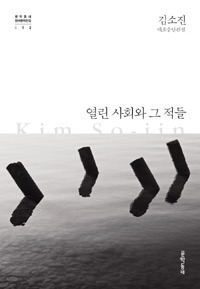
2) The Open Society and Its Enemies: This book's representative work is 'The Open Society and Its Enemies,' and I think this work is the highest in difficulty. There are really a lot of symbols in here. The 'open society' is depicted not simply as an open society but as 'the society one must pursue,' and the lowest class represented by the 'rice-grain folk,' the university students who belong to the intellectuals of that society, the hospital as a protest space, and the police as the opposing force strangely depict the era's conflicts, the resolution methods to be pursued, the future vision to advance toward, and so on. What impressed me was the expression 'rice-grain folk.' 'Rice grain' really is such a humble word, and I can only say it's remarkable that he brought this word as a metaphor for the lowest-class laborers. I think this is what a literary expression is.
3) Chunha Returns: To say something a bit off-topic, I think the wedding of the elderly newlyweds who appear here should be called a 'small wedding.' It depicts the neighborhood where briquettes, and 'Chunha,' 'Sangho,' and 'Byeongmun' live. The writing skill (descriptive power) that depicts this neighborhood is simply remarkable. If I started writing about the meaning of what returned, it would become a description of the whole novel, so I'll just jot down the off-topic things.
4) Beloved Dongbang: Simply, a work that ponders the social transformation imagined at 'Dongbang'; it depicts the protagonist and the protagonist's wife living in that kind of atmosphere where, having already become members of society, it's too difficult to realize the ideals imagined at 'Dongbang.' The line 'A good world doesn't come' is impressive.
5) In Search of Yongdugak: This too is a story about 'Yongdugak' and the narrator's past, with a tale of dirt-poor days positioned as 'reminiscence content.' Come to think of it, the writer really seems to use the method of 'reminiscence' very often. As if it were a habit.
6) Cheoyong's Tale: A modern adaptation of the Song of Cheoyong, with a hyangga that even appears in original composition; of course, the 'Song of Cheoyong' that arises in the relationship among the narrator 'I,' the 'wife' who goes off to do 'blending,' and a friend met after a long time, is adultery yet not adultery. In the end the narrator agonizes that 'he himself is Cheoyong' and the fiction concludes as he enters the house. In this fiction, society appears in the form of worry about sexual relations with the wife, and the figure of a friend called 'Huijo' who once did the student movement but is now busy living day to day. The 'open society' is still nothing but a non-open society.
7) Gaeheulle Man: This too has reminiscence. In a situation of waiting after getting contacted by a college-club peer, the past boarding room comes to mind, and a dream about the father comes to mind, and the story about the 'father' who volunteers as a gaeheulle man (dog-breeding helper) is the object of reminiscence. It's the part revealing that his father is not an 'antithesis' but merely a gaeheulle man. Here the narrator's perception of the father is revealed, showing that the father was depicted not as a very 'large existence' but, sadly, as a small one.
8) The Village with a Swamp: The 'swamp' is the very image of gloom. The swamp that starts from simple death at first and later even becomes an object of 'performance art.' Through the 'swamp,' truly, truly diverse cross-sections of society appear.
9) Bicycle Thief: A work where he happens to discover a bicycle thief and, talking with that 'bicycle thief' about the past, lays bare why his current behavior is the way it is; the ways people heal and embrace the wounds they hold are all different. There's no right answer here and it's hard to find common ground. The matters of the father and the wen-bearing old man are again the objects of reminiscence, and the story of the older brother of 'Seo Mi-hye,' the 'bicycle thief,' appears as another object of reminiscence. They laid bare their stories to each other, but rather than healing each other, it ends with the laying-bare and seems to show that the human relationship was severed. Is this what modern people's relationships are like..
10) Color-Plate Biology Study Guide: The Color-Plate Biology Study Guide connected to the father; his mother came to the hospital because a wound from the past hadn't healed and had festered, and through this are depicted reminiscence of the past 'father's' insect-eating, the 'I' who witnessed the father's affair, and the figure of the 'mother' who seems as if she wouldn't have wanted to see the father's affair. Linked to the cause of the father's insect-eating is the older brother's death.
11) Dreaming at Gyeongbok Inn: 'Gyeongbok Inn' is ultimately the space where the narrator sublimates and lays bare his pain through weeping. That's why this space feels to me like a 'cathedral' rather than an 'inn.' The narrator, now grown older, depicts the 'Gyeongbok Inn' anyone might think of, while reminiscing about his university days.
12) A Brief History (略史) of Shinpunggeun Bakery: A title meaning the brief history of Shinpunggeun bakery; Hyeongyeong is just a slightly dim-witted female-college-student friend who plays the role of an interviewing reporter, and the main content is actually with Jaedeok and Grandfather Shinpunggeun. The father's story comes up again, the story of the 'demonstration' connected to the uncle, and going way back into the distant past, the story of the great-grandfather's uprising during the Donghak Peasant Movement era, and so on — it shows that society, past or present, is still an era of 'rising up.' After reading this work, I really felt my heart filled with a 'warm feeling.' The ending of this work was a little different from the endings of the other works. The scene at the end where he leans his head out a bit more to look at the grandfather's bakery a little longer is really impressive.
13) The Black Jar Inside the Snowman: A past story of the narrator appears as the narrator 'I' comes back to an area about to be redeveloped — that is, the area where he lived as a child. It reveals the narrator's figure lamenting that if the village is redeveloped, his past 'memories' too will disappear.
3.
The ones I liked most were Gyeongbok Inn and Shinpunggeun Bakery, and the last work, The Black Jar Inside the Snowman, was decent in its own way too. Well, apart from such personal impressions, the fact that the writer's main technique is consistently 'reminiscence' makes me think about just what it is he wants to reveal through this device of 'reminiscence.' Isn't the object of reminiscence always the 'past'? If so, it's necessary to think about what he's trying to reveal through the past. The themes appearing in this 'past' are all small but big themes. It would be true of any work, but unlike Kim Seung-ok's fiction, where the focus is more on the 'individual's narrative,' a feature you could pick out of Kim So-jin's fiction is that, along with 'macro themes' like the student movement and the Korean War, the micro theme of 'the relationship with the father' is revealed.
There's also a sociology book called 'The Open Society and Its Enemies' by Karl Popper; this book was one I once wanted to read, but in the end it remains an unfinished book — now that I think about it, that's how it is. At any rate, the writer Kim So-jin, through the relationship between narrator and father, expressed the relationship between narrator and society, the problems of society, the direction society should pursue, and so on. Most of the short stories included in this book show 'endings where the prospect isn't clearly visible,' but I think this is because of this writer's distinctive gloom. Still, I think 11 and 12 had prospect.
Comments 0
No comments yet. Be the first.