1.
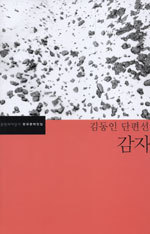
The writer I came to read next is Kim Dong-in. Honestly, I expected this time too whether I could satisfy my enjoyment, but it wasn't as much as I'd hoped. Maybe because I learned that many of Kim Dong-in's works are far from the so-called 'aestheticism' I'd known, there were too many moments while reading where I felt it was no fun, perhaps because the unexpected atmosphere of the fiction didn't dissolve into my head. Even so, the value of the writer Kim Dong-in cannot be disparaged (absolutely not), and this writer's unique world of works is creating its own distinctive space in Korean literature, and this writer's two works 'Potatoes' and 'The Sorrow of the Weak' have appeared on exams before, so I did want to see them again in my own way. Generally, if you summarize Kim Dong-in's tendency in a word, it can be organized as the nihilism and death contained within 'aestheticism'; the points to cite would be that not all his works are like that, and that 'Bongnyeo,' the representative protagonist who becomes somewhat absorbed into her environment, is the most famous. (Because of Bongnyeo, who changes under the influence of her environment, it's sometimes called naturalism too.) Since I feel too keenly this time that my writing skill is lacking to explain all the works included here, I'll leave a few out. Even this — I didn't know how to write it, so this time I also read papers. I'll mark the reference papers as references at the end.
2.
Kim Dong-in is a representative writer who advocated the artistic theory of aestheticism. If the 1910s had the transitional characteristic of establishing the 'new fiction' led by Yi Gwang-su — that is, fiction starting to appear that was novel-like in the modern sense — then the 1920s was the period when, taking those as models, things worth calling 'this is modern fiction' were created. Representative writers include Kim Dong-in here, as well as writers like Hyun Jin-geon and Yeom Sang-seop, and on another front, class literature began to appear from the mid-1920s. I won't talk about class literature here; it would be better to talk about it later when I read a short-story collection of class-literature writers and put up a post. Many researchers have done research on that part too, and I think it has value in its own way. Isn't literature both a 'means' and an 'art work'? In the postmodern era, it's an age where no thought or value system can be called 'wrong.' That's why everyone is respected, and so, even if class literature was distasteful in Kim Dong-in's eyes, it was meaningful to the class-literature writers. That was a long digression, but there's one thing to think about. Before he wrote aestheticist works like 'Sonata of Wild Flames,' he wrote works with a strong 'reality' of their own. Those are works like 'Potatoes' and 'Flogging'; in The Sorrow of the Weak, reality appears, but it's a bit disappointing that the author's intervention is still revealed in the way the inner awakening is shown. An early work is an early work. Still, even within these, the things composing the narrative had plausibility.
1) The Sorrow of the Weak: Starting from the fact that she has the name 'Elisabeth,' I thought it was a bit unusual. The things that happen in the position of 'home tutor,' worries about love, the baron's attitude, and so on — here there's no story of the protagonist confronting some social problem. This could be called the most basic characteristic of Kim Dong-in's fiction: strangely, a curious 'emptiness' is laid over the work. The protagonist comes to feel an empty emotion, or it ends in death, or the protagonist witnesses death, or the protagonist briefly loses the meaning of life, or wanders searching for someone — a 'conflict' a bit removed from the social reality in which the fiction was written appears. Did Kim Dong-in not want to depict protagonists absorbed in social reality, or did he think that even depicting it that way it'd be hard for reality to change? There's no way to know. Still, 'the weak one,' 'Kang Elisabeth,' is in the 'weak position' of being a home tutor, and after pregnancy, leaving the baron's house and living at her fifth-cousin-aunt's house, she remains 'the weak one' until her worries end. Even so, in the end the protagonist, through awakening, realizes that 'love' alone is the strength to live. Elisabeth realizes that when one perceives one's own weakness one becomes 'the strong one,' and the fiction ends.
2) Baettaragi: The word baettaragi refers to one of the 'boat songs.' (But how many people, while reading this work, first perceive that 'baettaragi' carries the meaning of a boat song before reading the content..) It's no exaggeration to say the boat song is the entirety of this work's narrative. It's fiction that unfolds, in a frame-story style, the tale entangled with 'baettaragi.' The scene at the last part of the fiction that depicts the scenery, the beauty of the baettaragi, and 'the one who sang the boat song' is a wonderful depiction even on a second look.
3) Flogging - A Passage from a Prison Record: A heartbreaking story. I was curious just how the subject of 'flogging' would come up. Because every piece of fiction has something its 'title' signifies, I guessed it would be because the structure of this fiction is determined by just how the flogging is depicted; the main content is the 'narrator' me telling the story of an old man who comes to receive 'flogging.' It's also a prison-experience fiction containing the author's own experience. At the end appears a part where the narrator 'I' attains a realization. The protagonist awakened in the end after all.
4) When the Eyes Barely Open: A work that ends with the death of the protagonist 'Geumpae'; works that end with the protagonist's death like this are actually things I'd seen a lot in foreign literature, but seeing it like this it's curious and new too. I think death is always a quite decent device for an ending. It seems to strangely contribute to heightening aesthetic completeness. Probably because the meaning 'death' holds is quite important.
5) Potatoes: Researchers say a narrative of 'concealment' appears; well, in that it's not a series of events caused by Bongnyeo's 'corruption' but also makes you think that in social reality Bongnyeo could only have ended up that way, the reasons 'Bongnyeo' arrives at death can be interpreted variously. It could be the husband's incompetence, it could be poverty whether or not the husband is incompetent, it could be the father, it could be that Bongnyeo simply abandoned the 'ethical view' she held — well, whatever the case, capitalism isn't perfect.
6) Sonata of Wild Flames: When we usually think of 'aestheticist works,' most people think of this Sonata of Wild Flames. It's a fiction work where a 'world of art' separate from reality is established. But that art isn't far away, as you can tell through the narrator's dialogue. In the aspect that a real world and an art world appear, this work is impressive.
7) Loitering: A Kim Dong-in fiction in which the 'labor problem' is revealed. I could see that his world of works was diverse.
8) The Toes Resemble: A story about a man called M. He has no reproductive ability, yet his wife became pregnant, and after that child is born, showing the child, he says this child's toes resemble his own toes. If this is Kim Dong-in's reality, then it seems to be reality.
- Gwanghwasa, The Tale of Kim Yeon-sil, and Gomne are no good. Too difficult.
3.
As I did my research, there were stories like this. That Kim Dong-in was a writer who had pursued reality, that he didn't necessarily only criticize class literature, that he walked a different path from Yi Gwang-su. And I came to learn that the phrase 'puppeteering technique' — that is, the idea that a writer must be able to handle his own literary world with certainty and freedom — is quite important. I think Kim Dong-in is certainly a quite meaningful writer of the 1920s, that is, the period when 'enlightenment' was losing its persuasiveness. Enlightenment doesn't step to the forefront. Not only this writer but also Chae Man-sik's 'A Ready-Made Life' shows, in the aspect that the studying done for the sake of enlightenment grows distant from the bourgeoisie way of making a living, I think it shares the same context.
I borrowed two research books to read later, and if, after reading, parts come up that I should add, I should add them to the conclusion. I'm glad I've come to understand the writer in a more multilayered way.
References
Kim Gu-jung (1992), A Study of Kim Dong-in's Short Fiction, Hannam University Hannam Language and Literature Society, Hannam Language and Literature Vol. 18, p395-415
Son Yu-gyeong (2004), 1920s Literature and Sympathy (同情) - Centered on Kim Dong-in's Short Stories, The Korean Modern Literature Association, Studies in Korean Modern Literature Vol. 16, p163-183
Yu Seung-hwan (2007), Reconsidering the Reality of Kim Dong-in's Literature, The Korean Modern Literature Association, Studies in Korean Modern Literature Vol. 22, p101-143
Comments 0
No comments yet. Be the first.