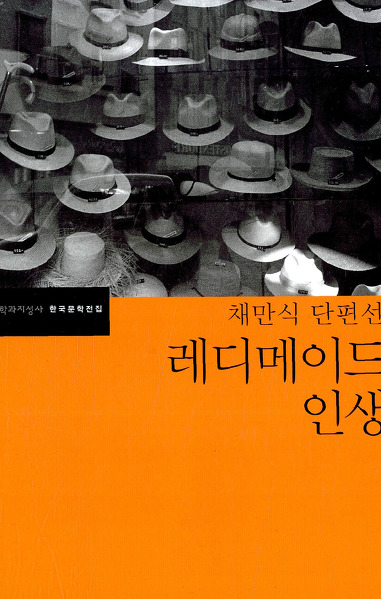
1.
We usually hear and learn that Chae Man-sik's novels make him the foremost master of satirical fiction. There may be various reasons for understanding it this way, but I suspect it's because the representative novels describing him—'A Peaceful World Under Heaven,' 'My Idiot Uncle,' 'Mister Bang'—are the works that come to mind first when one thinks of satirical fiction. But in fact, it may be somewhat unreasonable to grasp Chae Man-sik with only the single keyword of 'satirical fiction.' His other representative work, 'Sinner Against the Nation,' does not mock and attack the protagonist and society through satire. It is merely a work that contains the anguish of an intellectual and ponders just what action an intellectual ought to show regarding the morality and goodness that was called 'morale' in that era. Also, works written after liberation, such as 'Mister Bang' and 'A Tale of Rice Paddies,' go beyond mere satire to show that even though liberation was achieved, this is not directly connected to the happiness of life.
This time I referred to 'A Study of Chae Man-sik' (Kim Hong-gi (2001), Kukhak Jaryowon) as a reference work. The reason for this is that last time, when I read 'A Study of Kim Dong-in' together after reading Kim Dong-in's short story collection, it helped a lot in understanding the works. (Of course, I'm in the middle of writing that part too, but I'm not sure which will come out first. I'll add it as I write.) So this time too, I pair it with one more book.
The last work in the collection, 'The Legend of the Mantis,' is a play, and I didn't read it. The truth is I'm very weak with plays. I lack the ability to read plays well. Plays in written form are so difficult—it'd be less so if I just watched a performance directly. .
2.
1) A Tale of Rice Paddies: This is a work belonging to the category called both satirical fiction and psychological fiction. It satirizes a character who, having sold his rice paddies during the Japanese colonial era, complains even after liberation that they won't return the paddies he sold, asking what use the country is even after liberation. It doesn't simply satirize the character. Here there is also the author's deftness in capturing social reality well so as to enable the satirizing of the character. Now as then, 'rice paddies' (land) are one of the biggest factors by which the scale of wealth is determined.
2) Ready-Made Life: Because of this 'Ready-Made Life,' I think Chae Man-sik's novels should not be classified simply as 'satirical fiction.' 'Sinner Against the Nation,' which I'll discuss just below below, is for the same reason. Ready-Made Life begins with 'P' being unable to get a job. It depicts a life that has become an 'intellectual' yet cannot get a job, while on the other hand cannot do manual labor precisely because he became an intellectual. I borrow an expression from the work.
If he hadn't become an intellectual, he'd rather have become a laborer, but being an intellectual, even if he enters that world he runs right back out—99 percent of the time. The rest are all unemployed intellectuals with slumped shoulders, masterless dogs of a house in mourning who heave only blue sighs amid a powerless cultural reserve army. It's a ready-made life.
I wonder whether things are really any different now. I think it's still an era overflowing with 'ready-made lives' not much different from then. (Such words are my expression revealing a view of society still mixed with strong cynicism and pessimism, but I can only say that's how it is.)
3) Mister Bang: Mister Bang depicts the rise and fall of 'Bang Sam-bok.' It's satirical fiction in that it reveals 'Bang Sam-bok's' falsehood and exposure, and on the other hand it's also satirical fiction in that it shows Squire Baek's attitude changing. The change in Bang Sam-bok's social status as he rises by becoming an interpreter for a U.S. army lieutenant, and the change in his attitude, and so on, show the chaos of post-liberation society and contribute to depicting the disordered state of reality. This too is tremendous satire...
4) Sinner Against the Nation: Chae Man-sik is one of the representative literary figures who tried not to participate in literary-circle activities after liberation. The reason for that lies in his own reflection on having acted as a literary figure promoting Japan at the end of the colonial era. The 'sinner against the nation' here—that is, the protagonist 'I'—can without exaggeration be seen as the author himself. The usual reason this work is compared with Yi Tae-jun's 'Before and After Liberation' is that the 'Hyeon' appearing in Yi Tae-jun's Before and After Liberation is in fact no different from Yi Tae-jun's own path, and he casts off his anguish and begins to act, joining a socialist-aligned literary organization. Chae Man-sik, despite the requests of the many who tried to draw him in, ultimately returned to the countryside and spent his final years writing his other masterpieces after liberation (Mister Bang—1945.11.16, Constable Maeng—1945.12.19, A Tale of Rice Paddies—1946.4.18, The Road Back—1946.4.24, Sinner Against the Nation—1946.5.19). I suspect he judged that the intellectuals of the literary world at the time had no bone-deep reflection. In fact, the writings of those who did 'self-criticism,' led by Im Hwa, were not of a high level. Kim Dong-in, Yi Kwang-su, and others were not much different. In such a situation, 'Sinner Against the Nation,' written by Chae Man-sik who could not set himself right without first doing 'self-reflection,' is a work whose value cannot but be appraised most highly as self-reflective literature.
5) My Idiot Uncle: My Idiot Uncle is a novel that, through the narrator's gaze, shows an uncle who engaged in socialist activity while satirizing the 'narrator.' I don't recall properly seeing a work like this before My Idiot Uncle. Chae Man-sik showed, through his own craft, that a narrator with an immature gaze can be satirized to this degree. I can only call him a truly great writer...It came up on an exam a while ago, so it's not a work that'll appear for a while. But apart from that, the author said he didn't like his own works such as 'My Idiot Uncle' or 'A Peaceful World Under Heaven.' Should I say they don't seem like realism..
6) Sunset: The story of 'I,' 'the Hwangju aunt,' 'Chun-ja,' and 'Yeong-chun' can be seen as revealing disappointment with the outcome of post-liberation society. I suspect it contains the author's gaze on the differences in perception among various generations, the tragedy of reality, and the establishment of a separate government after liberation in which no value system could properly stand. It is, literally, 'sunset.' In particular, the scene near the very end where he talks again with 'Chun-ja' truly made me sad.
7) The Mugwort Cuckoo: This is a work that indirectly depicts the circumstances of a degenerate era through the mugwort cuckoo. Perhaps because the preceding works were too intense, the latter work came across to me as somewhat weak.
3.
Chae Man-sik attended Waseda University and dropped out. He himself, when making his literary debut, thought that literature was something written by geniuses and perceived himself as a genius, and the basis for that was that although he was the youngest, he had outstanding ability. But the 'getting by' brought on by his family's downfall was by no means smooth, and there is no doubt that this may have appeared as various kinds of 'gloom' in his world of works. The unwanted marriage was probably one of that kind too. But I want to praise his consciousness as a writer highly. While everyone treated the past as if it didn't exist (one might say their actions weren't so, but well, since I don't think they did proper self-reflection after liberation..) and fought for power, struggling to seize the initiative within the literary world, he alone did what had to be done.
He's wonderful. In a writer like this, we can find the buckthorn tree we used to read about in poetry.
Comments 0
No comments yet. Be the first.