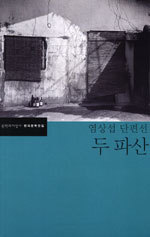
1. Yeom Sang-seop's fiction occupies a fairly important position in the literature of the 1920s. Kim Dong-in early on, regarding Yeom Sang-seop's novel 'The Green Frog in the Specimen Room,' acknowledged that he had seen in it the confessional-style fiction he himself had failed to achieve, and that became the starting point from which Kim Dong-in and Yeom Sang-seop established themselves as reliable rivals and fellow writers. Considering that Kim Dong-in at the time was a coterie-magazine publisher and at the same time lived as a 'literary' person, the most outstanding artist among those engaged in art, the fact that such a fierce Kim Dong-in acknowledged Yeom Sang-seop, I think, serves as a basis for guessing just how impressive Yeom Sang-seop's position was. Among Yeom Sang-seop's novels, the ones I read with difficulty, 'Three Generations' and 'Before the Cheers,' plainly show that I can't keep up well with his prose style; 'Three Generations' was at least okay, but 'Before the Cheers' was quite hard, and 'The Green Frog in the Specimen Room' compounded that difficulty. In my personal feeling, with 'Three Generations' there was no small amount of slackening tension due to its length and repetitive conflict, and relatively, unlike the structure of Yi Gwang-su's 'The Heartless' where conflict intensifies and then subsides again, the story proceeded with conflict continually latent, which I'd conclude was hard; whereas with 'Before the Cheers' and 'The Green Frog in the Specimen Room,' I see it as because the gloominess of the atmosphere those works give off was just too strong. Still, because their value as 'confessional literature' is important, this time I think I'll do a simple summary using these short stories of Yeom Sang-seop. For reference, 'Before the Cheers' tends to be classified as a novella, and indeed it isn't included in this book, which is a short-story collection; there was a separate Yeom Sang-seop fiction collection bundling it with other novellas. I'll write in more detail about 'Before the Cheers' around the time I get to read that. 2. The works were harder to read than I'd expected. The tendency was especially severe the further back toward the early works I went.
1) The Green Frog in the Specimen Room: It begins from the story that the green frog he kept jabbing with the dissection tools in the novel still hasn't been forgotten. This novel is evaluated as the first naturalist novel, and the protagonist that appears here is not a protagonist meant to show some 'narrative,' but appears as a single 'case' that compactly shows the life of an intellectual who has gone to 'ruin.' For that reason the narrative's gripping power may be somewhat lower, but through this low-impact narrative the reality the author wishes to reveal came to be well expressed.
2) Dark Night (闇夜): The expression 'a slave to material life'.. left a deep impression.
3) New Year's Eve (除夜): It's the story of a 'new woman.' It contains the idea of free love, and on the other hand also contains the importance of education for women. The narrator's anguish is revealed as the core part of this narrative. It put forward as the protagonist a character whose 'individuality' is revealed - the relationships with P, K, E, and so on, and the narrator's perspective on studying abroad and on love. Taking an interest in E, who had spoken of wanting to study abroad in Germany, marriage talks went back and forth between them, but in the end she couldn't marry him and married a certain man living in Daegu; yet because of a child conceived with a man she'd met before the marriage, she ultimately ends up leaving that household. It can be seen as a characteristic Yeom Sang-seop novel that tried to link 'love' with modernity. If, as a modern human being, one were to enjoy 'freedom,' there is in fact nothing one can enjoy as freely as 'love'; yet the novel internalizes the conflict that arises because society is not like that. I think this problem is still valid even now. And to add, I suspect a broader understanding of the 'love' problem is possible when it's linked all the way to 'Three Generations.'
4) Teacher E: 'Teacher E' is the protagonist of this novel. It's a work depicting the conflict that arises as he takes up a teaching post at a certain school. Teacher E, as an intellectual of action, earns the nickname 'hedgehog' and gains the trust of the students, but a conflict with Teacher A, the physical-education teacher, becomes the pretext, and Teacher A ends up resigning from the school. Afterward Teacher E tries to lead the students in a more righteous direction, but stirs up conflict with the students over the composition topic of 'the exam.' In fact, however, it turns out Teacher A had planned this, and the novel reaches its conclusion after the principal returns. The anguish of an intellectual trying to put what's right into practice appears, but the problem of 'marriage' still appears here. In the earlier novel 'New Year's Eve,' the marriage problem was truly a complicated matter, and this is the same. Somehow it bothers me that, unless 'marriage' as a subject is a problem stemming from the author's own experience, it doesn't seem like it would appear this frequently, yet it keeps appearing. The appearance of a narrator who dislikes marriage arranged by parents rather than autonomous marriage is one of the general characteristics of 1920s fiction, but that 'universality' doesn't dilute the very fact of having refused marriage.
5) The Rotary Press (輪轉機): It depicts the figure of a company that, despite running a 'newspaper company,' can't turn the rotary press because it has no money. Because it's 'labor' done to earn money, a conflict appears between the ordinary people who are desperate to make money right now and the protagonist who wants to draw a somewhat bigger picture.
6) A Lodging Record (宿泊記): The 'lodging record' that a penniless protagonist writes while moving here and there is precisely the title of this novel. It depicts the wandering of an economically poor person. While depicting the matter of whether even a 'Joseon person' is accepted or not, it gives form to the problem of identity.
7) Son of Liberation (邂放의 아들): A work in which the symbolism the 'Taegukgi' gives off appears strongly; it compactly depicts the conflict situation of the time, portraying the figure of a man who had passed himself off as Japanese trying to live as a Joseon person after Liberation. The matter of marrying a Japanese woman must have been a 'means of sustaining one's livelihood' for many people before Liberation. As Liberation came, figures like 'Jun-sik,' who had tried to live alongside 'the Japanese,' appeared.
8) The Western Sweets Box: When I first read the title I couldn't understand at all what it was talking about, but a 'Western sweets box' is a sweets box, a 'Western' one - that is, a sweets box that came from the West. Here, the 'Western sweets box' is a gift Bobae received from 'Miss Lee' for having done an English translation, in a situation where it's hard to make a living. But regarding this, the mother gets angry at the father and the sweets box is flung to the floor. Here is depicted a 'father' who, despite being a 'bachelor of English literature,' can't properly bring in money, along with the figure of the post-Liberation period. It's a work in which one can recognize that the 'love' problem present at the start of Yeom Sang-seop's literary tendencies had, by this period, already shifted its focus to 'economic problems.'
9) Two Bankruptcies (破産): Usually the bankruptcies of 'Two Bankruptcies' are interpreted as spiritual bankruptcy and material bankruptcy. The 'bankruptcy' of losing the stationery shop and the bankruptcy of losing 'spiritual value,' like that. In this novel where two people who were once friends fall out over money, there is a 'husband' who appears as an incompetent man, and a 'principal' who once worked in education but now makes a living through usury. It's one of Yeom Sang-seop's representative novels depicting the social conditions after Liberation.
10) Cutting Off Grain (絶穀): This too is a post-Liberation novel; 'cutting off grain' means to cut off grain. That is, 'fasting,' and the fasting here appears in two forms. One is voluntary fasting and one is fasting imposed by others. The 'fasting' that arises because the household is poor is contrasted with the grandfather's voluntary fasting, giving form to the novel's theme. The death of 'Hye-suk' from tuberculosis that appears during the unavoidable fasting, and the 'meat dish' that comes up afterward, are truly symbolic. As Chae Man-sik said before, the situation appears in which, even though Liberation came, the lives of the ordinary masses hadn't changed much.
11) A Stained Scene of the Times: This darn 'Seotda'(card game)…..suddenly I'm reminded of the film 'Tazza.' It depicts economic problems (hardship of living), the problem of mixed-race people, and family conflict. It was curious that it wraps up relatively warmly. I thought, so this is what 'a stained scene of the times' shown in the title is. Then I asked back what on earth an unstained scene of the times would be like, but an answer doesn't readily come. It's regrettable to fall into pessimistic thoughts about whether, after Liberation, conditions for the masses to live a life worthy of the name were even possible, but I myself just keep doing so. It's because, as I read on, the works of this period mostly tell these kinds of stories, so I grow skeptical. 3. If I compress Yeom Sang-seop's early tendencies into 'individuality and art,' his individuality appears, first, in the most basic problem of love. From 'Three Generations'' Jo Sang-hun and Jo Deok-gi, to 'New Year's Eve' written here, to 'Dark Night,' to 'Teacher E,' the 'love problem' intervenes in all of them. They may be characters who try to pursue autonomous love but can't, or characters who pursue an outright degenerate love. Or there seem to have been characters with no intention of pursuing love at all. In the later period, the focus does seem to return from 'love' to other conflicts. A work like 'Two Bankruptcies' discusses 'economic problems' and 'ethical problems.' The second characteristic is that he pursued 'nationalist literature' together with Yi Gwang-su, Kim Dong-in, and Choe Nam-seon. But because for him art was the expression of individuality, I think proletarian literature too could only be seen as belonging to one kind of art. Only, his logic of 'individuality and art' fits well if we say he criticized it in the sense of being wary of excessively 'instrumentalized' proletarian literature. 'Three Generations' is his representative work and is evaluated as a work that very symbolically and sharply depicted the social situation of the time, and the reason for that lies precisely in the characters' 'representativeness' and 'symbolism.' I didn't write a piece about 'Three Generations' and threw that writing away, but to summarize simply, within 'Three Generations' are contained a diverse cast of figures of the era. A degenerate educator, the eldest grandson of a posthumous-child family, the grandfather who built up the household, a socialist activist, a woman who nearly became a new woman but failed, a person who is poor but lives looking at the stars, a person who drifted from social values and went to ruin - all the figures one might expect from that era appear. The conflicts that arise among them were also very 'realistic,' so I think it can only be a highly-evaluated work. Also, as a writer who could wield 'Seoul speech' the best, Yeom Sang-seop was in a considerable position, and the fact that during his time in Manchuria he connects to An Su-gil was curious to me too. Come to think of it, from the late Joseon period through the colonial era to the early post-Liberation period, there were quite a lot of cases of doubling as journalist and writer, and Yeom Sang-seop was likewise so; in particular, with Yeom Sang-seop there are many traces of having spent his time as a 'journalist' merely as a livelihood to earn money. In the early period, many protagonists with English initials appear - whether it was because writing or making names like 'Eum, E, K, S, P' was a hassle, or whether it was to generalize the 'intellectual.' A friend said it was probably because it was a hassle, but I think this was, hmm, one process of Yeom Sang-seop building up his own literature. Rather, in the post-Liberation novels those kinds of English-initial names don't appear. There seems to have been some kind of change there, and in the sense that they no longer appear once you leave the early works in which the influence of studying in Japan was very strong, I think such a characteristic can be understood as one dividing point that distinguishes the eras of Yeom Sang-seop's literature.
4. In truth, I think the novella 'Before the Cheers' and the full-length novel 'Chwiu' should also be included in this piece. I've read 'Before the Cheers' before and read 'Chwiu' before too, and both works always come up when discussing Yeom Sang-seop. But if the purpose is to write about them, I'd need to read them once more, and the problem is I can't bring myself to read them. Still, I do intend to read at least up to 'Before the Cheers,' so I think I'll be able to add it later.... 'Chwiu,' being a full-length novel, I'll have to think about it a bit more before deciding whether to read it or not. As an aside, the fact that Yeom Sang-seop's pen name 'Hoengbo' came from drinking enormous amounts of alcohol is curious to me, and on the other hand it's just curious that it lets one guess at his 'artist'-like side. Whether it's fortunate or not that he had no interest in women but loved alcohol….
---
Bibliography
A Study of Yeom Sang-seop's Literature (1987), Kwon Yeong-min, Minumsa
Comments 0
No comments yet. Be the first.