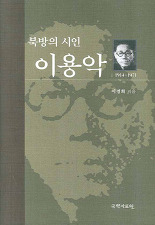
Until now, across colonial-era literature as a whole, the areas where I've read a lot of material — whether books or papers — are mostly 1920s nationalist-school fiction, 1930s poetry and fiction based on the coterie magazine 'Munjang,' and 1940s poetry — the poetry of Yun Dong-ju and Yi Yuk-sa published after liberation. As a result, there are some areas I'm somewhat lacking in. I'm lacking a lot regarding the 1930s Siinburak coterie members, 1920s poetry, and KAPF literature. Yi Yong-ak was one of the members of Siinburak. He was on friendly terms with Seo Jeong-ju. He belongs to the authors who have appeared a few times on the teacher-certification exam. The poetry collection 'Oranggaekkot' (Barbarian Flower) is quite famous among his collections. You could see it as a collection on the same level as Oh Jang-hwan's 'Seongbyeok' (Rampart), who was active in the same era. Anyway, I'll briefly note only what I jotted down after reading. This is closer to a simple record than to a review. The reason I'm not putting in any of my personal thoughts is that Yi Yong-ak's pre-liberation poetic world was quite consistent. After liberation he went up to North Korea with ideals but, frustrated by reality, his poetic creative activity can be seen as not very vigorous. His number of works is extremely limited, and he mostly wrote regime poetry — as is the case with much socialist poetry and fiction, works promoting and beautifying state policy appeared. Yi Yong-ak was no exception in that regard. But in the pre-liberation poems for which he draws attention, the sentiment of the North is contained. That's why they have meaning.
I'll mention only a few works that appeared on the exam.
1) Jeolla-do Lass: Hamgyeongbuk-do dialect and Jeolla-do dialect are appropriately mixed in. If you could grasp how this work reveals 'communal consciousness,' you'd belong to the cases of having read this work quite well, but I didn't manage that. It may be because I read too hastily, but since it's rather long, it was hard to grasp the poem's content all at once. Not all of Yi Yong-ak's works are this long, but many of them tend to contain a short 'narrative.' Many take the view that the 'Hamgyeong-do man' who faces the Jeolla-do lass is the author himself. Researchers say that among Yi Yong-ak's many works, the ones in which a young man from 'Hamgyeong-do' appears are easier to understand if you read them as projections of the 'author himself.' Indeed, since he was from Hamgyeong-do and was never far from a life of poverty and want his whole life, many say that sentiment is revealed throughout his works. I empathize with that part too. An environment that dominates a person over a long time has a considerable effect on that person's sentiment — to the extent that, knowingly or not, all of one's thoughts and reactions are related to that environment. — see pp.169–174
2) The Sound of Insects Filled the Air: This is the Yi Yong-ak work I felt was the saddest among the ones I read. The life of the poetic speaker's father is dissolved into the poem's content. Although the death of the father, who fed his children while going back and forth to 'Russia,' is an enormous sorrow to the poetic speaker, that sorrow is depicted in a truly pictorial way and is objectified. In other words, it's a situation where the speaker depicts it without emotional projection. It seems the very hard life Yi Yong-ak lived with his mother and other siblings after losing his father early begins to appear in earnest from here. This is my personal thought, but I suspect this 'pictorial' depictive ability surely came from the influence of modernist-school poets — the book argued that since 'Kim Gi-rim' was a poet from the same hometown, he was probably influenced after reading Kim Gi-rim's poetry collection. In the case of 'Baek Seok,' who well depicted the sentiment of the Jeongju region in Pyeongan-do, sorrow isn't inherent, but the way he renders poetic situations isn't greatly different from Yi Yong-ak's way. Still, I think the emotions are rendered differently. There may be a difference in that, while pain and poverty are revealed somewhat less in Baek Seok's poetry, in Yi Yong-ak's poetry they're always revealed.
The life as a migrant and the life as a poor family at the time that appear in this poem's content can be called representative content from which we can surmise that most people living in the colonial era lived hard lives. I think a work like 'At a Harbor Near Vladivostok' would also be easier to understand if put together with this family narrative of Yi Yong-ak's. — see pp.76–80
For reference, in Kwon Yeong-min's 'History of Modern Korean Literature' (2002), the description of Yi Yong-ak is far too brief. Kwon Yeong-min wrote: 'His poems, centered on the harsh experiences of reality in his boyhood, sang in a lyrical touch of the poverty and weary life that were hard to endure. His poems, while bringing experiential truth to life, simultaneously sought to expand the realm of that experience and shape it poetically into the wretched lives and impoverished reality of Koreans under Japanese colonial rule.'
Looking at the life of Yi Yong-ak, who 'worked his way through school' during his student days studying in Tokyo, I'm someone who has it really easy when it comes to studying. Looking at the life of Yi Yong-ak, who worked as a laborer at night to earn money for tuition and studied, I must live more diligently. I wish for myself to be able to hold the kind of steadfastness like the image of the 'Hamgyeong-do man' that appears in his poetry.
Comments 0
No comments yet. Be the first.