0. Last Saturday - on the 16th, I visited the 'Lee Jung-seop, A Hundred Years of Myth' exhibition. It had been a really long time since my last exhibition outing, so I had some expectations, and since a friend asked me to go together this time, I read a biography beforehand so I could play one-day curator for my friend. That biography is 'Lee Jung-seop: A Critical Biography, Choi Yeol, Dolbegae, 2014.' To talk about my satisfaction first, I'd rate it '★★★★☆'. It was an exhibition I'd want to recommend to others. There are occasionally exhibitions I recommend like this, and I'm happy that this one is among them. Come to think of it, the exhibitions I went to this year were generally satisfying. Let's get to the main point.
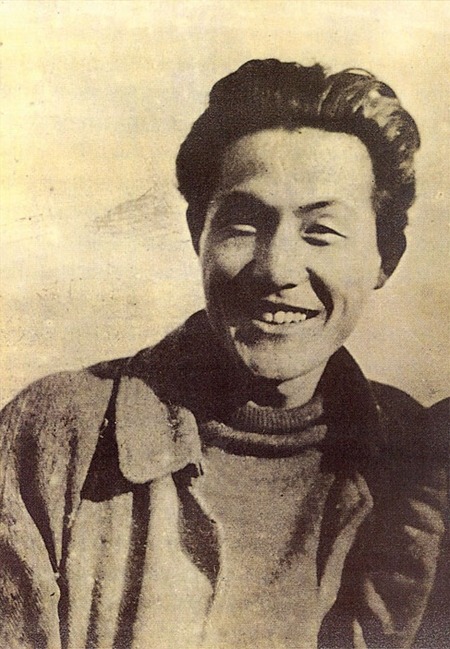
1. To borrow from the book's account, Lee Jung-seop is one of the 'mythologized' artists of modern Korea. Perhaps it's all the more so because he died lonely in a hospital at the age of 40, and because his life was that of an 'art-for-art's-sake purist.' But beyond all that, even this 'mythologization' would have been impossible without the story of his that can be read from the works he left behind. Fortunately, his story could be pieced together through the testimonies of many people and countless records, and based on this, his story became a myth. The exhibition of this artist who left such a large footprint in modern Korean art history was held this time at Deoksugung, and last Saturday I stopped by there.
I've been to Deoksugung many times. I went once with a lover I was seeing back then, and mostly I went all alone to see art exhibitions. One exhibition I remember is the 300 Years of American Art exhibition; even now the 'Brillo Box' I saw back then is vivid. It's a place with many memories for me. The palace isn't large, but it's a really nice place to stroll, and I was always glad that it has a special art museum exhibition hall like this.
2. First, to explain the exhibition's theme: it was organized around 'works' rather than chronology. It consisted of a total of 4 rooms. This was partly due to the structural characteristics of the 'Deoksugung Art Museum' and partly because the creation dates of many of Lee Jung-seop's paintings are uncertain. So the organizers arranged one room for 'silver-foil paintings,' one room for 'letter paintings' and his life in Seoul, one room for his life before the 1950s, and one room for the period when he spent his final years in Daegu and Jeongneung. Since 'photography' was prohibited inside, I'll explain how the exhibition was organized through writing, and refer to photo files for explanation.
3-1 Silver-foil paintings
If someone asks me to choose the most important work in Lee Jung-seop's art, the 'silver-foil paintings' absolutely cannot be left out. Even back when I knew nothing about Lee Jung-seop, I knew the 'ox' and the 'silver-foil paintings.' In this exhibition the silver-foil paintings were placed in the 2nd room, but since they are Lee Jung-seop's symbolic works, let's look at a few silver-foil paintings as examples first.
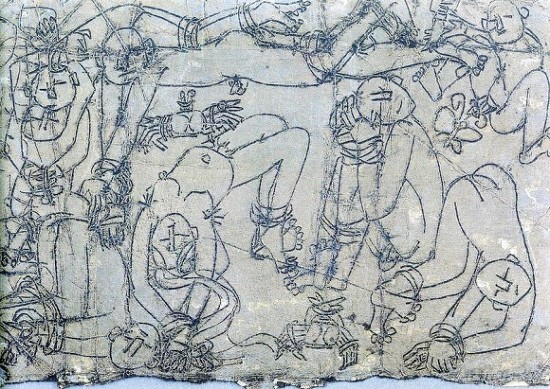
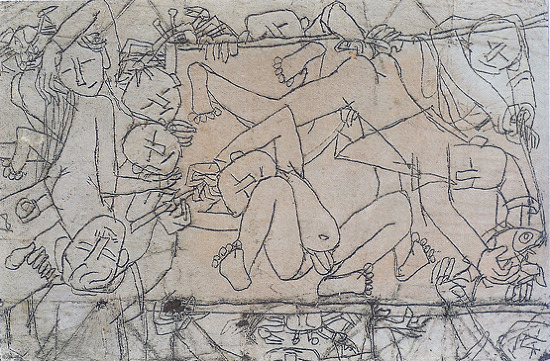
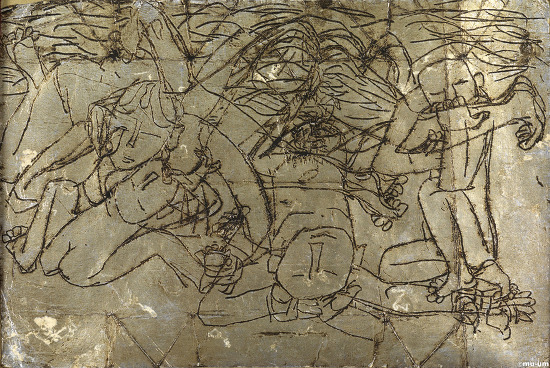
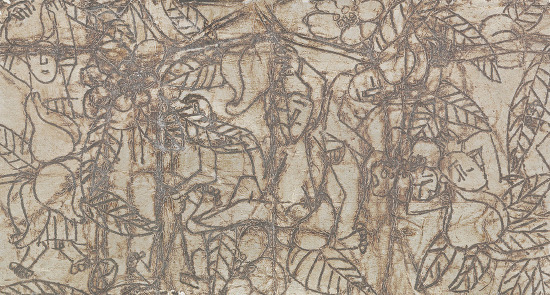
'Silver-foil paintings' are pictures Lee Jung-seop drew on the silver foil found inside cigarette packs. They weren't created simply by drawing, by 'applying color,' but through a process of scratching into the silver foil and applying color. Lee Jung-seop was an artist who placed great importance on drawing. His disciple Kim Young-hwan also used to say he learned the importance of such drawing from Lee Jung-seop. As that talent appeared in the silver-foil paintings, it was precisely in these 'silver-foil paintings' that he began to create pictures through line. If you ask why on earth he drew on the 'silver foil' inside cigarette packs, the answer can be said to be 'poverty.'
He was by no means poor from the start. Lee Jung-seop's maternal family was among the richest of the rich. His maternal grandfather ran a company, and based on that wealth, his cousin had already gone to Japan to study abroad while Lee Jung-seop was in high school. But after the war ended, the family had already fallen into poverty, and by the time he fled from Wonsan through Busan to Jeju Island, he had no proper money, so he lived day to day in poverty. To him, living like that, 'silver foil' was a kind of paper he obtained by chance, and Lee Jung-seop began drawing pictures on that silver foil.
The period when the silver-foil paintings were mainly drawn was, again, the time of his refugee life. It can be said to be the period when he went back and forth between Busan and Jeju Island. To bring out the characteristics of the 'silver-foil paintings,' the exhibition room was arranged as dark as possible, with light reaching only the 'silver-foil paintings.' However, the silver-foil paintings were crammed onto one wall; this was done because, given the nature of the room, it couldn't handle the light from the 'entrance,' but the use of space was still somewhat disappointing.
3-2 Life before the 1950s - Room 1
This was a quite disappointing part. For Lee Jung-seop, his life before the 1950s, that is, from birth through his middle and high school days, then his time passing through the Imperial Art School to Bunka Gakuin, and after marrying Masako, his art activities in Wonsan after liberation before fleeing as a refugee, was presented in just 'one room,' compressed to an excessive degree, which was disappointing. There was a lot of story to be told here. Moreover, on the exhibition route it was placed in the very first space... and it was so short... and even part of that middle space had been replaced with a video space... So I started explaining while lamenting to the friend who came with me. What can you do, I had no choice but to do the talking. Since the life of his teens and twenties was the foundation that made his artistic life possible, I slowly brought out the story. To summarize the explanation I gave my friend at the time, it's as follows.
1) The story of attending Osan School
After failing the entrance exam for Pyongyang Second Higher Common School, Lee Jung-seop went to Osan School in Jeongju on his maternal grandfather's recommendation. Jeongju in North Pyongan Province was the one city in the Pyongan region that produced an enormous number of intellectuals. Among the magazines later created with people from Jeongju, North Pyongan as the core, there's even a magazine called 'Sasanggye.' Other people from Jeongju, North Pyongan include figures like 'Baek Seok' and 'Yi Gwang-su.' As it happened, Osan School's founder 'Yi Seung-hun' and Lee Jung-seop's maternal grandfather had a connection, and through this he began his life at Osan School. The colleagues and juniors he met while doing art activities in the Osan School art club went on to meet Lee Jung-seop again when he later went over to Tokyo, in some cases; the standing of the Osan School art club appeared to be considerable. Someone like 'Mun Hak-su' is a representative example. If Mun Hak-su drew 'horses,' Lee Jung-seop drew 'oxen,' so the two of them were often compared, and there are many traces in Lee Jung-seop's records of his high regard for 'Mun Hak-su.' While living like that, the art teacher Lim Yong-ryeon, a Yale University art graduate whom he met, had a great influence on Lee Jung-seop, and afterward the works he submitted to competitions under Lim Yong-ryeon's guidance were selected several times, creating the opportunity for Lee Jung-seop to enter the world of 'art.' Of course, in the middle he injured his arm once and had to take a break from school, but even during that period Lee Jung-seop seems to have matured.
2) His Tokyo study-abroad days
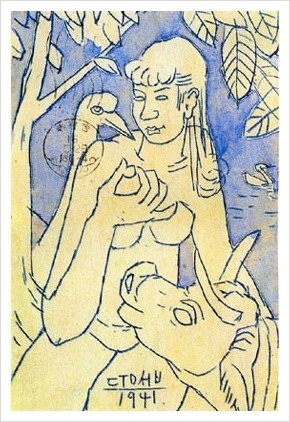
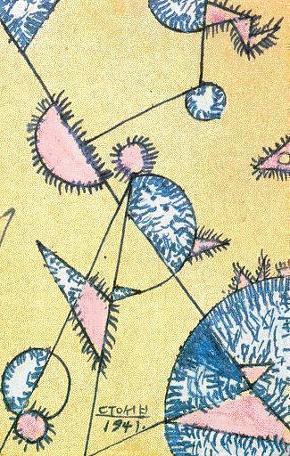
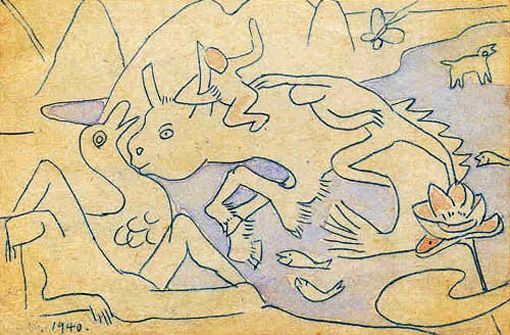
As for why he went to Tokyo to study, Choi Yeol gives these reasons. Lee Jung-seop wanted to go to 'Paris,' but while attending the Imperial Art School he returned to Korea midway, and since he ultimately needed his family's help to study abroad, he chose the relatively more feasible Bunka Gakuin. As for how he came to attend the Imperial Art School at first, he cites the fact that it was hard to get into the Tokyo School of Fine Arts at the time, and that Lee Jung-seop's cousins had already settled in Tokyo and were attending school there. This is exactly when the saying that environment matters can be used. Because the people around him were in Japan, I think it was natural for Lee Jung-seop to take an interest in that direction even when he went to the Imperial Art School. Anyway, after finishing Osan School, at age 20 he went to Japan to study art, and passing through the Imperial Art School, he entered Bunka Gakuin. Bunka Gakuin is recorded as the freest-spirited school of its time. In 1944 it ended up being closed precisely because it wanted to keep protecting that free atmosphere, but for Lee Jung-seop, he eventually married Masako, whom he met while attending Bunka Gakuin, and during his time in the research course at Bunka Gakuin he sent those famous 'picture postcards' to Masako, and he was very active during this period. He participated in the Free Artists' Association and held exhibitions among Koreans at the time. From my perspective, I thought this might have been the happiest period. The paintings of this period have varied and stable color, and the lines are soft and beautiful. In a situation where it wasn't a time when he couldn't paint for lack of money, I think Lee Jung-seop's life as an 'art-for-art's-sake purist' shone the brightest during this time. The years of one's twenties and thirties are said to be a time overflowing with energy and passion, and that was true for Lee Jung-seop too. But Lee Jung-seop's once-comfortable life began to change little by little after Japan started World War II.
In the case of the picture postcards, more than about 20 works were gathered on one wall. As you look at them, you can find yourself thinking how truly beautiful they are. From here you can already feel just how devoted his love for Masako was.
3) Residence in Wonsan after study abroad and before liberation
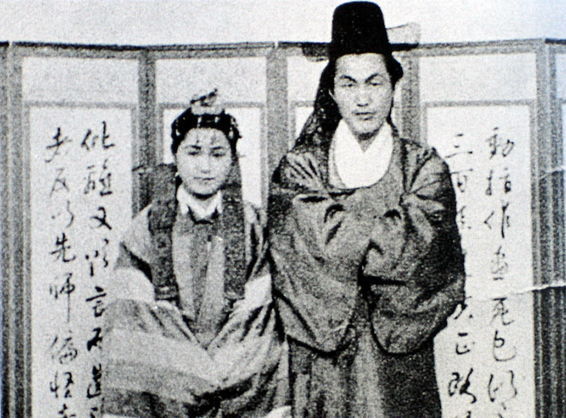
As Japan declared war on the United States and Britain as well, Japan gradually fell into danger, and Lee Jung-seop crossed over to Wonsan first. He parted from Masako, but afterward Masako, after a voyage that risked her life, arrived in Korea, met Lee Jung-seop, and held their wedding. The name given to her at this time was 'Lee Nam-deok.' When I see the countless works in Lee Jung-seop's art that wouldn't exist without 'Lee Nam-deok' (Yamamoto Masako), it's truly heartbreaking, yet I could feel Lee Jung-seop's pride as a 'painter.' Some might say Lee Jung-seop's works would have come out even without 'Yamamoto Masako,' but 'Yamamoto Masako' risked her life to cross the sea during the war to come meet Lee Jung-seop, and he married that Masako in Wonsan in 1945. Masako's love for Lee Jung-seop was also devoted.
4) 1945 ~ life in Wonsan before fleeing to Busan
The exhibition didn't describe his life in Wonsan at length either. I think the biggest reason for that is that the works he left behind in Wonsan can't be seen. After staying in Wonsan following liberation, he was investigated for being involved in the illustrations of Gu Sang's collection 'Eunghyang,' and later when the national army occupied Wonsan and then began the Hungnam evacuation, Lee Jung-seop boarded a boat fleeing south, taking his wife and two sons. At this time most of his works were left behind in Wonsan, so the works from 1945 to the early 1950s do not survive. But there are records of Lee Jung-seop being active in art organizations during this period, and since Wonsan was the only city in North Korea at the time that could rival 'Pyongyang,' its influence and scale, though hard to gauge, are presumed to have been considerable. Oh Jang-hwan, whom he met during this period, he encountered again as a person immersed in the ideals of communist ideology, unlike when they had met before, and 'Gu Sang' fled to South Korea first but later became a very close friend in Lee Jung-seop's life. Gu Sang even wrote a poem for Lee Jung-seop after his death. Looking briefly at Gu Sang escaping while under investigation: among the people who came from Pyongyang to investigate at the time were figures like Han Seol-ya and Song Yeong, and Han Seol-ya is a representative writer who became immersed in idolizing Kim Il-sung after liberation. From the Communist Party central leadership's viewpoint, the organizational activities within Wonsan were not to their liking, which is why they sent these culture-bureau people. What a small world it is. In any case, with his 'Wonsan' life ending like this, Lee Jung-seop, boarding a boat with his family during the Hungnam evacuation, came to face yet another life. That other life was in rooms 2, 3, and 4 of the exhibition.
Honestly, the first room was disappointing. Given the nature of the exhibition, an exhibition with only 'text' and no paintings was relatively awkward to organize, so I understand keeping the story up to this point brief. So it couldn't be helped. As a result, it felt focused on the period afterward. That later period unfolds in South Korea. The times he spent in Busan, Seogwipo, Tongyeong, Seoul, and Daegu are precisely the period of his activity in South Korea. One fortunate thing is that there are picture postcards, which survive relatively well among the works up to Wonsan, and works that survive only as plates printed out and displayed, so I hope you'll be sure to see those. I don't know how far the curator will explain. I didn't get to hear the curator's explanation (I didn't find a docent during my time slot...), and it's just that I felt it was lacking compared to what I'd read in the biography, so this part may differ from person to person. If a docent fills in the insufficient content up to Wonsan, it would be easier to understand his character as an art-for-art's-sake purist, but since I've never seen that happen... Still, I think if you refer to this writing, you'll understand his life up to Wonsan in rough outline.
3-3 Tongyeong, Seoul
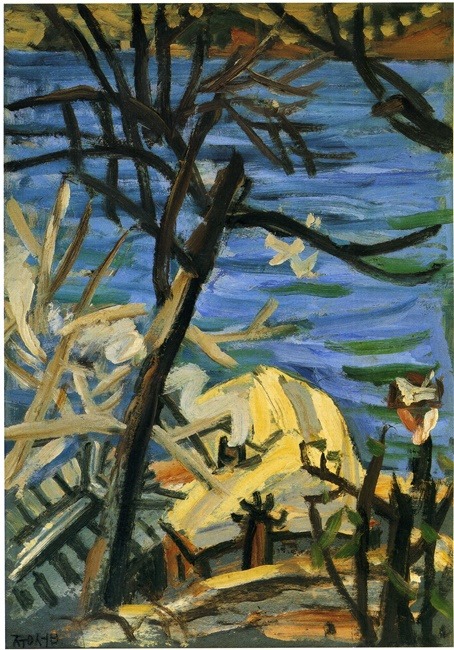
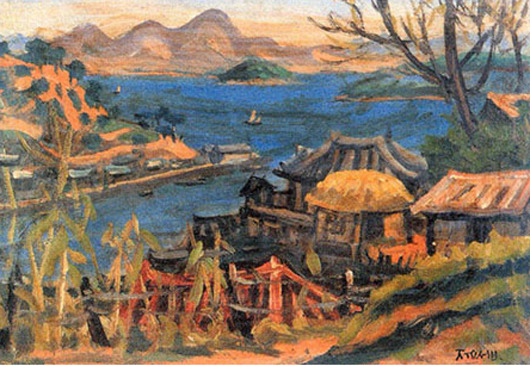
With the help of Yoo Kang-ryeol, who was the president of a certain steel company, he had a relatively stable art life in Tongyeong. The paintings of this time bring 'color' back to life again. It was a period when he could obtain paints and paper stably, and it appears to be a period when Lee Jung-seop himself enjoyed emotional stability. At the time, in a famous tea room in Tongyeong, Lee Jung-seop met Yu Chi-hwan and spent time with other artists. Among the works he painted during this period are works depicting the seaside scenery of Tongyeong, a work depicting Chungnyeolsa Shrine, and so on, and you can confirm in the paintings that, compared to before, there was more economic ease and his spirit was richer too. First, you can see a bit more economic ease in his use of paints, and you can feel the richness of his spirit in that peace is felt in the composition of the paintings. Perhaps Lee Jung-seop's own statement that his paintings are an expression of life can be confirmed from points like these.
After doing his art work in Tongyeong like that, he went up to Seoul and prepared a solo exhibition. The venue was the Midopa Gallery. At the time, the Midopa Gallery inside the Midopa Department Store was one of the Seoul galleries with the heaviest foot traffic. The purpose of the exhibition held here was to raise travel funds to go to Japan. He prepared works like that and submitted about 45 pieces. Among the works submitted at this time, the representative one is the 'White Ox,' which later passed to the Hongik University Museum, purchased under Lee Kyung-sung's lead. Among the photos taken at this time, the representative one is a photo taken together with his cousin Lee Gwang-seok and his family, and besides that there remain a guest book from the time and a photo with his colleague Han Muk. As the solo exhibition began, criticism of Lee Jung-seop's exhibition gradually started appearing in newspapers, and the critics of the time highly praised Lee Jung-seop's works. Among them, the criticism that said 'no new trend appears' particularly stays in my memory, because I think it well expressed Lee Jung-seop's art. Lee Jung-seop's art itself wasn't art that changed while following trends like Kim Whan-ki. He had his own unique composition, color, and touch, and in expressing it he used many extremely 'Eastern iconographies.' The iconographies we usually know, like the 'lotus flower,' 'wild goose,' and 'deer,' are representative clues that tell of the Easternness of Lee Jung-seop's art. The exhibition closed successfully, but unfortunately, in the process of collecting payment for the sold paintings, the collection didn't go well. He went around like that, but soon Lee Jung-seop entrusted the collection work to someone else and went down to Daegu.
3-4 Daegu, Jeongneung
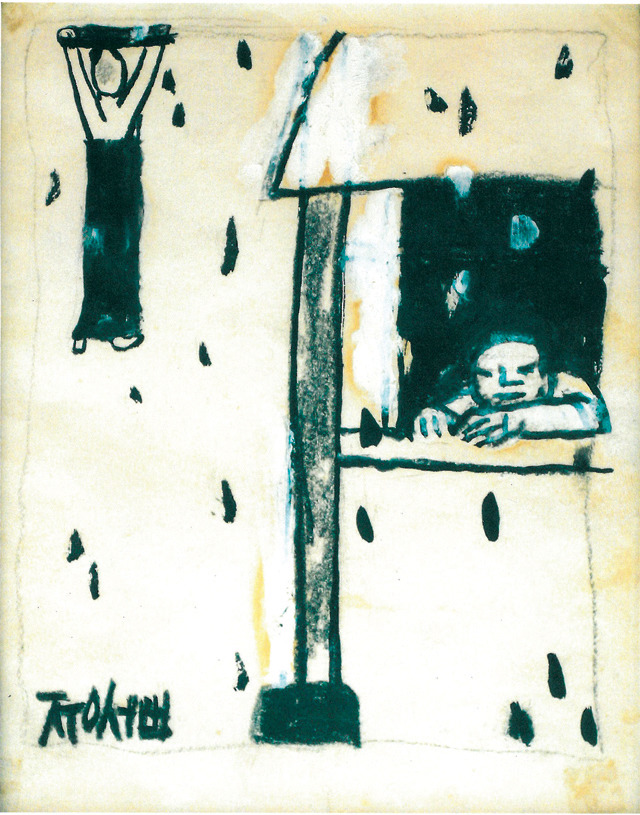
The reason Daegu and Jeongneung were grouped into one exhibition room is probably because this period is recorded as effectively his 'final' period. Following Seoul, he held a solo exhibition in Daegu too, but the Daegu solo exhibition failed, making the path to crossing over to Japan even harder, and from around this time it's recorded that Lee Jung-seop's mental illness compounded. You can understand this better from Gu Sang's record, which testifies that he made remarks heavily laden with self-reproach about having sold his paintings. After coming up to Seoul, he first spent a painful life receiving electroshock therapy in a psychiatric hospital, but afterward he was given a chance for art therapy by coincidence, and it's recorded that he overcame his first mental illness about two months after beginning the painting therapy. After recovering, he resumed his life as a painter while living in Jeongneung, but as his body deteriorated due to internal organ diseases like jaundice, his mental illness recurred and Lee Jung-seop's health condition worsened. It's recorded that Gu Sang, seeing Lee Jung-seop deteriorate like this, was very sad at the time. He was eventually moved to the Red Cross Hospital, but the free ward of the Red Cross Hospital was already a space for 'the dying,' and Lee Jung-seop passed away in 1956.
If I had to choose a memorable work among the paintings that were in Room 4, that is, the ones he painted in his final period, I would choose the 'Returnless River' series. The painting shown above is precisely one work from the 'Returnless River' series.
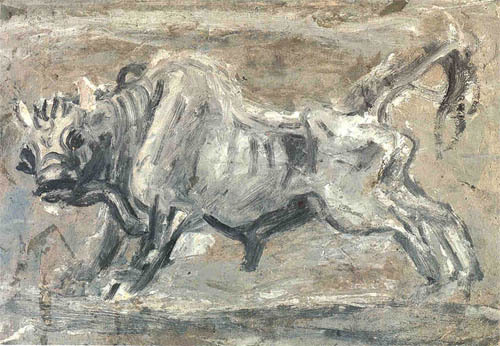
And then there's this 'faintly drawn ox.' Looking at the blurred ox, the friend who came with me said that Lee Jung-seop's life all appears in his paintings. It's really true. I don't think all painters are like this, but in Lee Jung-seop's paintings in particular, you suddenly feel the artist's psychological state at the time the work was painted, the surrounding circumstances, and Lee Jung-seop's gaze. I think that connects with the artist's values, which regarded his paintings as 'an expression of life.' Moreover, while Lee Jung-seop didn't seem to be in such a state back when the 'ox' appeared powerfully, this strange image seen in the late Lee Jung-seop shows the atmosphere of his 'final period.' This could be confirmed in the exhibition room too.
4. To conclude the review
If there's something I learned from Lee Jung-seop's exhibition, it was his passion and purity. If you ask how I was able to learn the word passion, I was able to feel it in his works. It's not simply because of Lee Jung-seop's creative fervor. The passion of continually pursuing what he wanted to express despite poverty was something to learn, and so was the pride as a 'painter' felt in the letters and postcards he sent to the people he loved. Also, even when carving his name into his own works, he carved his name in Korean written horizontally rather than in English or Chinese characters, and from that too I could learn his philosophy. From the records that reveal the guilt he, who pursued a life as an 'art-for-art's-sake purist,' felt after selling his paintings, and the regret over not being able to go see his sons and wife, I could feel his purity. About the purity and passion I had been dreaming of, I came to newly realize that Lee Jung-seop was a person who never let go of his grip on his passion and purity even as he approached the age of 40.
Someone once said: can you really live a life of continual failure while holding onto purity and passion in Hell Joseon? Set aside purity, passion, and what you want to do for a moment; when just eating and getting by is hard, how can you keep maintaining such passion and purity? But Lee Jung-seop was born in the Japanese colonial era and then went through a turbulent period afterward. Even while living hard, having fled because of the war to a southern place where he had no ties at all, he never let go of what he pursued. Would materials really matter to a 'painter' who wanted to keep painting? Isn't that exactly why the silver-foil paintings came about? Some say it was thanks to the countless people who helped him that he turned out the way he did. His maternal grandfather, Gu Sang, his cousin Lee Gwang-seok, Yoo Kang-ryeol the steel company president, and so many others helped him, so he was able to spread his talent. I can't deny all of that either. But I think such help also came because they recognized Lee Jung-seop's character. If you can feel the passion and purity he had even just from paintings decades old, what must the people who actually met him have felt... The thoughts that come to me as I read the surviving records aren't much different. To sum up, I think the figure of the person called Lee Jung-seop was someone who pursued what he pursued.
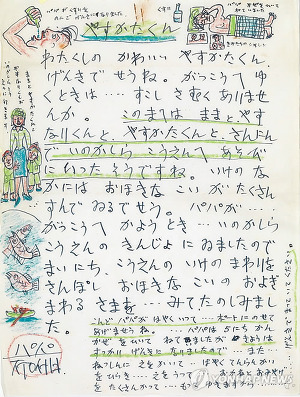
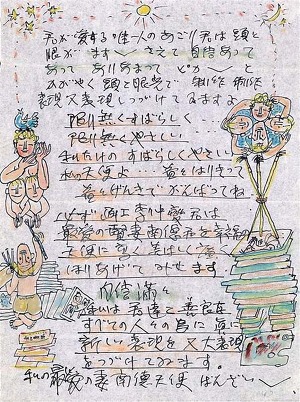
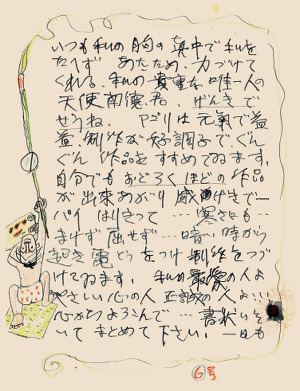
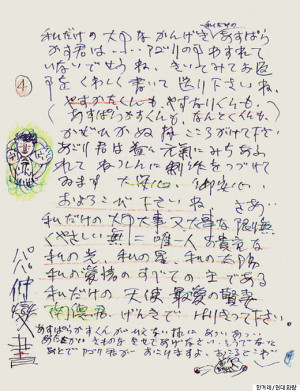
There's a bit of personal reflection too. I'd been thinking I wanted to try becoming a romantic. Purity and romance have a point where they connect. But this time, looking at the letters Lee Jung-seop sent, I reflected that I shouldn't talk about being a romantic given who I am now. Becoming a romantic is quite a difficult thing; as I looked at Lee Jung-seop's countless picture postcards and letters, I felt his works give off such an enormous aura that most people would gaze at them with awe. For someone who uses expressions like 'asparagus,' what more words could be needed? I came to look back on whether I, too, had really struggled to break out of conventional things and existing frameworks, or whether I'd merely flailed. Hmm, what's important, setting all that aside, is that there really are so many ways and languages to express loving someone. And it was also meaningful that you can learn passion from such things.
Did I write too much only about reflection? Is it too textbook-like? But Lee Jung-seop was that intense. I think the criterion for judging an artist is how the artist's 'work' is, and Lee Jung-seop was intense because I could feel the purity and passion I pursue in his works. Moreover, I felt that his passion didn't come only from his surrounding environment but that his own will was there too. I think I'll write Lee Jung-seop down in my mind as a meaningful person to me.
Comments 0
No comments yet. Be the first.