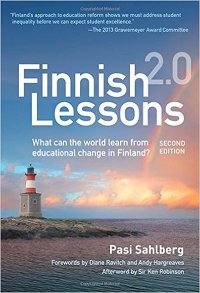

0. This is not the first time I have encountered Finland's education system. The book 'The Finnish Education Revolution,' which I briefly encountered a little last year and during my military service, is still powerfully imprinted in my mind. The way I came to read that book back then was through the help of an older friend who was a fellow soldier, and this time I came to read it simply to escape my dreary life. A life of nothing but studying for exams is truly dreary beyond words, so I often need some other source of vitality, and these days I'm doing a great job of 'reading,' so reading became that method. I picked the book because I wanted to. Since I had so much time left over, it was a book I stumbled upon while stopping by a bookstore for a bit. I read it because I thought I should buy it and give it a read.
While studying for exams recently, I have been encountering various theories of pedagogy, and among them the ones that have stayed with me most are teaching-learning theory and curriculum theory. The reason these particularly stick with me is that they are the parts most closely connected to the life around me. As I pondered which approach would have the best effect when talking to my younger cousins in some way, results like these emerged. As for why I thought of curriculum, it's because developing critical thinking about the current curriculum and recalling how the existing curriculum was structured also helped a lot with my exam studies. I have also been applying various theories—objective-centered curriculum, experience-centered curriculum, self-determination theory, achievement goal theory, social learning theory, expectancy-value theory, and so on. In that context, I think my understanding of 'Finnish education' was able to deepen a bit more.
1. Standardized Testing, PISA, Educational Reform
Above all, the reason I first felt 'Finnish education' was 'amazing' was probably in the PISA results. This small Nordic country came to score quite high in the international comparative assessment called PISA, compared to other countries. Korea reached a similar level, but what I paid attention to even more was the 'average academic achievement.' Even though it had to be accompanied by an understanding of the country called Finland, it was very valuable data. Finland was precisely the country with low income inequality and, compared to other countries, quite low inequality of academic achievement among students. From a very young age I held the position that we should prioritize education for ordinary people over 'elite education,' so seeing 'Finland' bring about such a result made my eyes spin. And after that, little by little, I began to think about education systems other than Korea's. About just what 'education system' and what 'education policy' would best help realize the educational ideal I envision. Some say we should do compensatory education, some say we should only do elite education, some say we should dilute the visible 'scores' as much as possible—there's so much talk, but how is one supposed to know what's right and what's good? But to sum up what I felt from the book I read this time, the point is that I began to ponder the standardized testing system itself, which makes such 'comparison' possible. The standardized tests—in other words, academic achievement assessments, the college entrance exam, and the so-called 'uniform nationwide tests,' along with various education policies into which 'standardization' and 'external logic' intervene—and the results they bring about.
As written in the book, after the 'educational reform' that began around 1990 in Britain, numerous countries began to apply 'market logic' and 'competition' to education. The reason they implemented it that way lay in the belief that teachers, trusting in 'lifetime tenure,' weren't working. On the other hand, under the current of 'neoliberalism,' there was also an atmosphere of trying to pursue low-cost, high-efficiency in 'education' as well. But Finland did not apply that 'external logic' to education and pushed forward with its own philosophy. An example of that is the ban on 'quantitative assessment' during the first 6 years of school. They recorded that they carried out students' development solely through 'qualitative assessment' for those 6 years. It cannot but be an astonishing thing. The 'educational reform'—which strengthens teacher accountability through the 'assessment-centered curriculum' I'd learned about before, and through strengthened accountability pits teachers against each other in competition to thereby practice better education—confronted the 'falsehood' that in reality it had never brought about improved results, and it was a shock to me that Finland instead showed improvement in 'academic achievement,' demonstrating that strengthening accountability is not actually strengthening accountability. Was the improvement of students' academic performance through 'standardized testing,' through comparison, really a mistaken notion? Perhaps there was 'critical awareness' that the existing system was wrong, but I feel that my ignorance about which system is better—in other words, about 'alternatives'—is somewhat resolved by reading this book. After all, Finnish education was raising students' academic achievement without administering standardized tests.
Moreover, it is important that by not administering standardized tests at an early point (before the 6th grade of elementary school), learners did not develop a sense of burden or aversion toward learning. That students who suffer the pressure of scores while taking standardized tests are very unlikely to view 'learning' itself positively is something anyone can understand if they think about it. Come to think of it, all students surely think of themselves as precious, so if they feel their value somehow drops because of a single 'score,' it's only natural they'd come to hate the test. Even with adults, just doing performance evaluations at a company has that effect, so children can be no different.
2. Compensatory Education
Another of the things that left a deep impression on me was the timing of 'compensatory education.' Generally, when living in Korea, I think compensatory education—supplementary education aimed at students who experience learning difficulties—is carried out mainly during 'high school.' It's very hard to see cases of compensatory education being implemented intensively during elementary or middle school. Especially if one did so during elementary school, parents would most likely rise up and protest, asking whether you're trying to brand their child as a slow learner. But in Finland, compensatory education was actually being implemented far more during the early years. The data the book presented is this graph.
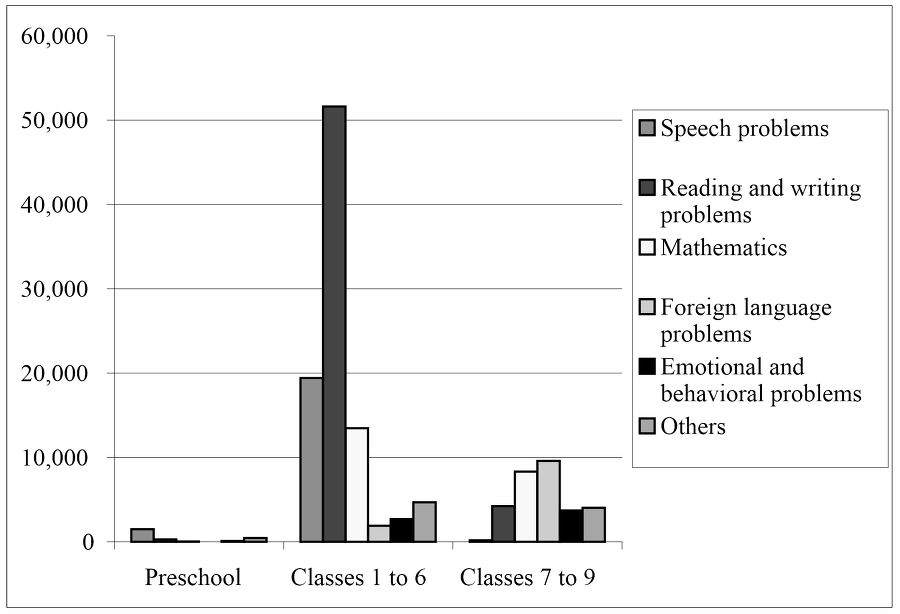
Interpreting this data goes like this. It means that compensatory education is implemented for students with learning disabilities at an early point—Classes 1 to 6 are grades 1 through 6 of Finland's comprehensive school system, so if converted to the Korean education system, you can think of it as the elementary school period—and this struck me as quite remarkable. I had pondered Korea's education system several times, so I'd given some thought to what the problems were, but it was remarkable that there's a country like Finland that actively implements a 'Head Start' movement, and I was shocked that such early compensatory education brings about the average improvement in academic achievement that comes later. Finland's education, which shows that theory is not just theory, that theory can actually be applied, has enormous implications. It's no exaggeration to say that most of Korea's education today is itself an educational system clinging to a system of 'external rewards' and 'standardized scores.' Everyone is fixated on test scores, and in fact it's an era with more parents fixated on external scores than on students' personal, internal goals. Yet they boldly rejected standardized scores and, from early on, created an atmosphere where anyone who falls behind can receive support early—not compensatory education as a 'stigma'—thereby raising students' average academic achievement. There was a reason various educational scholars criticized U.S. President Obama's education policy spearheaded by 'strengthening accountability.' It was because it had no effect.
3. The school is a small community that realizes democracy.
John Dewey's 'Democracy and Education' is evaluated as a book that made a considerably large contribution to modern educational philosophy. That's because, if we name the greatest reform of 'humanity' undergone in passing through the modern era, it would be the 'democracy' achieved on the basis of the abolition of the class system. Saying that everyone's voice is equally precious is precisely 'democracy.' It means that not the king deciding everything and wielding all power, but rather the rights of each individual 'citizen' being most important, and this democracy had become a value that can no longer be removed from modern society, and Dewey spoke of 'school' as the first space in life that realizes such democracy. And a researcher who visited Finland, upon reporting on the realization of such democracy, said that here a school grounded in the democracy that John Dewey spoke of has been realized. Although it is merely that researcher's remark, this holds quite great value. Here a question arose for me. Namely, which parts are said to be the realization of democracy.
1) Learners
I think it is difficult to explain Finland's school democracy while leaving out the learner. Their class curriculum, rather than being uniform-style classes over 2 semesters like in Korea, began with dividing the year into 5–6 terms and designing a level-differentiated curriculum for each individual student per term. Individual differences among learners exist in Finland too. Perhaps because minimizing such individual differences is the goal of Finnish education, I think providing an individualized curriculum for each learner is a considerably 'advanced form of education.' Korea does implement 'level-differentiated classes' too, but this amounts to at most 3 sections—upper, middle, lower. And because the year is operated by dividing it into 2 semesters, attention doesn't go well to students' individual changes. But in Finland there is an individual curriculum, and being able to choose classes suited to one's own level over 5–6 terms is 'democracy' that reflects the learner's opinion. Moreover, whether to learn more after completing the minimum compulsory education period is purely the 'learner's' portion. The atmosphere of society does not force this.
2) Culture Among Teachers
For most of Finland's teachers, the maximum teaching time is 4 hours a day. The remaining time is said to be used for teaching-learning research, consultation among instructors, and the like, and I felt that the occupational culture of teachers who can pour considerable time into consultation and material development is also quite democratic. The principal is no exception to teaching either. Like other teachers, they must devote time to 'teaching' equally. You can see the role of a principal who is far removed from the kind of teachers in Korea's education system who fail to properly grasp the realities of the field because they only do 'management.' Teaching, also managing the school, communicating with the local community, and needing to grasp educational trends—that is what the principals at Finland's many schools are. In such a situation, I believe consultation among teachers can only naturally settle into a rational consultation culture. Of course, the difference in society's overall culture cannot be ignored. As 'Tyler,' who appeared on the show Abnormal Summit, says, the fact that 'the elder-younger order' is not simply about following the opinion of the older person has, on its flip side, something to do with the irrational culture of Korean society. The reason many people, including myself, envy Europe's rational debate culture is precisely that it is closest to democracy. And Finland is realizing that.
4. Education is not made up of the 'education system' alone.
Northern Europe is among the best countries in the world to live in. Various social systems underpin this. The reason 'education' cannot be made up of the education system alone is precisely that it forms a very close connection with 'social systems.'
1) Free School Meals
At least in Finland, students don't pay money to eat at school. Here, the concept of 'universal welfare' applied to everyone takes priority, rather than discriminatory welfare based on the 'gap between rich and poor.' I think the reason they do this is that, when looking at the value of 'education,' they view it as shared growth for everyone rather than 'competition.' Korean society tends to insert economic-efficiency logic into everything. But when it comes to where to place the value of education, I support 'Finland's' universal education a bit more. Education must not be a matter of getting more or less depending on the income gap. At least considering that education can have the greatest influence in improving social structure, we should implement an education system that considers everyone as much as possible, and that's why I think it's enough for me if everyone receives quality education. They say any society is led by 5 percent of its people, but even so, if that 5 percent owns the wealth of society as a whole, isn't that wrong in its own way? The world doesn't belong only to those people; it runs because others contribute too. Even if the 5 percent make the plans, without the countless people who actually carry out those plans, those people could not become the 5 percent either. In that sense, I think elite education needs an approach as a concept of additional education for 'when the bright want to learn more,' and the basis should first be creating an environment where all students can learn as much as they want to. And in order to realize that, the external environments must be in place so that they can receive education that way, and one of those is precisely 'free school meals.'
2) Bonds Among People
It's no exaggeration to say that 'Hell Joseon' is in fact a 'specimen of broken trust.' At a time when many countries that achieved rapid industrialization in the late 20th century still grapple with corruption, mutual bonds and trust are hitting rock bottom. Yet Finland, even though it wasn't a particularly wealthy nation, did not lose trust among social groups. Although it had no outstanding industry, everyone agreed on the front of building competitiveness through education. Here I think this 'trust' is very important. Finland's educational reform was not something achieved briefly over a few years. Starting from the establishment of comprehensive schools as early as the 1970s, even as teachers from various schools began conducting classes in one place, everyone still sympathized with and agreed on the 'values' being pursued. To be able to say that the school closest to home is the best school, the members of the school must put in that much effort, and society must be able to give support and trust to members who make such efforts—and this society is pulling that off.
3) Corporate Culture
Among the passages I read in the book, the one that left the deepest impression was an interview with a person serving as a top executive at Nokia.
Even if we hire a young person who doesn't know the math or physics needed to work at our company, it's no big problem. We have colleagues who can easily teach math and physics. But if we hire someone who doesn't know how to work together with others, someone who can't think differently or come up with original ideas because they're afraid of making mistakes, there's nothing we can do. Do what you need to do to keep the education system up to date. But you must not eliminate the creativity and open-mindedness that now exist in Finnish schools.
The author Pasi Sahlberg recorded that this was content from a memo he wrote during the time he led the Finnish curriculum science-education task force in '92–'94, and it was quite impressive content. It was because it ran along exactly the same lines as the story my mother sometimes tells about the 'teacher certification exam' for selecting teachers. My mother also said that the certification exam should evaluate people's character and their ability to cooperate with those around them. What companies, too, sought to obtain through school education was not specialized knowledge but 'ability,' and this became, as an outcome obtained from Finnish education, one corporate culture.
5. What on earth can I tell the children living in Korea?
In OECD (2016), Trends Shaping Education (Paris: Author), the values that come with globalization were expressed simply in pictures, and if I pick a few impressive ones, there were diversity, immigration, climate change, 21st-century skills, social cooperation, national values, occupational inequality, rapid change, and 'the decrease of education budgets.' (There were tremendously many other keywords too, but there are too many to include them all, so I'll omit them.) It is clear that these various keywords will be applied to the educational field. After all, these are all stories related to everyday life. One must be able to understand the value of 'diversity,' must cultivate competencies suited to the 21st century, must find a path to social coexistence, the pace of change is too fast to predict, the neoliberal current is applied to education too with the logic of minimum cost and maximum efficiency being applied, and so on—various problems will be conveyed to students directly and indirectly. As a result, I find myself pondering. Just what kind of person who tells what kind of story should I become, and with what thoughts should I serve as a member of society.
I have many close younger siblings and cousins. Perhaps because nearly 99 percent of these younger ones currently attend school in Korea, after reading a book like this, I often ponder what I can tell them, and through what kind of story I can cultivate their inner motivation. Such pondering is also an extension of the simplest conclusion about my major subject, 'Korean language,' namely 'becoming an active reader and a skilled writer.' In that situation, I think what I can do for the younger ones is to play the role of a guide who helps them be able to take an 'interest.' I do not dwell on the school test scores or academy test results the younger ones bring. I tell them those things have meaning if you tried, but don't dwell too much on them. Instead, I tend to talk about 'attitude,' which can be a bit harder. Whether you enjoyed it, whether you did it because you wanted to, whether you tried, whether you feel the content you studied is good, whether there's anything that connects to real life. Once people start being evaluated by 'scores,' everyone is bound to get stressed. It would be nice if the numbers were absolutely high, but in a situation where not everyone can be like that, 'evaluation' in Korean education mostly focuses on 'ranking,' and as a result what you lose is interest in learning and what increases is nothing but a negative attitude toward learning. That's why I don't dwell on scores.
In my opinion, I think we need to cultivate a positive attitude in the growing children. Such a positive attitude does not come from 'scores,' and if we place the field where that positive attitude can be used most often in 'education,' then students can hold a positive attitude toward their own learning as well, and because they were learned and raised with positive values, I think they can also build the strength to be able to change society. And through that, society can change. I think we are a generation that must seek the path of 'coexistence' by pursuing a society where everyone can live better. When we do, true globalization will be achieved as well, and Korea, too, I think, will become a more livable country.
Comments 0
No comments yet. Be the first.