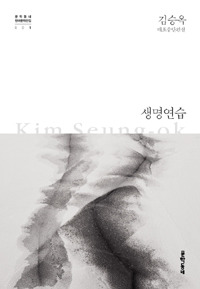
1. Kim Seung-ok is a writer who displayed his talent at a very young age. As the first generation to learn and grow up using only 'Hangul,' the 1960s writers came to present novels with a different mood and feel from postwar fiction. At the forefront were the writers we know well: 'Choi In-hun,' 'Kim Seung-ok,' and 'Lee Cheong-jun.' Among these three, I rate 'Kim Seung-ok' the most highly. That's because the stories of war fade away, and he is no longer telling the story of 'the individual from a macroscopic perspective' but simply talking about 'the everyday human being.' On top of that, even reading him again now, fifty years later, I really do get the feeling that he is 'modern.' I suspect this is the power that emerges from Kim Seung-ok's prose style. Another characteristic of Kim Seung-ok's fiction is precisely his 'inner world.' When you read his debut work 'Life Practice,' the term 'inner world' first appears, and in the debut piece the protagonist expresses this 'inner world' as a 'basement.' And the inner world of the professor who talks with the protagonist is expressed as an 'Oxford-made castle,' and the work talks about 'self-discipline' as the way to live while guarding such an inner world. Stories of cracks forming in that 'inner world' are works like 'A Journey to Mujin' or 'Seoul, Winter 1964,' while 'Life Practice' or 'Notebook of Fantasies' contain a bit more about how such an inner world came to be formed. You can also see, little by little, the inner world beginning to collapse. In 'Notebook of Fantasies,' there's a friend of the protagonist who mostly collapses, or who dies after firmly establishing his inner world.
2. I'd like to discuss all the works, but I judged 'Fecundity,' 'Geon,' and 'To Understand My Younger Sister' to be a little difficult, so I left them out. Also, I didn't want to leave out the works that remain longest in my mind and come to me most often, like 'Life Practice' and 'Notebook of Fantasies.' Other works I remember are roughly 'Seoul's Moonlight, Chapter 0' and 'A Cup of Tea,' but since they aren't included here, I excluded them. They are works I've read before, but because I think Kim Seung-ok's early works carry more significance, I'm leaving them out of this piece.
1) Life Practice : This is the debut work. The novel where the term 'inner world' appeared. Everyone has an inner world. That inner world might be a 'basement' (the protagonist-narrator) as it appears in the novel, or it might be a very sturdy fortress wall because it is 'Oxford-made' (the professor). The mother of the protagonist (narrator) has an inner world that, though invisible, seems close to a very solid and strong 'glass castle'; the older brother's inner world was in the 'attic,' and the older sister's inner world we can read through writing like 'paintings' and 'novels.' As a way of preserving this 'inner world,' the narrator talks about 'self-discipline.' The story of the friend who shaved off his eyebrows—setting the work aside, my own inner world, well, it exists, but I don't know how to explain it. The inner world I wish for is one where you can see every kind of castle just a little, in other words, where, when viewed from various angles, the castle looks different at each angle—building such a castle is my dream. I'm also a person who has an 'inner world.' That inner world is one that embodies and puts into practice a single 'ideal.'
2) Notebook of Fantasies : I really liked the title of this novel. Of course, in that the novel ends with 'death,' this work shares a lineage with various Western novels. The way the protagonist doesn't narrate directly, but the work is structured as a frame story, proceeding as if it were 'someone's memoir,' was truly fresh. And the various social and personal problems entangled here symbolize, very effectively, the anguish of the countless people living in that era, and the remarkable thing is that this story could play out very similarly even 'now.' Because the emotion I felt when I wanted to drop by home for a while had a strangely similar atmosphere to the protagonist returning to his hometown in the frame story. Both the prose style and the content are modern; even looking at it again now, it's modern. It's a novel whose story would be accepted even if it had come out just yesterday. The figure of the 'protagonist returning to his hometown' in 'Notebook of Fantasies' is not so different from the situation of countless young people today. The protagonist is said to have returned to his hometown 'in the middle of university life' and ultimately taken his own life, but these days it's a common situation for someone to take their own life while preparing for 'employment' after graduating university, so the timing has merely shifted a little while the essence remains unchanged. A notebook filled with 'fantasy'-like stories seems to gain resonance even to this day.
3) History : I had remembered this novel only as a story about 'a man who has kept his strength,' but reading it this time I came to realize that, in fact, beyond that story, there is another story hidden within it. It wasn't simply a novel trying to talk about a person who possesses 'strength,' but one trying to discuss which kind of life is more 'dynamic' and 'meaningful.' I'd like to discuss it in more detail, but then I'd have to lay out the entire contents of the book, so to summarize it goes like this: Are people who live regular lives truly happy, or are those who try, by whatever means, to live each day a little more, the happy ones? I still don't know the answer. Whether the meaningful life is the one where you go into your room every day at 10, get up at 6 in the morning, everyone comes out at a set time to eat breakfast and listens to music at a set time—put unkindly, a life like 'a squirrel on a wheel'—or whether a life that, though a bit harder, keeps thinking and struggling toward a better life is the decent one. I don't really know whether I've seen 'a decent way to live,' but even so, I think that endlessly pursuing something is meaningful.
4) A Journey to Mujin : A Journey to Mujin was a novel recollecting regret and memories of bygone days. In this novel above all, I think what matters is whether one agonizes over what 'my own path' is, amid various characters like Ha, Jo, and Park. That's because, unlike the protagonist in the frame story of 'Notebook of Fantasies,' this protagonist doesn't choose death but chooses the road back to Seoul, tearing up the letter he wrote and heading up. In the end, even though the 'I' who discovered the 'past self' chose to return to the present self, this novel was very sensuous. From the 'I' who says 'fog' is Mujin's specialty, to 'Ha' who wants to go to 'Seoul,' to 'Park' who complains about why he must sing such a song, to the friend 'Jo' who looks pitifully busy—this novel created the many possible faces of 'I' as separate characters so that you can feel them through their conversations. Following the past and present of the secretary 'I,' this novel is a truly remarkable work in that the more you reread it, the more you find yourself drawn to newly visible sentences and words. The agonizing figure of the protagonist 'Yun Hee-jung' is Yun Hee-jung's, but in truth he is also a 'proxy' for many people who read this work. Because everyone has had a past they dreamed of, and people who, living in the 'present' after that dreamed-of past, often live as someone far removed from the 'ideals' of the past. In the figure of 'Yun Hee-jung' coming to Mujin and agonizing, we can find our wandering past, or our present figure that is still wandering. Right. That's why this novel still stays in my memory and comes to mind often. His attitude of deciding to affirm irresponsibility just this once stays in my memory often. The fact that he wanted to affirm 'irresponsibility' that way and tried to step out of his inner world for a while, but failed, is also a characteristic of this novel. If 'Yun Hee-jung' had shattered his inner world, it would probably have become an unrealistic novel.
5) Seoul, Winter 1964 : The part early in the novel that sums up the atmosphere of 'Seoul, Winter 1964' in just a few sentences is truly a tour de force. Just as Kim Dong-in summarized Bok-nyeo's situation at the close of his novel 'Potato,' Kim Seung-ok proceeded with the story while mentioning the mood of the novel in advance in a few sentences. In this novel, no 'communication' takes place at all. In the figures of people hoping the fire won't go out, we can see the frustration and fear about 'a situation where one must set out searching for somewhere else,' and in the scene where An and 'I' learn of the 'man's' death and hurry to flee that spot, we can confirm the shape of 'individualism.' Moreover, as the title suggests, this novel reveals the very environment of its title with delicate yet concise descriptive power, and this can be said to be writer 'Kim Seung-ok's' most outstanding trait. The fact that 'An' and 'I' appear to wander at the end of the novel is precisely because their 'inner worlds' cracked due to the man's death.
3. In the end, Kim Seung-ok talked about the 'inner world,' discussed the way of living regarding this 'inner world,' and then discussed people whose worlds crack and waver ever so slightly. The ironic point is that after he later had a spiritual experience, he stopped his creative activity. Even in the part where, in publishing his collected works, he himself answers why his work is interpreted as 1960s literature, I suspect it's because his artistry can be found in the works he wrote as 'young Kim Seung-ok.' I'm not sure whether we should lament that the cracking of the 'inner world' didn't lead to the development of the world. Some critics say that if Kim Seung-ok had written just a few more works like 'A Journey to Mujin,' he could have become an even greater writer, but in the end that never happened, and it's probably because his artistry shines brightest when viewed against the backdrop of the 1960s era.
Comments 0
No comments yet. Be the first.