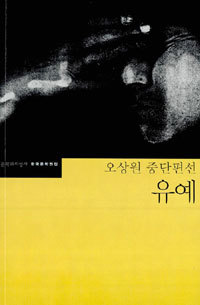
1. Among Oh Sang-won's works, 'Reprieve' is by far the finest. When we pick a novel that best exemplifies the 'stream of consciousness technique,' one of the narrator's narrative methods, we usually choose Yi Sang's 'Wings' and Oh Sang-won's 'Reprieve,' and so in order to understand this 'stream of consciousness technique' we often read 'Reprieve.' But in fact, while paying attention to the stream of consciousness technique shown in 'Reprieve,' many people also say that the novel 'Reprieve' itself is simply wonderful. That is because it properly possesses all the elements a short story should have. If one were to simply write down consciousness without any reason or context, it would probably become a novel like 'A Day in the Life of Kubo the Novelist.' That is because Park Tae-won's 'Kubo' writes down his consciousness based on the things he sees around him (Gyeongseong). The works to be examined this time are 'The Yellow Line Zone,' 'Reprieve,' 'Fracture,' 'Living Dead,' 'Treason,' 'Drifting,' 'Reward,' 'Reality,' 'Medal,' and 'Loss (失記).'
2.
1) The Yellow Line Zone: This is a medium-length story. In terms of book length, it runs about 150 pages. The 'yellow line' is a yellow line; if you're really clever you might be able to think of something just from this 'yellow line,' and the 'yellow line zone' referred to here points to a U.S. military base. Even now, 'U.S.' military facilities are still colored somewhat differently from Korean military bases. I'm not sure whether they are still 'yellow areas.' The content is the story of protagonists who want to secretly take out goods from a warehouse inside the 'yellow line base' and, using that as capital, live out the rest of their lives in comfort. Among them there is a brother and sister who must live together off 'prostitution,' and there is a man who keeps these 'prostituting' women as his own employees. There are also people without jobs. Since I know nothing about how much they stole from U.S. military bases at the time, I have no way of knowing whether this was written based on fact, but because many novels of that era all depicted lives lived off U.S. military supplies, the idea of stealing 'supplies' and making a big haul with them, like the protagonists in the novel, does not seem to be pure fiction. Sadly, just when the protagonists have nearly finished digging the tunnel, the American soldiers move the supplies from the warehouse to another place, so the warehouse they break into ends up being an empty space, and the novel ends as they show a hollow, futile laugh. The psychology of the characters is presented here in a very multilayered way. It reveals various psychologies—the psychology of Uncle Bear, the psychology of the young boy, the psychology of Jeong-yun, the psychology of the young boy's older sister, and so on—and the 'child's' gaze performs the role of criticizing this society and raises the question of just what 'value should be pursued.'
2) Reprieve: This is a work that narrates, through the stream of consciousness technique, the things that come to mind for a soldier who has been taken prisoner. Oh Sang-won made his literary debut by winning the Hankook Ilbo New Year's literary contest with this 'Reprieve.' I think it is a truly wonderful work. The 'consciousness' shown here is not an incomprehensible consciousness like the 'consciousness' in 'Wings.' Rather, I think it is a work that shows a fairly 'plausible' stream of consciousness. It is a work that makes you ponder what on earth war aims at, and on the other hand, what on earth the value of life is. The fact that the events taking place upon the 'white snow' are vivid enough in the mind that, despite being 'stream of consciousness technique,' you can imagine it as if painting a picture—that is another charm of this novel.
3) Fracture: One of the characteristics of the short stories Oh Sang-won wrote is that he wrote about 'right-wing organizations,' and here right-wing organizations are generally people who carry out the work of 'assassinating' certain people. The protagonist is a member of such an organization. Apart from these works, the 'protagonists' Oh Sang-won depicted in various works are protagonists who agonize over 'murder.' He raises the question of abandoning a human being for the sake of one cause.
4) Living Dead: This is a work in which individual psychology is revealed very intensely, and it uses a stream of consciousness structure similar to 'Reprieve.' If I were to pick one curious point, it would be that many of Oh Sang-won's 'short stories' conclude by depicting a scene that looks like 'death.' This work, too, had an ending structure similar to 'Reprieve.'
5) Treason: This is one of the two works that come to mind when I think of 'Oh Sang-won.' One is 'Reprieve,' the other is 'Treason,' and in this work 'Treason' he depicted a protagonist who joins a right-wing organization and then betrays it. In that sense it amounts to 'treason.' He depicts a protagonist who repents as the death of a girl's 'mother' overlaps with the illness of an innocent young man's 'mother.' Here the protagonist does not make the choice of killing one human being to gain another, but instead sets out to find a 'life for humanity' that he believes to be right. I think the description 'triangular face' is truly astonishing. It seems there has never been such a precisely felt 'character description.' Even though it is not a complicated narration, I think it was an apt word capable of describing the character's personality and behavior.
6) Drifting: This contains the stories of the older brother and me, and our older sister, all together. The story of 'father' is also contained here. Here the 'older sister' makes a living through prostitution with others, and the older brother criticizes the father's actions, but that does not mean the 'older brother's' actions are justified. Here too, in that the world is depicted through the gaze of 'Yeong-sik,' we can see that the 'gaze of a young child' is being used. But here 'Yeong-sik' is merely the object of the focalizing speaker, not the narrator. Yet Yeong-sik is never absent from any of the moments in which the events are depicted.
7) Reward: This too is mainly about people trying to survive by skimming off U.S. military supplies. Given this much, it seems we can regard the stealing of U.S. military goods at the time as something that happened openly. It is a strange novel that shows how the foolish have their own ways of survival in their own foolish manner. This too is a short story.
8) Reality: This contains the horrors of war. The deaths of innocent civilians were the kind of deaths that could be snuffed out as easily as blowing out a candle, all for the sake of the soldiers of war. The change in the relationship between the senior sergeant and Private Sin, and the conflict over killing civilians, run throughout the novel, and on that basis it reveals the cruelty of war. Just as the title suggests, it is a novel that makes you question whether 'reality' is something inescapable.
9) Medal: A 'medal' is in fact something honorable and proud, but the image of the 'medal' seen in the novel is not so. It shows that soldiers, too, are ultimately victims of war, and shows a situation in which, despite receiving a medal, the recipient's actual life has not improved at all even with the 'medal.' It shows that a medal cannot guarantee everything, and that one must go on living even with a serious wound to the leg—to the point that receiving the 'medal' seems meaningless.
10) Loss (失記): The protagonists are young children. The reason the Chinese characters were deliberately added is that we need to precisely grasp the meaning of 'loss,' in other words 'losing something.' Here the protagonist 'children' play war, play at being demonstrators and revolutionaries. Over this the adults lament that the world has gone wrong. Then the children come out into the city, and watching people of various sorts, they see an actual demonstration and see soldiers. In that situation they become children who have 'lost their way.' In fact it is told as a fable with 'children,' but the children here symbolize not 'children' but adults. Saying that 'the children have lost their way' is in fact no different from saying that 'the adults have lost their way.' That is how much it was an era rife with confusion of values.
3. In Oh Sang-won's novels, the 'state of society' is strongly revealed. These are the most fundamental parts by which we can recognize his characteristics as a writer of war literature. Here no trace of the 'petite bourgeoisie' is to be seen. There is only the individual within history. As a method of depicting such an 'individual,' the author chose to frequently use 'stream of consciousness,' and I think this left a powerful impression on the novels of that era. The part pointed out as a limitation is truly consistent. The violence and cruelty of war, its mercilessness and inhumanity are revealed, but in fact it does not deal well with historical meaning. However, I think there is definitely something to learn from the questions about what the 'valuable thing' that can be found in Oh Sang-won's novels is, and from the figure of the protagonist who tries to pursue that 'valuable thing.'
Comments 0
No comments yet. Be the first.