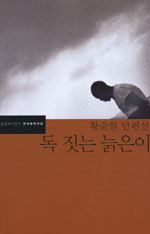
1. If you studied the Korean (language) section of the CSAT diligently, you can probably remember at least Hwang Sun-won's 'The Shower' — that's the kind of thing associated with the author Hwang Sun-won. Because in this novelist Hwang Sun-won's work you can find the story about the 'purple flowers' we've all heard about so often, and a prim, fair-skinned girl protagonist appears who reacts to the boy by calling him a 'fool.' Of course there are other impressive works besides 'The Shower,' but 'The Shower' in particular is an unforgettable one. The most basic method for constructing such an 'initiation tale' is the 'prose style.' You may have heard Hwang Sun-won's style described as 'poetic,' and what 'poetic' means here is not narrating situations through realistic, detailed description, but rather describing situations through as concise, sensory, and somewhat beautiful a style as possible. As a result, even when depicting a desolate reality like in Hyeon Jin-geon's short stories, he can take a somewhat 'sentimental attitude.' The elements of the 'initiation tale' (coming-of-age novel), his prose style that could be called lyrical fiction, and the narrative structure unfolding through the 'child's' gaze are his most basic novelistic characteristics. But looking at the changes in his view of fiction that appear afterward, Hwang Sun-won's life as a writer is quite multilayered. Unfortunately, works like 'Descendants of Cain' aren't included here, so it's somewhat difficult to discuss even those changes, and I'll focus on the short stories that are included.
Most of the short stories here are works built on a strongly 'lyrical' prose style. There are also a few told from a child's perspective. Including children who behave strangely. I plan to read and write about 'Descendants of Cain' when I have time. I'm glad that in this piece I can still cover the important works — 'The Shower,' 'Star,' 'The Old Potter,' 'The Dog of Mokneom Village,' 'The Crane.'
2. Many of these are short stories of around 30 pages.
1) The Shower: Regarding Hwang Sun-won's novel 'The Shower,' researchers have debated whether or not it should be seen as a 'coming-of-age novel.' I couldn't reach a conclusion on whether this work can be considered a coming-of-age novel. Comparing it to other works — if it were a novel that really gives the sense that the protagonist 'grew up,' like Oh Jeong-hee's 'Chinatown' or Park Kyong-ni's 'The Age of Distrust,' I'd feel it deserves to be called a coming-of-age novel, but in Hwang Sun-won's The Shower I felt it was hard to find such 'growth.' The boy protagonist doesn't particularly become more grown-up. But the reason researchers see this work as an 'initiation tale' is that there is the awareness of 'love.' Seeing the fair-skinned girl, the dark-skinned boy feels reluctant about his own appearance and, on a rainy day, shows consideration for the girl. This is the part where his growth is said to be depicted. It's also because a 'coming-of-age novel' isn't a type of novel that has to span from child to adult, and in the sense that he experiences 'love' for the first time — one of the steps of becoming an adult — I think it's right to see it as a coming-of-age novel.
To understand 'initiation tale' more, you need to look into academic papers. In fact, the concept similar to this 'initiation tale' wasn't created in Korea; the concept of the 'coming-of-age novel' emerged from applying genres like the Bildungsroman, which was developed abroad, to Korea. Hmm, I think this reference would be a good one to consult.
Park Yeong-sik (2008), 'The Genre Characteristics of the Coming-of-Age Novel and an Analysis of "The Shower,"' Eomunhak 2008-12, The Korean Language and Literature Society
Regarding Hwang Sun-won's novel 'The Shower,' researchers have debated whether or not it should be seen as a 'coming-of-age novel.' As for whether this novel can be considered a coming-of-age novel, I'm closer to being on the fence. If it were a novel that really gives the sense the protagonist 'grew up,' like Oh Jeong-hee's 'Chinatown' or Park Kyong-ni's 'The Age of Distrust,' I'd feel it deserves to be called a coming-of-age novel, but in Hwang Sun-won's The Shower I felt it was hard to find such 'growth.' The boy protagonist doesn't particularly become more grown-up. Though if it were defined as lyrical fiction containing tragic elements, I'd follow that without a word. Since I wasn't the only one who thought this way, the researchers probably debated too. The common opinion of researchers who want to see it as a 'coming-of-age novel' is precisely because of the 'initiation tale' elements. Falling in love for the first time, feeling distaste toward one's own appearance, and showing self-sacrificing behavior for the girl — these correspond to the initiation tale's idea of undergoing the rite of 'love' and growing a step. The reason I see this novel as lyrical fiction lies precisely in its prose style. Rather than being concise and realistic, somewhat unrealistic description stands out. It's because I focused on the style that renders facts in beautiful language, unlike Hyeon Jin-geon's style that depicts facts plainly. Of course, a novel doesn't have to belong to only 'one category.'
2) Star: 'Star' contains both a child's gaze and longing for a mother. It's a work that shows a shift in the gaze toward an older sister as she's compared with the deceased mother. Personally, when I think of 'star' I tend to recall Yun Dong-ju, and I think I'll remember that this novel used such a 'star' in a slightly different but similar way. The child's gaze, feeling the sister has become ugly and comparing her to the mother who wasn't, was, well... not to my liking. (Just a personal impression.)
3) Winter Forsythia: A novel dealing with the story of an ajumma and a patient. It was published in 'Hyundae Munhak' in August 1967. I think the main understanding of this work lies in how the relationship between the 'ajumma' and the 'patient' is portrayed as more than family, and in understanding the depiction of behavior and the humanism dissolved within it. In fact, 'historicity' isn't really apparent here either. I think Hwang Sun-won's view of fiction generally lies in writing novels unrelated to 'history.' I got the impression he tries to exclude as much as possible the influence of history — hmm, most immediately, the influence of 'ideology.' Content about social criticism isn't very visible either. Rather, it was content holding the relationships and behavior between one human and another. There's also a lesson that you shouldn't judge people by appearance.
4) Mountain Village Child: 'Mountain Village Child' ends as a story of a child who ultimately longs for his 'father.' It's a really short piece, and the story's pull wasn't especially strong. But I could grasp that he is a 'child' who longs for his father.
5) The Dog of Mokneom Village: Here a 'dog' is set as the protagonist to depict the village's story, but actually the 'dog' here doesn't seem to be merely a 'dog.' I couldn't shake the feeling that it's a fable to think of it as just a 'dog.' What exactly the existence of 'Shindungi' was meant to signify keeps lingering with me.
6) The Bulls: A story close to an 'initiation tale.' I felt that 'Bau' here is a bit smarter than the protagonist who appeared in 'Star.' At any rate, the story unfolds as Bau follows behind his father. In the course of that unfolding, Bau forms a sense of solidarity and shared feeling with his father, so here 'growth' seems to be more in focus.
7) The House: This corresponds to a novel telling the story of Jeon Pil-su and 'Makdong-i,' featuring a scene of squandering a fortune through gambling. One characteristic, if you can call it that, is that content about squandering assets through 'gambling' can be found in other works of this period besides this one. Also worth remembering is that 'conflict' isn't very prominently featured in this novel. The author seems to have focused more on 'description.'
8) The Mantis: This is a work that can be called the one where Hwang Sun-won's distinctive lyrical-fiction style centered on 'description' is best displayed. Based on conciseness, it shows content unfolding through the narrator's narration rather than through dialogue. A truly 'unusual child' appears. A truly unusual 'child' indeed.
9) The Sound: Probably, the title 'The Sound' of this short story can be found in the 'chick's sound' seen at the novel's ending. The ending scene, where the woman's behavior shown through the chick's sound is connected to her own child, being the most impressive — I wonder if that isn't a trait unique to the short story. This kind of feeling in a short story is the sort you can sense from novelists who write 'short stories' very well, and feeling it several times in Hwang Sun-won's work shows that Hwang Sun-won really is remarkable. I think 'lyricism' isn't very visible in this work.
10) Chicken Sacrifice: A work that depicts a boy based on a story about 'chickens.' The death of the 'rooster' seems to have acted as a considerable trauma for this boy, but I can't quite get a handle on what story the work was specifically trying to tell. Among researchers there was a case arguing that the rooster's death and the swallow's soaring carry initiation-tale elements — in other words, that he underwent the meaning of a 'symbolic death' — and while I understood it, it didn't quite resonate. The word 'initiation tale' itself feels to have a somewhat larger spectrum of implied meaning than other words.
11) The Crane: After 'The Shower,' this is a work most people will know. It contains a story of 'war,' but there's nothing that foregrounds the war. Listening to Deok-jae's story — that he became vice-chairman of the Farmers' Alliance because his father was ill and he thought it might make life a little easier — Seong-sam, walking through the woods, recalls the past upon seeing a 'crane.' Even though the novel itself is very short, the story is very well constructed around the title 'The Crane.' I think the crane was quite apt as a device for recalling the past. Many things can be chosen as a device to lend 'a sense of reality' to a novel, but in choosing a device imbued with memories of bygone days, this 'crane' — strange, perhaps not even well-suited — naturally created the novel's lyrical atmosphere, I think.
12) The Brush-and-Ink Peddler: The brush-and-ink peddler reminded me of Yi Tae-jun's work. I think a work like Yi Tae-jun's 'Moonlit Night' is the most similar. Even though this 'Brush-and-Ink Peddler' ends with 'death.'
13) Roots: The 'maternal love' of the church ajumma holds the most basic foundation of this work. People's gaze toward this church ajumma isn't warm, but the church ajumma's maternal love is truly warm. It's a heartbreaking story. It may be a little hard to read. But it did warm my heart.
14) People of My Hometown: A story about 'Kim Gu-jang' runs through the thread of the narrative. Here too I felt a narrator's gaze like in Yi Tae-jun's 'Moonlit Night.' Seen this way, you can't help but feel that Hwang Sun-won's range of styles is truly diverse. He clearly has, as a foundation, a prose style capable of achieving 'lyricism,' and since he narrated various situations on that basis, he produced these curious works whose content differs but whose 'overall feel' is the same.
15) The Primary-Color Tumbler Doll: I think Old Man Yun's behavior is quite valuable. Since this work itself is composed through Old Man Yun's perspective, this character — grounded in Old Man Yun's behavior and thoughts — has a considerable effect on the novel's composition. The fact that there's no particular protagonist to focus on apart from 'Old Man Yun' is also one factor that draws you into Old Man Yun.
16) The Acrobat: A work in which the 'author's' name is directly revealed, a work containing the desolation of life after the war. It depicts hardship itself. It depicts a life of anxiously wandering here and there looking for a room to live in because there's nowhere to live.
17) The Old Potter: A work recently set in the September 2017 mock exam for high-school seniors. The work was published in April 1950. It expresses, briefly but intensely, the life of 'Old Man Song,' the 'old man who makes earthenware jars,' before the Korean War broke out. Hwang Sun-won's stylistic traits are well revealed here too. The short-breathed, concise, description-centered narration contributes greatly to forming the novel's atmosphere, and in this work, rather than lyricism, the hardship of living and Old Man Song's heartbreaking feelings at having to send off his son are better revealed. The description-centered ending is quite impressive.
18) Old Man Hwang: It dealt with the story of an old man of the same age and old Jaeni. It was truly sensuous. This was a novel that gave the feeling, as if the 'boy' and 'girl' from The Shower had kept on surviving, parted, grown old, and then met again to share one more bond of fate. The image of Old Man Hwang recalling Jaeni's past in particular is truly impressive.
19) The Swamp: It depicted the relationship between Tae-seop and a girl. Tae-seop is in a position something like the girl's 'tutor' or 'private teacher,' and looking at the girl's mother's circumstances you can tell it's a typical household of a victimized woman, and the 'girl' who grew up in such an environment shows an attitude of trying not to follow in her mother's footsteps. It was strangely interesting how 'free love' is revealed. It was a fun work because of the subtle romantic feelings you could sense in content like inviting her to go to the movie theater together or to take a walk, and in the dialogue. I also think it was a very fine work in terms of revealing inner psychology.
20) The Scarecrow: The male protagonist, Jun-geun, rather than appearing as a sturdy, robust image, shows a somewhat contemplative and morbid attitude, which can be interpreted as a device expressing their instability. The object such a male protagonist is drawn to is 'Myeong-ju.' Myeong-ju's image is closer to the primitive than to the modern, and Hwang Sun-won generally placed more value on this kind of primitiveness and wrote novels in which the protagonist follows it. In other words, it can be grasped as an authorial consciousness that tries to overcome what's wrong with the modern community through 'primitiveness.'
3. To sum up, Hwang Sun-won's novels have quite a lot of keywords, so they can't be summed up with one or two, but if I try to organize them one by one, here they are.
1) Novels in which, through 'initiation tale' elements, one experiences something and grows on that basis
2) The 'primitive image' presented as a solution to 'modern things'
3) A lyrical prose style that forms atmosphere in a concise, description-centered way
4) A healing attitude that, rather than being buried in history over historical conflicts, pain, and problems, tries to embrace reality
5) Longing for things that are vanishing (similar to Yi Tae-jun)
6) Stories about maternal love
Comments 0
No comments yet. Be the first.