
The reason 'Alice' can still be 'Alice' even after losing her memory is thanks to her family.
This piece got a bit late. It took longer than usual because topics I normally hadn't organized popped up more than I'd thought. Assuming a single piece usually finishes in 2 or 3 days at the fastest, this piece became one I had to hold onto for over a week. In truth it's not this piece's fault. Since it's something that happens from time to time, I should have been aware that the more a piece has many things I felt, the more I inevitably have a lot of thoughts. In any case, the film itself was very satisfying.
I came to know the film 'Still Alice' during my student-teaching practicum in the first semester last year, in the class of a Korean-language teacher. Among the Korean teachers at that school, she was quite advanced in age, but in her class you could feel an indescribable warmth. On the day I observed her class, the story the teacher mentioned before beginning the lesson in earnest was exactly this 'Still Alice.' That day is still vivid to me — probably because it had been a very long time since I'd seen a teacher start a class by talking about a film. My English teacher from my high school days too, very occasionally, would start a class by talking about films. So I think that's why it left an impression. Grateful that such a memory remains, I'd like to begin this piece.
The keywords of this piece are 'subject matter,' 'story structure,' 'impressive scenes,' and 'family.'
1. Subject Matter
'Still Alice' depicts the protagonist 'Alice' as she begins one day to lose her memory, goes to the hospital, hears the word Alzheimer's, and lives on. The setting of 'losing one's memory' isn't actually a tremendously novel subject. A great variety of films have told the story of a 'protagonist who has lost their memory.' For example, there's 'A Moment to Remember' (Nae Meorisokui Jiugae) where Jung Woo-sung and Son Ye-jin acted, and '50 First Dates' which Adam Sandler and Drew Barrymore did together. In these two films, they dealt with 'love between a man and a woman' within the process of losing memory. Meanwhile, the closest film depicting a relationship drawn out as the 'protagonist' begins to suffer an illness would be 'The Theory of Everything' which Eddie Redmayne and Felicity Jones acted in. In other words, if you exclude the disease called Alzheimer's from the 'subject matter,' it's hard to find any 'special point' unique to this film. The development of content where hardship befalls the protagonist, they share the difficulty with family or a lover, and they overcome it together with family, also has no particular difference — yet I liked this film. I'd say it had been a really long time since I watched a film while empathizing. Come to think of it, the film 'Amour' comes to mind too — that film depicted the final days of an elderly couple, and likewise the 'grandmother' one day shows symptoms of having fallen ill, and the grandfather cares for her; that's how popular this 'subject matter' is.
If there's a 'special point,' it would be 'family.' I thought the purpose was probably to depict not a film drawing the romantic relationship with one ailing side, but the protagonist who's contracted Alzheimer's and the people around her, and the change of the protagonist 'Alice.' In a way, there's a tendency for it to fall into emotional manipulation — what my younger sibling calls a so-called 'tearjerker melodrama' — but this film didn't do that. I felt it adjusted the intensity appropriately. This point can be called exactly the strength of Hollywood film.
2. Story Structure
The film's story begins to unfold as Alice, in the midst of giving a lecture, can't recall in her mind the words she needs to say, and after that, while jogging outside, can't recall her own schedule, and goes to the hospital. The 'Alice' before losing her memory is depicted as a 'professor' lecturing at Columbia University, living an utterly ordinary life, and to receive a diagnosis about her memories indiscriminately disappearing, she takes a simple test from a doctor and hears that she may have a rare-case Alzheimer's. After this she talks with her husband, and as she tells her children that her symptoms are Alzheimer's, the family responds with worried gazes and talk that her symptoms may be hereditary. At this point 'Alice' bursts into tears as she brings up the subject. (In the midst of this, one daughter displays the ability to intuitively grasp that 'Mom' is ill; the male children fail to grasp it.) The tears that come here are tears that come because 'Alice' had never anticipated at all that she'd contract Alzheimer's, and they're tears mixed with the complex emotions she feels about herself while telling others of her symptoms. Her telling her husband in the middle of the night is also the same context. As the 'husband' explains near the very end of the film, 'Alice' was the smartest and an expert in that field. It'd be the same for me, I think. If my memory suddenly started failing and one day I felt I had 'Alzheimer's,' even I would probably despair for several days; I'd have trouble sleeping too.. How would you live, with the feeling that you might lose your memory one day? It's a film that depicts the figure of Alice losing her memory little by little like that, and the figures of her family.
In this story structure too, as with the subject matter, I couldn't find any 'singular point.' But there was something in this film that struck me strongly. I think that lies in the emotional depiction that comes across quite 'realistically.' The scene where the daughter Lydia (Kristen Stewart) asks Alice 'what does it feel like not to be able to remember' is quite impressive. Because she said that sometimes she can act like an ordinary person, but when she can't, she's endlessly anxious and doesn't know what to do.
You can tell that the way people react to Alice splits clearly by gender — the men in the family, Tom and John, don't show many scenes of expressing their emotions. It's no exaggeration to say Tom is almost a nonexistent person. But Lydia and Anna show more emotional expression. 'Alice's' husband and son don't directly reveal their emotions. The husband 'John' especially is even more so. Even if he himself regards the situation as serious, separate from that, if he starts moving about gravely in front of Alice, it could amplify her anxiety further. Moreover, John falls into conflict as he's offered a good position in the field he currently works in. Lydia too struggles before the dream of being an 'actress.' In the end both compromise to some degree, and the latter part is the content of Lydia coming down to the house and living together with Alice.
3. Impressive Scenes
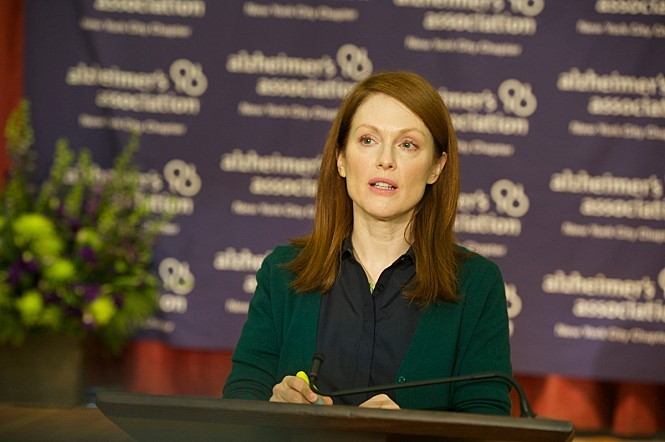
1) Alice appearing as a speaker at an Alzheimer's conference
There were a few impressive scenes, and the first among them is, after all, the 'speech' scene. The scene of coming forward to speak at an Alzheimer's conference as a person experiencing 'Alzheimer's' is a scene where she strove to best capture her own thoughts while representing people experiencing 'Alzheimer's.' Before, it was fine not to mark with a highlighter how far she'd spoken, and fine not to print out all the words she had to say, but now, because she can't make a long utterance otherwise, it was a speech that wholly contained the feelings Alice feels. What was impressive was her own state, which she expressed as 'I'm struggling.' Of course it's hard, but the one striving to overcome such suffering was exactly 'Alice,' and the family all strive to treat that Alice well.
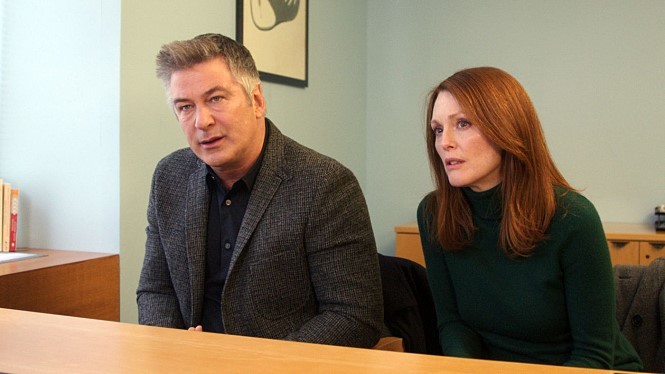
2) What the attending physician Benjamin says to Alice, who keeps failing to remember during a memory-recall test
The second is the scene where the attending physician Benjamin speaks to 'Alice' while she's with her husband, in a situation of experiencing frustration upon frustration in the memory-recall test. 'Don't lose your hope' is impressive. Right, it's hard, but there's no need to lose hope. In fact, the doctor may have deliberately given praise to stabilize 'Alice's' mood, but setting aside whether it's true, there's no need to lose hope just because things are hard. Living without holding hope seems harder more often. As the doctor says, I too tend to think that holding hope is better for living. The moment you become a pessimist, the 'wishes' you can hold for the world disappear, and you also come to stop hoping for anything from the world.
3) The scene of going into and looking around an elderly care/protection facility.
The scene of looking around a care/protection facility where elderly people live, while she herself is still fine, came across strangely. Alice goes without telling this to anyone else. Curious about her own future, Alice sees the figures of various people, but Alice doesn't rejoice in this place. Her gaze, as she calmly watches people and pictures what her own future will be like, was impressive. I don't really know whether one truly loses all memory and becomes unable to even speak words, but if such a situation comes, it seems like she might not even be able to feel even very sad emotions. I hope it doesn't turn out that way. In that hospital too, Alice's heart seemed complicated. The fact that she might come to live a 'confined life,' seeing a chair where a bell rings just from a person standing up, couldn't help but stir strange emotions in Alice, I suppose.
4) The scene of forgetting her dinner appointment with John (husband) and returning home late
What exactly is a 'normal' — that is, an ordinary life? The husband John had promised to have dinner together with Alice, and because of this was waiting for Alice at home, but Alice returned late. It's because she didn't remember that promise at all. For Alice, now a 'normal life' has become a life of losing memory. John worried tremendously over this losing of memory, but Alice herself says she couldn't help it because she's a 'person losing her memory.' It's a scene that shows John that a 'normal life' for him can't be a 'normal life' for Alice. In other words, after this incident, you can see the family's responses regarding a 'normal life' becoming tailored to Alice.
5) The scenes of not recognizing people around her - not recognizing Lydia after Lydia's performance, and not remembering the son's girlfriend at a family meal.
Not recognizing 'family' or not recognizing people close to the family is a quite sad thing. Alice watched her daughter Lydia perform, but doesn't remember that it was Lydia. I wonder if that's really how it is — well, since people actually losing their memory apparently often don't recognize even their own family, this isn't completely wrong, but even so, it was truly heartbreaking.
6) Recollecting the past
Alice's 'past recollection' scenes, which appear often in the film after she's diagnosed with Alzheimer's, are truly strange. This is a part that usually appears in other literary works. In Park Wan-suh's novel 'Mother's Stake 2,' 'Mother,' after collapsing, recollects 'that day' that drove her older brother to death, and sometimes smiles like a child. Meanwhile, the elderly female protagonist of the film 'Amour' likewise, after collapsing once from a stroke, begins to remember and act like a 'child.' Generally, explaining such scenes — that is, elderly people regressing while behaving like 'young children' — is a very difficult thing. It's because I'm not a doctor, and I have no way of knowing for what reason those people show such behavior. It seems to be because, since memory disappears, one may feel oneself to be young, and on the other hand may also have difficulty because the word one wants to say doesn't come to mind — but I thought that for Alice, the 'past' is perhaps a repository of happy memories. Though brief, her past-recollection scenes that appear here and there seem to have had a happiness unique to that era, different from now. And I thought that happiness was perhaps what could be remembered the longest.
7) The scene of finding the phone after a month and being glad.
On the day she couldn't find her phone and rummaged through the house at night but it didn't turn up, leaving her frustrated, John said he'd help look for it together the next morning but in the end couldn't help look. The phone was finally found a month later in the kitchen and handed to Alice, but Alice remembers having lost it 'yesterday.' It was a scene showing just how rapidly the situation of losing memory was progressing. Since Alice had been carefully recording the things she needed to remember on that phone, the joy of having found this phone couldn't be expressed in words, but it was also a scene where I could guess to some degree the suffering and hardship she'd have lived through without this phone.
8) The moment she discovers the video letter she made for herself
'Alice,' who by chance discovers the video letter she made for herself - the butterfly folder -, fails to remember her own past and tries to attempt suicide as shown in the video. At first I never anticipated at all that she'd film such content when she filmed the video letter. I'd only thought it would frequently be a 'video for the purpose of memory recall,' but it wasn't that — it was a video requesting herself to commit suicide. Since Alice was in a situation where she no longer even remembered having filmed that video, Alice, who watched this video, tries to take the medicine as shown in the video. Of course this suicide attempt failed thanks to the housekeeper who returned home, but the point that she had been planning suicide on her own was quite shocking and also seemed like the 'last resort' she could realistically choose.

4. What on Earth Can Family Do?
The family's reactions to 'losing memory' showed change. At first they can't adjust, but from some point they grow accustomed to Alice frequently losing memory, and even repeating the same story several times comes to look like something they just do ordinarily. Maintaining as much composure as possible toward the other person who's losing memory was the only response they could make. Not showing awkward or uncomfortable reactions even when she asks the same question several times in short succession — that was the most basic method they used. Because on the outside she looks so perfectly fine, and as Alice put it, on days when conversation actually goes well she's so very ordinary, but on days when memory doesn't come well, she's not the ordinary Alice but becomes tangled up.
Lydia, setting aside her own dream for a while, finally came down to the house to care for her mother 'Alice,' and 'John,' seeing such a Lydia, embraces her and bursts into tears. It's the scene where John lets out his feelings for the first time. In fact, after she'd contracted the illness, Alice asked her husband whether he couldn't take a brief break, but the husband, sadly, wasn't in a situation to do so. It's a scene that reveals the pressure of 'John,' who'd never once been in a situation to reveal such emotions. How hard it must have been — when he probably had nothing in mind but the thought that if he wavered, Alice would waver too.

5. The Director's Intent.
What can be discerned from the title and from the film's content is that even though 'Alice' has Alzheimer's, Alice is still 'Alice.' Who protects that, you ask? It's exactly family, and the people around her. I'm reminded of a piece I read before about 'self-concept.' What I immediately recall is the point that self-concept isn't formed by oneself but is formed from 'others' messages,' and regarding all of Alice's actions, the family strives to treat her like the Alice of before. At the same time, they don't say anything about the things she can no longer remember. For dangerous parts they try to reduce the danger as much as possible, and they try to share difficulties as much as possible. This, I think, is exactly what the director intended. That even if I lose my memory, Alice is still 'Alice' to her family.
The director didn't try to deliberately manufacture sadness. I think he depicted people who have a family member losing memory amid calmness and the everyday. Because of that, he didn't immerse excessively only in sadness, but rather made you think about one person and the family around that person. It was a film that made me think about how I might act, what I might think, what feelings I might live with, if someday someone in my family began to lose their memory. This is probably the point a bit different from Korean films. If it were a Korean film, had they inserted the code of emotional moving, they'd probably have driven it all the way to the end and focused on making people shed tears, but this film wasn't like that, and because I got the feeling it adjusted the intensity appropriately, the calmness seems to last a long time.
It makes me think about various things after a while.
Comments 0
No comments yet. Be the first.