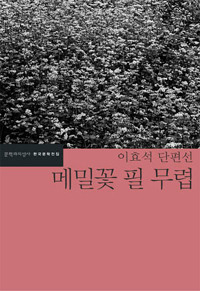
1. When studying Lee Hyo-seok's works over time, the biggest thing always discussed is that you can see two things: that there are works of his as a 'fellow-traveler writer' and works as lyrical fiction. Among the works included in this collection, the works in the early part correspond to the works of the 'fellow-traveler writer,' and the works other than the early ones correspond to works in which the tendency as a fellow-traveler writer has disappeared. Of course, the biggest reason for placing Lee Hyo-seok as a representative of lyrical fiction would be because of his most representative work, 'When the Buckwheat Blooms,' but even apart from that work, the spectrum for understanding 'Lee Hyo-seok' is very diverse. Personally, the early works, that is, the works he created during his fellow-traveler-writer period, were more impressive to me, so first I'll talk about those works and then talk about 'When the Buckwheat Blooms' and the other mood fiction related to 'sexuality (性).'
I've used the term 'mood fiction' before too. At that time I used the term mood fiction with works like Yi Tae-jun's 'The Crow' as examples, and the mood fiction of that time had quite a gloomy mood, but for Lee Hyo-seok mood fiction refers to quite lyrical mood fiction. 'A field of buckwheat flowers spread out under the moonlight' is impossible in reality and carries a somewhat unrealistic character, and this can be seen as an indicator revealing Lee Hyo-seok's ideological tendency that appears after the 'KAPF crackdown.' Considering that after the KAPF crackdown writers' 'expression of ideology' was comprehensively prohibited and the literary atmosphere changed a lot, the change in Lee Hyo-seok's work tendency can be seen as utterly natural.
Another perspective for viewing Lee Hyo-seok's fiction is the 'focus on the issue of sexuality (性).' This is the perspective of Kwon Young-min (A History of Modern Korean Literature, Minumsa, 2002), which holds the view of seeing Lee Hyo-seok's works as an extension of the 'sexuality issue' that Na Do-hyang attempted in the 1920s. Works like 'A Rose Falls Ill' and works like 'Wild Apricot' correspond to this. 'When the Buckwheat Blooms' is a work interpreted as having resolved the issue of humanity's instinctive sexuality within an affinity with nature.
In my case, I didn't reach a clear conclusion about which tendency should be taken as the 'main tendency,' but the early works created during his activity as a fellow-traveler writer were personally impressive works to me. There's something gratifying about them. Of course not all works are like that, but in particular 'The Breaking Red Lantern' couldn't but be a very impressive work to me. I hadn't imagined that the symbol of the red lantern breaking as the revolution succeeds would be revealed this effectively.
In any case, since the purpose is to write a short understanding and review of the stories included in the short story collection, I think it would be fine to look briefly at the tendencies of the stories.
2.
1) The City and the Ghost: A work in which the issue of social poverty is dealt with. The protagonist's action of going with a club to check on the ghost was something I found quite hard to understand, but considering the situation of the poor mother and son, I think it's plenty possible in their situation. The fact that it was a poor mother and son rather than a goblin would be what's important. Lee Hyo-seok's early works clearly show a work tendency different from romanticist tendencies, so I think that's why researchers pay attention to them. Well, in textbooks they keep emphasizing only 'When the Buckwheat Blooms,' though.
2) The Breaking Red Lantern: This novel, with a title about the 'red lantern' of the red-light district—that is, the place where gisaeng work—breaking, is about gisaeng going on strike demanding humane treatment for themselves, and depicts this. On top of that, a 'solidarity strike' also appears here. Several gisaeng houses gather and even hold a rally, and the protagonist 'Bongseon,' feeling some indescribable emotion through a 'speech,' breaks the lantern of Bonghangnu with a stone. At the same time, news comes that the 'Chuwollu' below has also gone on strike, and the novel ends. It's a very impressive ending. It's a work from Lee Hyo-seok's fellow-traveler-writer period, full of some indescribable gratification.
3) Mahjong Philosophy: Mahjong Philosophy deals with the 'workers' issue'—that is, the issue of the 'strike'—but in that it reveals at the novel's ending the point that within its underlying aspect lies the issue of foreign capital, it corresponds to a novel that shows a bit of tendency. Usually a novel would be likely to end with a 'workers' victory' or a raising of consciousness, but this novel doesn't do that and concluded by revealing a more essential issue. To me it felt like a somewhat unusual ending, and I couldn't shake the thought that this kind of novel ending, because it contains content somewhat critical of Japan, might have been a rather dangerous approach.
4) Prelude: Usually 'prelude' refers to a musical form of piece meaning 'overture.' The content is similar too. The protagonist, walking along holding medicine 'to die,' comes to harbor a different intention thanks to a 'woman' he meets. Namely, he sets his own conscience alight. It's a short story that depicts up to the scene where the listless protagonist regains his will and begins to act again. When I finished reading it, I could realize how apt this novel's title is and at the same time how Western a title it is. If you were to change it to a Korean title it would be something like 'Heoduga,' but I can't shake the feeling that doing so distances it a bit from Lee Hyo-seok's flavor.
5) Don (豚): From here on these are de-political works. One of the important events of the 1930s is precisely the 'KAPF literature crackdown' incident. After this, under Japanese rule, the Government-General of Korea prohibited activities with a 'political color.' Because of this incident, Lee Hyo-seok no longer reveals his color as a fellow-traveler writer and begins to take an interest in other areas. That, I think, was in 'sexuality' and 'lyricism.' The travelogue-like character and the longing for Europe that appear in the later period of his work activity correspond to yet other interests, and from 'Don' on, he turns his attention for the time being to 'sexuality' and 'instinctual things.' As Kwon Young-min said, this is also the part Na Do-hyang mainly focused on in the 1920s, and it would be good to remember that in the early 1920s Kim Dong-in too wrote, to some degree, fiction about free love and the issue of sexuality.
The 'Don' in this novel doesn't refer to money as currency but is a word referring to 'pig.' But rather than this simply appearing as a pig, the pig is a medium for realizing a certain desire, and that desire means achieving a relationship with Buni. The relationship with Buni can of course be called a romance or marriage in which sexual relations are inherent.
6) Season: A novel dealing with a love story centered on Bobae. As I said above, you can see that after the KAPF crackdown no novels appear in which the proletarian-revolutionary color that Lee Hyo-seok pursued shows. In this work too.
7) Mountain: This novel consists almost entirely of 'description.' As if all the descriptive scenes from Lee Hyo-seok's most famous work, 'When the Buckwheat Blooms,' were gathered in one place, this work is full of description. The novel is about Jungsil, who thinks of Yongnyeo, imagining based on the mood he feels in nature, and within the content no narrative containing a particular conflict appears.
8) The Field: 'Munsu' is clearly dragged in at the end of the novel, but in the novel itself there's no gloomy mood like that at all. Only the beauty of nature appears throughout from start to finish. That's the most predominant mood and description of this novel. Because the main story is the story about 'I' and 'Okbun' and 'Munsu,' their love story and the description of nature overlap in a similar mood, giving a feeling similar to the love-story setup of 'When the Buckwheat Blooms.' You can grasp that the macroscopic historical or social backgrounds don't much affect the shaping of the novel's content. Comparing it to another work, the way it handles the macroscopic background can be seen as similar to a work like Kim Dong-in's aestheticist-leaning 'Sonata Appassionata,' while thematically it can be summed up as discussing 'love.'
9) Pomegranate: The scene where the story ends as Junbo's name as a novelist—that is, his name on a novel book—is discovered was quite impressive. The 'old days' that Jaehui longs for refer to her happy times, and the feeling that those times seem like they won't come is precisely the main feeling of this novel.
10) When the Buckwheat Blooms: The work usually brought to mind when one thinks of 'Lee Hyo-seok' is precisely When the Buckwheat Blooms. The basic interpretation of this work—that it depicts the novel's space based on a buckwheat field and composes a fantastic setting by utilizing 'moonlight'—is compressed into the single word 'lyrical fiction,' and this lyricism can be seen as being attained, unlike before, by not fully revealing the 'issue of sexuality.' On top of that, the story depicted within Heo Saengwon's life and the moonlit mountain path contributes to lyricism on the basis of the material of 'love.' Not leaning only toward description, nor leaning only toward dialogue about love, and thanks to the narrator maintaining an appropriate distance, I think this work has a living cleanness. Depicting the things it can take away as appropriately and well as possible is what can be called this work's charm.
Down to 'Wild Apricot' below corresponds to the Yeongseo trilogy. The 'Yeongseo' referred to here is the Yeongseo region—that is, the left side of the Taebaek Mountains—and here it can be seen that some of Lee Hyo-seok's autobiographical stories are contained. Lee Hyo-seok was from Keijo Imperial University and lived what was effectively a 'study-abroad' life very far from home, and the story about the father who supported this is revealed little by little.
11) Vignette: It dealt with the story of Jaedo and Hyeonbo. The aspect of holding 'literature' in high regard could also be said to resemble Kim Dong-in's past self. You could grasp that Jaedo and Hyeonbo would ultimately go their separate ways, but as for what content could be organized out of the title 'Vignette,' I too can't readily give an answer. If I had to look for one, it gives the feeling of having turned an incident from Lee Hyo-seok's school days into a vignette and put it into the novel? But I'm not certain.
12) Wild Apricot: In Wild Apricot, the story of the head of the hypnotism office and Hyeongtae, Jaesu, and the Seoul lady appears. The commentary included in the back of the book interprets this story as the story of the head of the hypnotism office and Hyeongtae, giving an explanation that places 'the head of the hypnotism office' in the same position as Lee Hyo-seok's father, but actually, apart from that part, the story of the Seoul lady and Jaesu could be seen as a rather shocking development of events. At least for me. Because if this event hadn't happened, the ending part could have been different. If so, Hyeongtae might not have worried that the Seoul lady would run away.
Hmm, the narrative aspect of depicting the space that appears throughout the novel isn't much different from When the Buckwheat Blooms. It maintains almost the same framework. I think I can only say that Lee Hyo-seok's descriptive method is truly remarkable. In particular, the fact that dialogue barely appears is impressive.
13) A Rose Falls Ill: It's the story of Namjuk and Hyeonbo. Hyeonbo tried to set up a troupe and go on a touring performance, but it doesn't go as he wished. Namjuk is a woman who came back up after seeing a recruitment notice about the performance. The two had met before with feelings between them but lost contact at some point, then reunited through the troupe work, yet Hyeonbo didn't have enough financial means to take care of Namjuk, and in the end, during a period when Hyeonbo didn't contact her for a few days, Namjuk earned money through prostitution and went back down to the countryside. Probably here 'the rose' refers to Namjuk. The basis for this is precisely the scene in the novel's content where Hyeonbo, as narrator, makes a remark about Namjuk's 'prostitution.' I came to think that her going so far as prostitution shows just how desperate the situation was for Namjuk, and one of the biggest characteristics of men at that time would be precisely their 'notions about sexuality.' This is still somewhat valid now. Seeing that there are still men who, strangely (by my standards it's strange), prefer a woman who has never once had a sexual relationship.... whether this should be called a preference... I'm a case where it's hard to accept this as a preference. It's something that makes me think of a kind of repressed notion of sexuality, like—if you love each other, you can have sexual relations. The solemn-and-grave-ism about 'sex' visible in Korean literature, in that it's the perception of sexuality demanded across society as a whole, leaves no room for denial, I think.
14) Fantasy Club: Fantasy—literally meaning preposterous thoughts. It's truly fantasy. Fantasies like a trip around the world. If these people were really rich this wouldn't be fantasy, but they aren't. Also, it's a shame that, compared to their worrying about Unsim, what kind of situation Unsim is actually in doesn't appear in the novel at all. Researchers usually say Lee Hyo-seok's 'Europeanism' appears, but I can't readily understand just what meaning that comes across with.
15) Sunflower: A novel in which the meeting with 'Unhae' makes up the story. Unhae is a protagonist who, after things with a fiancé didn't work out, is focusing on mine work. The book's commentary describes this work as 'a work that can also be seen as revealing the author's ideological turn' (p. 516). But apart from that, the point that interest in culture and art is revealed was easy to grasp.
16) Travel Sorrow: It's a work in which the narrator's perspective, dreaming of freedom and exotic culture due to a dance troupe? from Russia or people like that, is revealed. It mainly deals with the story up to the troupe's performance and dissolution, and what appears through this can be called the range of emotions the narrator feels. The narrator feels various emotions through Katarina. Among those emotions there are emotions felt through flowerpots, and emotions arising due to the troupe's dissolution. The narrator's nostalgia and the nostalgia the Russian dance troupe gives off overlap, and the wandering consciousness of these two can be seen as overlapping and being revealed too. Because of the way the melancholy inherent in the protagonists juts out the more the novel heads toward its end, it was a work that becomes a bit hard to read as you go. Because I could find the actions and emotions the protagonists let out strange.
17) Harbin: It corresponds to a novel written through travel in Manchuria. You can grasp that the self-consciousness as a colonial writer is revealed.
18) Mountain Valley: It's a novel depicting a series of situations that arise because of a woman Jaedo brought along after selling a cow. Of course, that newly arrived woman, as it happens, has her own husband come find her and ends up living together leeching off Jaedo's home, so Jaedo is dejected, and the existing wife who had married Jaedo eventually gives birth to a son, but in fact that son isn't Jaedo's child, so the son dies. And so Jaedo, with futility and surging suspicion, again drives the cow and leaves for the salt flats, and the novel concludes its story.
19) Blades of Grass: It depicted the story of Junbo and Oksil. The love story of the two is the main story, but it's depicted as if this love is something that absolutely cannot be permitted. In this novel you could see that romanticist love appeared intensively. Of course, scenes where the macroscopic background acts directly on these two's situation are hard to find.
20) While Burning Fallen Leaves [essay]: Literally, it transcribes into an essay the emotions and thoughts that come while burning fallen leaves, and its descriptive power alone is certainly first-rate, and his romanticist thoughts are well revealed.
3. To sum up, you can see that Lee Hyo-seok's fiction includes both the well-known work 'When the Buckwheat Blooms' and novels with a somewhat different mood. Of course, on exams they ask about 'When the Buckwheat Blooms.' Probably one reason for that could be that it's hard to find in that era a lyrical novel as tremendous as 'When the Buckwheat Blooms.' By my personal preference, I'd like to hold his 'fellow-traveler-writer period' works in somewhat higher regard. It's because there's something fiery about them, but not everyone is like that, of course. Lee Hyo-seok's fiction was truly enjoyable.
Comments 0
No comments yet. Be the first.