I'm writing, belatedly, about this film I watched well over a month ago now.
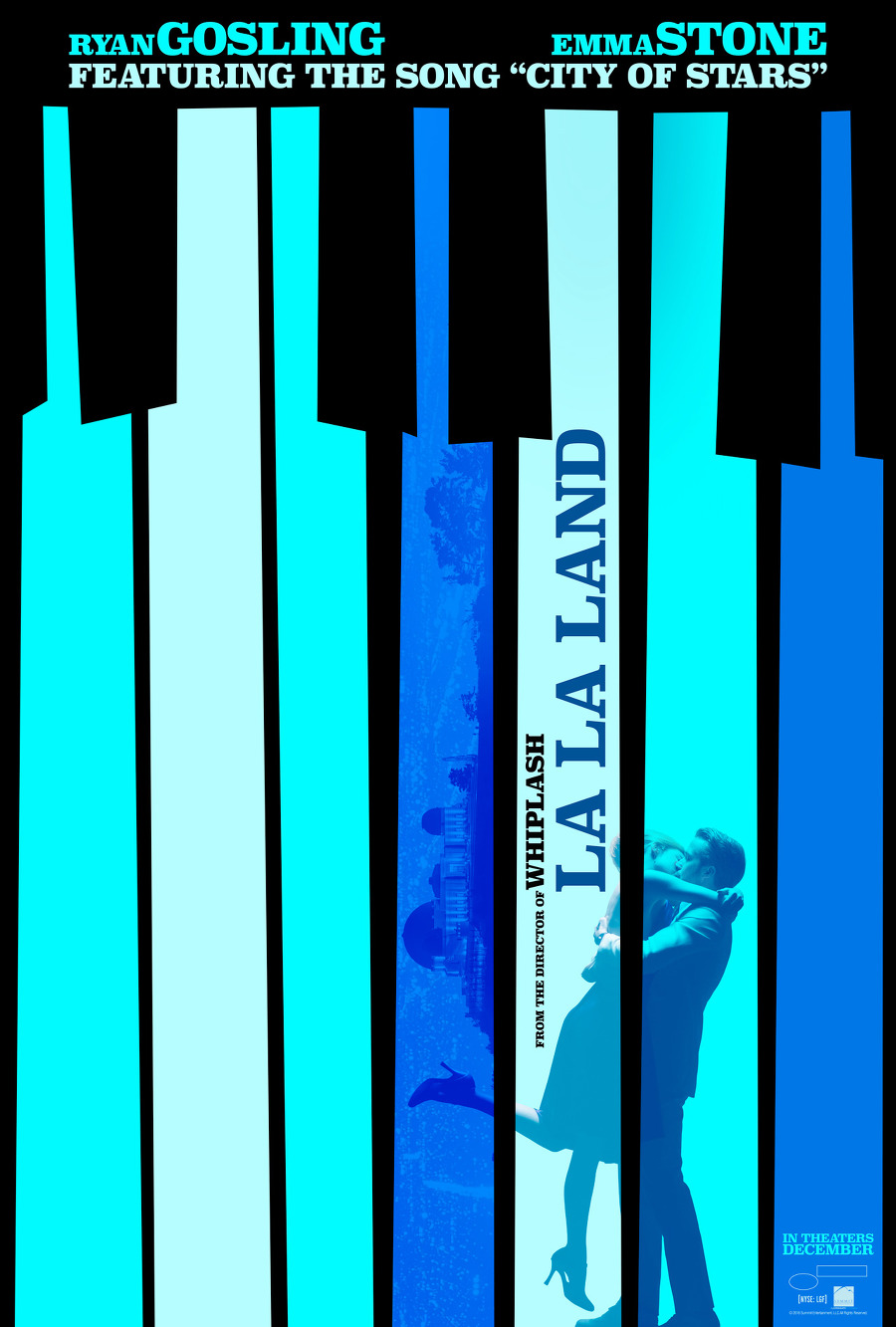
The film 'La La Land' is somewhat different from the Korean-pronunciation way of saying it as 'ra-ra-laendeu,' but if you read it bringing out the feeling that its distinctive 'la la' pronunciation gives, you get a little closer to understanding what the film was trying to say. Since it's a musical film, watching it with someone, hmm.. honestly, there's no one around me who'd be up for watching this kind of film together, so I went to see it alone. I watched the film while eating a hamburger, and I should never do that again. Just watching the film alone is already overwhelming. As expected, when watching a film you must only watch the 'film'... I come away with a very big and important realization.
This piece probably won't be a very long one. Of course, once I actually start writing it might get long. I'll look at a few points worth examining about the film and wrap up the piece simply.
1. Characteristics as a musical film, characteristics as a Hollywood film
Before talking about the film, I can't pass by without briefly mentioning a few of the musical films I've watched before. There are a few 'musical films' I remember. Just a few. First, while looking at those works, I think I should mention my 'own personal genealogy' of musical films.
The film 'The Sound of Music' is one of the few films I remember from my childhood. It was a quite impressive film, and the story itself was largely composed as a 'family story.' The music in the film is also quite easy-to-remember music. Music made using solfège note names was the kind of song anyone could sing along to. Personally, regarding the 'songs' in musical films, I think the broader the range of audience empathy or the easier to sing along, the better, and the reason is that it raises accessibility. Even thinking about it now, this film's songs were the best on that point.
Meanwhile, in 'Singin' in the Rain,' the film proceeded on the basis of dances with the sound of tap shoes. This film was one closer to romance. I thought that many scenes in 'La La Land' may have come from this film. There are many musical films, but the film that immediately came to mind for one that mainly deals with 'romance' was this one. You can't lump a film's theme into a few categories, but dealing with individual growth, dealing with love between people, or depicting the harmony of families are the themes of most 'drama' films. Thinking that way, you can see that this film's theme has love at its center.
There's also 'Mamma Mia,' famous for its theme songs. Of course, it's not that this film has no 'romance' either, but even so, this film gives off more of a 'family' atmosphere. And because Meryl Streep's acting stands out so greatly, there's a tendency for 'Amanda Seyfried,' who comes off relatively very beautiful, to get buried. As they say young blood can't be hidden, many audience members probably went 'wow, she's pretty' every time they saw Amanda Seyfried, but that doesn't mean Meryl Streep's acting seasoning has rusted... moreover, the fact is that a story driven by 'a mother's love' is the backbone of this film. So the two things are mixed. The daughter's wedding and the mother's past romances.
There's also Tim Burton's film starring Johnny Depp, 'Sweeney Todd, A Cruel Barber'(Sweeney Todd: The Demon Barber of Fleet Street). I suppose some people saw this work as a stage musical, but since I only saw it as a film, I can't pass by without mentioning it. Within director Tim Burton's distinctive work-world, Johnny Depp is an actor who has quietly carried out Tim Burton's 'persona,' and this film was a musical film in the form of a 'revenge drama.' It's a bit unusual. This film too consists of a musical film, but romance content barely appears. Of course it's not that there's no romance.... but romance plays a somewhat small role.
The most recent film I watched is 'Les Misérables.' Les Misérables is a work that has been performed for a longer time as a musical, and this isn't the first time for a film. There was a Les Misérables film about 20 years ago too. Since the story itself is the pre-French-Revolution Paris centered on 'Jean Valjean,' this too isn't a story with the love of Marius and Cosette at its center.
But 'La La Land' can be seen as a film that plays tug-of-war with dreams, with love placed in the middle. Also, the 'music' that appears in the film is often lyrics that reveal the individual's inner self, and the story's structure itself can't be called very solid. It's because, in choosing the musical as a method of expressing emotion, it focused on revealing individual emotion rather than on the solidity of the story. And the reason I've mentioned musical films like this is that parts appear in this film that borrow scenes from films that came out in Hollywood long ago. I won't mention them all one by one, but really various scenes — the scene of trying to dance while grabbing a lamppost, the scene of standing in front of a movie screen searching for someone, the scene of dancing among the stars at the Planetarium, and so on — borrowed from classical Hollywood films, which is why people speak of this film as having the history of Hollywood. You can find out which specific films particular scenes of the film were modeled on with just a little internet searching. I think the fact that it reproduced scenes from films said to be quite good among the classics can be one of the reasons it received considerable acclaim from critics. Another reason would be the comparison with the director's previous work, 'Whiplash.' I'd have to say it's a warm film a bit different from Whiplash, and a film that's easier to relate to.
A musical film largely needs two things. One is song and the other is dance. The genre of musical itself is a genre accompanied by song and dance. Here, the songs were realized through the actors' voices, and the dance too was realized through the actors' movements. In this part too, the borrowing of classical musical films appears. The tap dance done in the long-take scene of a bit over 6 minutes — the scene where, after the party, Mia in a yellow dress and Sebastian dance around a lamppost and a chair — you can tell is very similar to the tap dance that often appeared in the film 'Singin' in the Rain.' Besides this, there are scenes of dancing among the stars along with an orchestra at the 'Planetarium.' La La Land realized this song and dance very well. The songs especially were sung really well — maybe because Emma Stone, who played Mia, has sung in a few other films too. Ryan Gosling also apparently kept practicing piano steadily for several months in order to play the piano himself..
2. The Film's Plot
1) Dream / Reality
As I mentioned a bit in section 1 as well, the big framework of this film can be divided into dream and reality. The reason many critics call it the dreamlike La La Land can be easily found in two elements: one points to 'La La Land' as a space for dreaming the 'dream' one truly wants to realize in the future, and the other points to 'La La Land' as a space so unrealistic that it's just like a dream. Both Sebastian and Mia have dreams, and here this dream appears as a hard-to-realize dream, but the film shows the protagonists drawing close to that difficult dream. The example of this is exactly when Sebastian, to Mia who always just endlessly went to set auditions, suggests how about making a 'one-person play' and staging it herself. After those words, Mia actually did do a one-person play. Of course, that one-person play has the problem of carrying both success and failure. In Sebastian's case, he wanted to open his own jazz club and increase the number of people who appreciate 'jazz,' but he lacked the money to do so, and for this he joins a band proposed by his friend 'Keith' and starts earning money. Of course, in the situation of just earning money like this, the one remark Mia made to Sebastian helps him realize his dream again.
I think the 'realistic' scene is located at the film's end. Mia has become a famous actress, married someone else, and Sebastian opened his own jazz club. The fact that the jazz club Mia and her husband happened to go to is Sebastian's club 'Seb's' is a coincidence and plot created by the film, but the fact that the two broke up is the realistic point. Of course, the part where the two 'succeeded' is part of the dream, but the point that the two broke up for the sake of their own achievements can be called a scene suggesting the compromise process in which they had to break up for their own goals.
The parts where this conflict or opposition between dream and reality appears most sharply were about two scenes. One is when Mia and Sebastian are having a meal under green curtains. It was a surprise-event day for Mia. The other scene would be the part showing Mia's feelings after she finishes her one-person play 'So Long, Boulder City.' Both correspond to scenes where 'reality' draws near before one's eyes. The day they fought during the meal corresponds to a scene where Mia reminds Sebastian about the 'dream' while at the same time the collaboration with Keith she chose turns into something that became meaningless — and from Sebastian's standpoint, this is like a cruel choice. Because Sebastian made that choice after hearing the phone call Mia had. To now say it's not needed would understandably be upsetting. The scene right after the 'one-person play' ends brings Mia great self-loathing along with the result of no longer dreaming the dream of being an actress. It's because, on her boyfriend — Sebastian's — opinion, she tried the one-person play she planned herself, swelling with dreams, but it flopped so badly she couldn't even pay the theater rent. Also, the audience feedback she heard in a situation where she herself had no perfect conviction about her own choice has an aspect of egging that on. In other words, the film's content, which seems like 'dream' won in the showdown between dream and reality, in fact flows into a story where 'reality' is prioritized more.
2) Helper and comrade
The helper plot is so famous, after all. As in the review of the film 'Flashdance' I wrote before, in this film Sebastian plays a kind of helper role. However, the freshness of this film can be seen in the fact that it doesn't end merely as a helper role. The previous helpers were mostly helpers who had no conflict with 'real-world problems.' That is, they had no economic worries struggling to realize a 'dream.' But Sebastian isn't like that. Even though he wants to open a jazz club, he has no money, so he plays at restaurants and receives money, but even that doesn't go smoothly. Because the more he reveals his own color, the more it's not the case that the public accepts that color. After Sebastian starts band activities with Keith, he starts playing the helper role, but he's certainly different from previous helpers. Because he's a helper who isn't pursuing his own dream. To make a simple comparison, the helper in 'Flashdance' can be seen as a helper in a situation where they had finally achieved what they wanted, so it's different.
But the reason he's a 'comrade' is that Sebastian too didn't let go of his dream. He still held that dream. I saw it as just that he was waiting a bit for the right time. As a result, he opened a jazz club too. And Sebastian was a person who talked about dreams while at the same time being a person who hadn't achieved his dream.
3) The Rialto Theater
As those who watched the 'Rialto Theater' carefully would know, the Rialto Theater is, simply put, a theater that shows the degree of progress, the rise and fall, of Mia and Sebastian's love. Meeting and watching a film at that theater showed the two feeling fondness for each other and ultimately coming together, but in the latter part of the film it shows this theater having closed. The point that the Rialto Theater was showing 'classic films' reflects the temporal setting of this film, but on the other hand, with the theater — which kept opening even while showing classic films — closing down, it allegorically reveals that their dreamland cinema no longer exists, and that the moments of these two's love, in other words the moments they met for the sake of a 'dream,' have also ended. The film the Rialto Theater was showing was a very classic film. Classic, but an important dream. That is, it corresponds to one of the film's important materials, 'the dream I want to pursue.' At that 'meal' on the day the two protagonists encounter reality, the two confirm to each other the reality that has grown distant from their dreams. Sebastian had given up his own dream for Mia's sake, but the two confirm that Mia, because of Sebastian, had been steadily thinking about her own dream rather than reality. To organize it: while the theater was still showing films, their dreams were alive, but at the 'point when it closed its doors' and films were no longer shown, this 'theater' was indirectly showing that their dreams too were dead.
3. Features Unique to This Film
- Four seasons, costumes, fonts
What was impressive is that the film shows these two's lives as one year. Spring, summer, fall, winter, like this. The start of love began from the 'discovery of a dream.' The discovery of the dream, in Mia's case, began through 'Sebastian,' and through a phone call Mia exchanged with her mother, Sebastian buries his own dream. I suppose these four seasons may indirectly show both that time passes — compressed somewhat intensively — and at the same time that the cohabitation of their love and dreams also comes to an end through one year, following the seasons. After Mia's audition, of course the two said they would love each other forever, but there's no way to know whether it really was so.
Meanwhile, this way of developing a film by showing spring, summer, fall, winter like this is one of the development methods that's very hard to find in recent feature films. I got the strong feeling that when the director planned the film, he seemed to want to reproduce 'classical Hollywood' as much as possible, and you can grasp that everything from this kind of typography to the costumes the actors wear was all intentional. You can tell that the dresses Emma Stone wore (one-piece dresses) are of a somewhat old design rather than completely modern dresses, but it also played a part that, maybe because this actress really pulls off vivid colors well, all the clothes were beautiful. From pastel tones to intense vivid colors, there were no clothes that didn't suit her, and you could really see traces of much consideration when choosing the costumes.
As for the fonts, I think you'll know. There weren't many fonts that appeared, but in the font marking the seasons I could feel traces of retro film. An atmosphere similar to the film's setting.
3. The Director's Intent, and Closing Remarks
The director's intent was 'to take the old musical but ground it in real life where things don't always exactly work out' — in other words, the goal was to realize a very old musical in the real world. And that real world too is not a real world where, like in films, all the things you wish for come true, but a world where things work out sometimes and don't work out other times. Because our world is certainly a world with more things that don't work out than things that do. I think a film was a film. Even the part where the two more or less achieved their dreams was a film. Some might ask whether dreams and reality can't coexist, but in my personal opinion, I think they can coexist and also might not coexist. These days I'm thinking they can coexist. Just a bit busy — I think coexistence is possible. For no particular reason.
The film's ending felt similar to the film 'Café Society' that I'd seen before. I really thought it was similar. In the end you can surmise that both chose their realistic dreams and moved forward. They lived lives that prioritized their own achievements a bit more, between their achievements and love. I think the song that suits this film best isn't the music that appeared in the film, but Richard Sanderson's 'Reality' — though I'm curious how the readers reading this feel.
If the chance arises, the thought remains that I'd like this director to film a movie again based on this kind of material, under a slightly more solid story structure. Most of the people who say 'La La Land' was worse than expected show a common opinion in exactly this 'looseness of the plot.' Regarding filling the plot's deficiency with musical elements, people who deeply felt the protagonists' emotions didn't mind that 'deficiency,' but I wasn't like that, you see..
Comments 0
No comments yet. Be the first.