0. Before getting started.
I thought it would be appealing to organize the whole of art history too, but for the time being I planned this short serialization because I simply wanted to organize, one by one, the postcards I had or the paintings that left an impression among ones I'd seen. Each piece is going to be quite short. Since it'll likely go author by author, the first piece for each author may be a bit longer, but otherwise I'll add only explanations to aid understanding of the painting. Moreover, since this blog has almost no fixed readership, there's some freedom in how I run it. It seems to be made up of nearly 99 percent 'my own record-keeping' and 1 percent reader demand, so I thought organizing things this way wouldn't be bad either. I can't yet know how the January 3rd announcement will turn out, but for the time being, if you read this kind of painting-aid writing, I think it could help with the 'understanding of art' I mentioned before.
1. Introducing the Painting
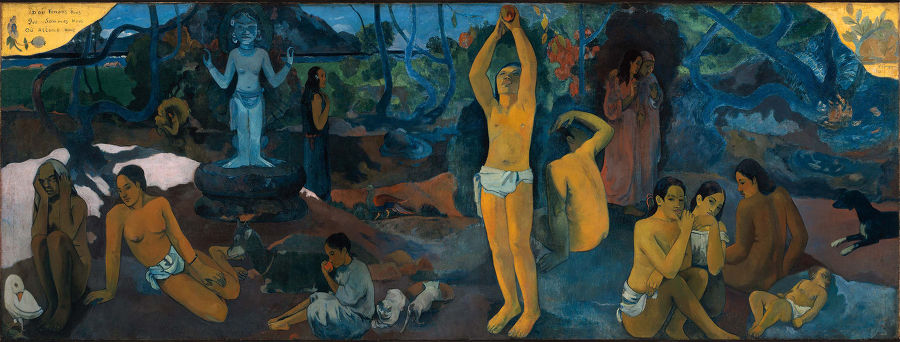
This time's painting is Paul Gauguin's 'Where do we come from, What are we, Where are we going?'. Translating the title, it can be rendered roughly as 'Where did we come from, where are we, where are we going'. Among the art-titled works I'd seen, I think it was perhaps the most philosophical title. Maybe because it's been several years since I saw this painting, the longing is considerable. I went to see this painting back when the Seoul Museum of Art was holding a 'Gauguin exhibition'. Because it's 3.7m wide, I vividly remember that they hung only this painting on one wall of the exhibition hall. I also remember that there were few people that day, so I saw it at ease.
Gauguin's occupation was, from the start, a life in which he wasn't a 'full-time painter'. He was originally someone who worked in a stock-related field. In fact, from our conservative viewpoint, someone working in an 'economic occupation' beginning to paint raises quite a bit of puzzlement, but Gauguin actually didn't mind such things. And he had a fondness for painters who recognized his style. Well, it's also a well-known fact that Gauguin once lived with van Gogh. (Apart from living together, I don't know whether the two got along well. Because Gauguin and van Gogh had such very different temperaments.)
Gauguin was a painter who went around searching for a paradise different from where he lived. He went around looking for places less touched by civilization, and this can be interpreted as probably being because Gauguin wanted to find the most primal aspects of human life. Generally, among his paintings, the ones he painted outside France depict what human life consists of, from 'the everyday' to 'death'. In that sense, the painting above can be seen, from its title on, as a painting that condenses what Gauguin pursued.
What can be grasped through this painting is broadly 'life' and 'beyond life'. From the 'child' in the lower right to the 'old person' in the lower left, it presents human life in condensed form, and at the same time, in the upper-left from the middle, you can see the figure of an idol representing religious symbolism. It tends to be interpreted as a symbol regarding what lies beyond life. Let's omit the person in the middle picking an apple. Because too much guidance can harm individual interpretation. Every painting needs freedom of interpretation. The thoughts that arise for each reader when they look at this painting after seeing the title are more important too. Where on earth did we come from? Our being 'here' where we are now was actually an event unrelated to our will, but it has already passed by. With our questions still held.
It seems Gauguin, seeing primitive nature and primal life on the island of Tahiti, thought 'this is exactly what I'd been pursuing'. And the title that remains as a trace of him pondering what might lie beyond this life is precisely this painting's title. When he passed through several islands and arrived at Tahiti among the Pacific archipelagos, he may have partly discovered the natural life he'd thought of. At the end of such thoughts, I tend to ponder this. Where we came from, where we are, and where we're going. In fact, our life isn't so different either. Of course, as in Milan Kundera's novel 'The Unbearable Lightness of Being', where it's said human life leans on one or the other value of lightness or heaviness, if we could live a 'light life', we might not need to agonize over where we should go. But I suspect that even within that light life, the being called the human is one that holds curiosity about where it should go.
Trying to write after a long time, the writing doesn't come out well. As 2016 draws to a close at the end of December, I close this piece wishing you a day in which you think about where you're going, where you came from, and where on earth our life is.
Comments 0
No comments yet. Be the first.