0.
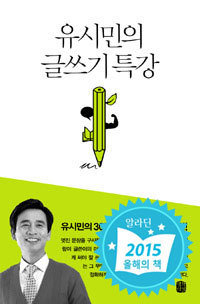
A few days ago was my birthday. Luckily, someone close gave me a book as a gift. That book is precisely 'Yoo Si-min's Special Lecture on Writing'. I read this book over about three days, and today I write about it. The feeling I get from the fact that I'm doing writing about a 'special lecture on writing' is quite peculiar. It's a bit funny, and a bit awkward too. But well, since writing is a means of self-expression, I'll start, thinking that my impression of this book is, in the end, my own expression.
1.
The book's content structure didn't carry only content that matched neatly by section like the table of contents. But roughly summarizing this content into a few themes, I could summarize it like this.
1) The author 'Yoo Si-min's' experiences related to writing - others' stories he heard from various people, his own university years, his time as an exchange student in Germany, the period after graduating from university, his time as a columnist, etc.
2) Strategies needed when writing - 'separate confessions of taste from argumentation', 'when making a claim, present appropriate grounds for it', 'write easily', 'use simple sentences (sentences with one subject and one predicate) rather than complex sentences', 'for appropriate expression you need the necessary vocabulary, and the only way to acquire such vocabulary is 'reading'', 'rather than using difficult words, use easy expressions readers can understand as much as possible', 'practice many times', deciding in advance on a length readers will find readable and writing within it, etc.
3) A list of recommended books for building refinement and increasing vocabulary - Top priority: Land (Park Kyong-ni), On Liberty (John Stuart Mill), Cosmos (Carl Sagan); others: The God Delusion, What Is History, Lectures (Shin Young-bok), Justice, Moral Man and Immoral Society, Silent Spring, The Selfish Gene, Six Easy Pieces by Feynman, The Protestant Ethic and the Spirit of Capitalism, The Theory of the Leisure Class, The Science of the Mind, The Right to Hold a Different Opinion, etc. (shortened because there are too many)
4) Examples of poorly written prose - prose that became too complicated in the translation process, prose written by Koreans whose subject-predicate relations were complicated to begin with, prose he himself had published in the past and a manifesto he wrote himself, etc.
2. Personal Impressions
I majored in Korean language education at university. Within 'Korean language education' is included learning the teaching methods for 'listening-speaking-reading-writing', in other words listening, speaking, reading, and writing. In my eyes, I felt this book truly unpacked writing and the reading necessary for it in an easy way and got well into the eyes of the general public. The reading strategies and composition (writing) strategies I'd learned in classes at university until now were often strategies that required some time to explain to someone who hadn't taken the major courses. Of course, the framework was very simple. In the case of composition, you can cite planning, generating content, organizing, expressing, and the metacognition underlying these stages that helps you do them well; and for reading, you can cite surface-level comprehension + comprehension of the text's content using the background knowledge I as a reader hold, inference of content not written in the text, and criticism and appreciation of the text's content, up to my own creation based on this. But how to actually convey this in words is another matter, and he unpacked this problem well based on his own experience.
Some of the things in the book are things you can actually do. The content I remember impressively was the content about putting reading and writing into practice. The content is this. Back when the author had just graduated from university there was no such thing as a smartphone, and most people carried small notebooks. The author himself always carried a small notebook, and wherever he went he wrote down what he wanted to write. Of course, since writing it all out could get him threatened by the tremendous security and censorship of the 1980s, he'd jot down passing thoughts only as words, and come home and recall them again to write. That's how the author, in his young days, wrote little by little. These days, even when waiting for someone at a cafe, with just one smartphone you can see and enjoy various content, but in 'those days' it wasn't like that. That's indeed so. Even I, until a few years ago, would fiddle with my phone while waiting for someone. Though now I've changed into someone who always brings a book.
The author recommended doing 'writing' in such spare moments. Reading that passage, I thought about how, when I was to meet someone at a cafe, I'd go a bit early and read a book, but it had been so long since I'd written. The time when I had 'the writing habit the author spoke of' I remember as my soldier days. At that time I wanted to write well. As it happened, I had a subject to write about. Reading what I wanted among the works called the world literature collection, and writing my impressions of those books, was my hobby in those days. I prepared writing material in various ways. I'd read book reviews, look for research papers on the author or on the work. I also tried transcribing the book's contents. That's how my writing skill, which they say is slowly built over a long time, gradually improved, I suppose. The class 'Composition Education Theory' I took after returning to school became a class that taught me why on earth composition is so hard and complicated, and yet must be done. I suspect that if I hadn't started writing during my soldier days, even now I'd have a hard time writing properly.
I'll try to remember that the reason the first sentence is hard to write is that the first sentence isn't simply a first sentence but plays a very important role in determining the content that comes after. Also, I'm glad I could recall again one of my goals, writing prose that's easy to understand like a magazine. Going forward, I think I should distinguish argumentation from confession of taste and, when argumenting, write by citing valid grounds.
Above all, I'd like to recommend this book to others. That is, if they've tried writing and have even a little thought about it.
Comments 0
No comments yet. Be the first.