0. The occasion
It's been a while since I watched this film. To be exact, I watched it the day after I watched 'On the Beach at Night Alone.' I had bought this film in advance from a site online and even saved it, intending to watch them back-to-back, so I watched them back-to-back. As it happens, recently while wandering around the Hongdae~Hapjeong~Sangsu area, after seeing a café just like the scene from the film, my memory of the film came back and I decided I should write something. Of course, I won't write at length.
If I must say why I watched them back-to-back, it's simply because I wanted to watch them back-to-back. You could say it's because I became curious about the director named Hong Sang-soo.
1. Synopsis
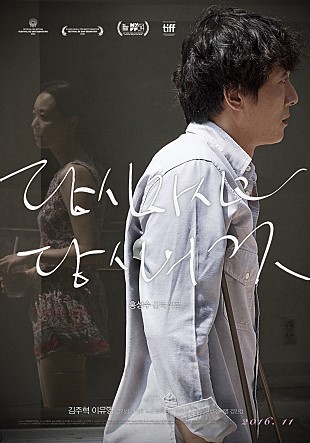
The film's story begins as Young-soo (Kim Joo-hyuk), a painter by profession, hears that his mother is critically ill. Meanwhile, within that story, his girlfriend 'Min-jeong' appears. Min-jeong (Lee You-young) had promised Young-soo not to drink, but a friend tells Young-soo that rumors are rife that she's been drinking outside and that only he (Young-soo) doesn't know, and recommends he check with Min-jeong. That evening Min-jeong comes into Young-soo's home, and starting with Young-soo's question of whether she's been going around drinking, the two end up quarreling. After that, Min-jeong declares they should take a break in the relationship, and so Min-jeong and Young-soo become separated. Afterward, Young-soo, missing Min-jeong, throws drinking sessions almost every time, and even goes to the front of Min-jeong's house, but nothing progresses; the situation of separation simply continues.
Meanwhile, in the interim, Min-jeong meets two other men. One is Jae-young (Kwon Hae-hyo), and the other is Sang-won (Yoo Jun-sang). Both of these men think of Min-jeong as 'someone they know' and strike up conversation at a café, but Min-jeong says she's a 'twin' or claims to be 'a stranger.' In other words, from here on it becomes impossible to know whether this character 'Min-jeong' is really 'Min-jeong,' whether she frequently gets amnesia from being drunk, or whether she's pretending not to remember. However, thanks to this 'strongly insisting she doesn't know' reaction, the audience begins to think about the meaning the title holds. Explaining the story's structure in more detail would make the story too long, so I'll omit the story and move the content along to the film's thematic consciousness.
'Yourself and Yours,' put simply, is a film that throws out a question about 'viewing the other person through what I possess.' In the film, the 3 men (Young-soo, Jae-young, Sang-won) each project onto Min-jeong the view of Min-jeong they each held. That is, in viewing 'Min-jeong,' they don't listen to 'Min-jeong's' story, but view Min-jeong through others' stories or through the memories or stories they themselves hold. However, Min-jeong strongly denies such 'others'' stories and keeps throwing out the message, "I am not the person you know." As a result, conversation doesn't work. The point at which such 'blocked conversation' smoothly becomes conversation begins when Young-soo, Jae-young, and Sang-won try to approach the conversation having discarded the image of 'Min-jeong' they hold.
2. Image
Viewing someone with an image when you look at them is a very natural thing. It's because people look at the figures the other person has shown thus far, then remember and judge those figures and store them in their minds. They store and store the thought 'this person did such-and-such before,' and when that accumulates, they can draw out the proposition 'this person is this kind of person.' But this film points out the errors of such images. Because the film structurally made the protagonist 'Min-jeong's' characteristics ambiguous, you can't know whether she lost her memory from drinking or whether amnesia just easily occurs in her — but given that the Min-jeong who appears in the film is continuously one single Min-jeong, Min-jeong demands that others discard the 'image of me' they hold, while others, looking at Min-jeong, demand that Min-jeong appear in accordance with the image they hold. But this is an 'incompatible' image, and Min-jeong sends the message that she won't engage in conversation unless others discard the image they hold, thereby making them come to think of Min-jeong as 'Min-jeong 4.'
My thoughts are a bit complicated, but if I organize them a little: there were many times like this in the past, and thanks to that, these days I try not to view the other person through such 'images,' and instead treat them with the feeling of just 'looking at' the new aspects of people that appear in each and every moment. I'm not sure whether that's the right answer, but when I do that, people seem to get the feeling that 'they're being treated as they are.' So when starting and maintaining human relationships, I'm feeling that this method is quite meaningful. In what way is it meaningful? I feel it's meaningful in providing 'comfort' between people.
3. Men are either wolves or babies
This is something Min-jeong said, and I related to it a lot. I still want to try becoming an 'alien' that's neither wolf nor baby, but I'm not sure whether that's going well myself. I'm just trying.. But when I look around, it really seems most men are either wolves or babies. When I talked to a friend, A, he said his mother also used to say, 'Men are either brats or bastards'...
4. In closing.
I wrote briefly. This film is worth watching. Even better if you have a partner. It might perhaps become a chance to reflect on your own behavior over time.
Comments 0
No comments yet. Be the first.