0. Before the main point.
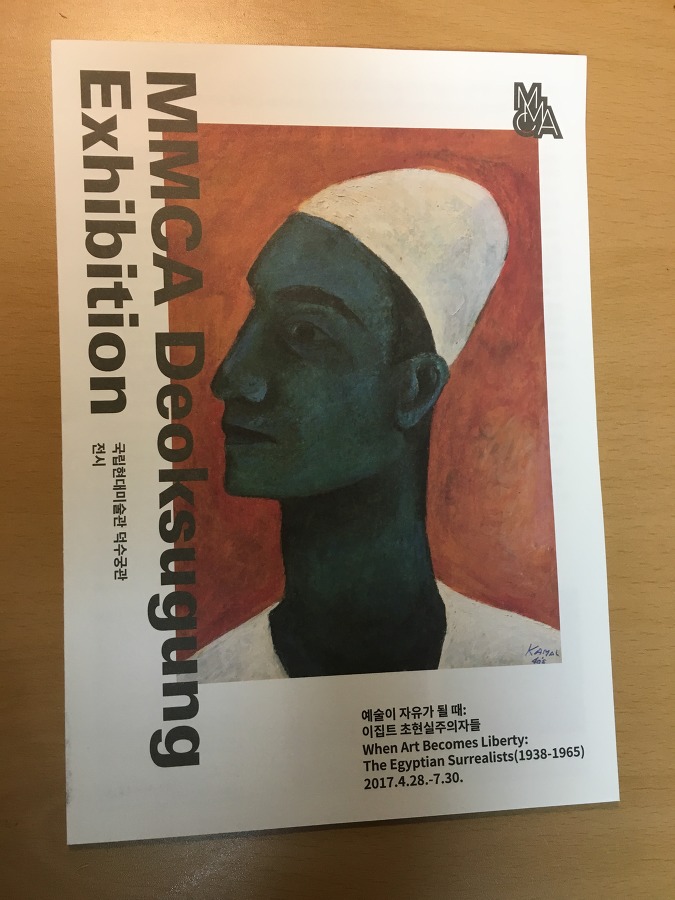
A little while ago, using the early-May holiday, I went to see 'When Art Becomes Liberty,' currently running at the MMCA Deoksugung. The weather that day was the worst. The sky was blue, but it was a sad day where the blue sky couldn't be seen because of the fine dust. Even so, thinking when else I'd get to see this exhibition, I just pushed ahead. This Seoul outing had an unusual number of twists and turns: on the first day there were 2 guesthouse overbookings, and on the second day, when I saw the exhibition, I lost the exhibition ticket right in front of the museum entrance and had to run back to the entrance to get it 're-issued.' I really wonder what kind of jinx was on this outing.....It's an exhibition that calmed down a difficult trip somewhat. Thanks to the museum's distinctive atmosphere...
Well, anyway, the subtitle of this exhibition is 'The Surrealists of Egypt.' And, I'm guessing, the exhibition title probably borrowed the title of the book 'When Breath Becomes Air.' In Korea it's published under the title '숨결이 바람될 때.' It's a non-fiction work capturing the life of a certain doctor before dying, and finding any 'commonality' between that book and this exhibition wasn't easy. It just feels like only the title's structure was borrowed. No matter how much I looked, there was nowhere that mentioned the connection. If that's the case, why bother borrowing the sentence structure... I felt the title 'When Art Becomes Liberty' is too lacking in communicative power. I think it would be much more intuitive to just say something like 'those who wanted to realize freedom through art.' Well, since it's already in progress, I'll keep the criticism only this far.
For the order of this piece, I decided on: what 'surrealism' refers to, then what connection there was between Egypt's reality and surrealism, and lastly my exhibition review.
1. 'Surrealism'
The subtitle 'surrealists' is one of the most basic frames for viewing this exhibition. I'll add the explanation of the other frame separately further down, and since I thought it necessary to first understand 'surrealism,' I moved the order to the very front. 'Surrealism' (초현실주의) is usually called by the term 'surrealism.' In fact, the word '초현실주의' itself is a translation, and since this tendency was born starting from the term 'surrealism,' there are still scholars who call it 'surréalisme.' Before explaining the tendency of the works in writing, I think it would be good to revive from memory a few surrealist painters we might know, so I think it's best to first look at a painting you might recognize.
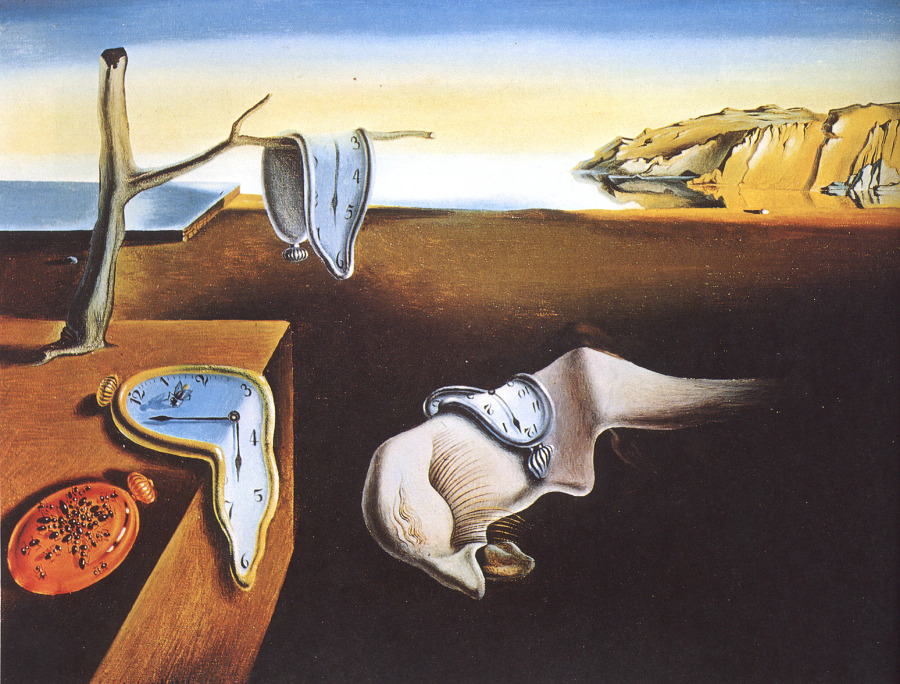
This is the work Dali painted, 'The Persistence of Memory.' Since it's a painting with drooping clocks, it's probably a painting you've seen at least once, so I showed it first. The 'drooping clocks' that 'Salvador' Dali painted are probably one of the few paintings that Koreans, having learned about them in school art class, remember because they felt them to be so 'unusual.' Another surrealist painting is the one below.
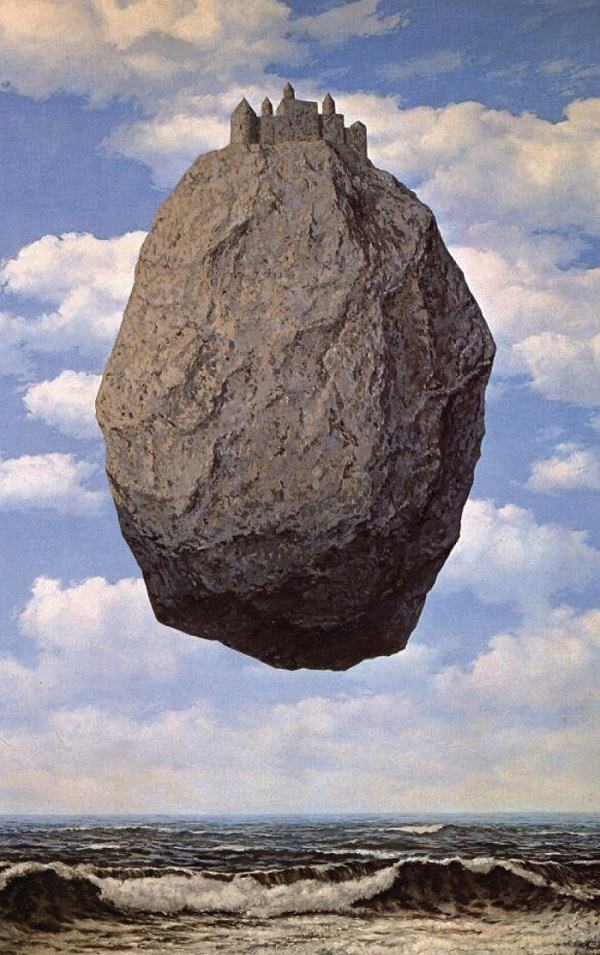
This painting too is one I think you've probably seen at least once. It's 'The Castle of the Pyrenees' painted by René Magritte. It's a truly curious work, with a castle embedded on top of a floating rock. As for René Magritte, I once went to the Magritte Museum while stopping by 'Brussels,' the capital of Belgium, so he's also one of the painters I remember rather well. We learn paintings of this style as 'surrealism,' or seem to have heard it somewhere, but unfortunately Egyptian surrealism shows a slightly different tendency from these paintings. General surrealism, surréalisme, is interpreted as having appeared because, after the World Wars, simply reproducing reality couldn't exert influence on reality, and because reality didn't change. You can understand this a little more easily by considering the very 'simple logic' that before surrealism there could only be 'realism.' Korea's literary works are similar. In the 1920s realism made up the main part, but moving into the 30s, as 'realism' didn't bring about improvement of reality and rather only a more desolate and devastated reality filled everything, surrealist works and modernist works came to appear.
The techniques that generally represent 'surrealism' include 'frottage,' 'collage,' and 'automatic writing,' and among these, 'automatic writing' is shown very well in Yi Sang's 'Wings,' which we've heard of at least once. The novel's closing, 'Let's fly, let's fly, let's fly just once more,' makes this easier to remember. The one who properly established this 'concept' of surrealism is André Breton. This 'André Breton' achieved the definition of the term through the 'Surrealist Manifesto.' The reason I went out of my way to mention 'definition of terms' is that, in the process of people beginning an adventure into some 'new field,' the most important task is exactly the definition of terms. By defining the concept of a term, you can determine the breadth and direction of the discussion and determine its character. After Breton published the 'Surrealist Manifesto,' which ran to 100 pages, many artists thereafter began movements concerning surrealist art, each in their own country in their own way.
2. Surrealism and Egypt
Honestly, for this part it would be good if I referred to relevant English books, but there are none at the library right now and direct purchasing takes a long time, so I'm letting you know in advance that the content is somewhat insufficient. It would be good to cite the catalog, but if I did that, I'd be redistributing the catalog's content, which doesn't seem desirable. So I'll just add my rough interpretation.
After Breton's Surrealist Manifesto, various countries took in 'surrealism.' Egypt was one of those countries. Only, Egypt had a more practical issue at stake. Namely the problem of the nation's independence and identity. Whenever any country is colonized, that country's culture and identity inevitably get shaken. Also, a yearning for the value of 'freedom' amplifies, and I think this part was exactly the core for the Egyptian artists of that time. You can easily confirm this just from the fact that the name of the group holding such a tendency was 'Art and Liberty.' It takes a great deal of time for the tendency of an art group to be determined, but in the case of a single flow where someone lays down a definition, like the 'Surrealist Manifesto,' once people start following based on that definition that was made, the work of concretizing the 'thought' sometimes proceeds rapidly. I think surrealism was probably that example. In a way that fit each country's situation - in this exhibition, exactly 'Egypt.'
The exhibition explains that the 'Art and Liberty Group' led the surrealist movement within Egypt. This group held the 'Free Art Exhibition' over 5 occasions and, through various writing activities, announced their ideology and thought and their stance on art. Of course, this group later disappeared, but I'll just mention that it had various influences up until the 60s. For detailed materials related to this, if you search 'Surrealist of egypt' or 'Egyptian surrealist' in the Google search box, various materials will come up - in English, but you can refer to them.
3. Exhibition review
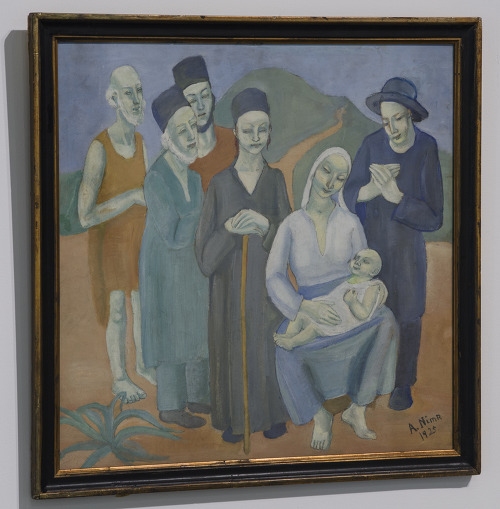
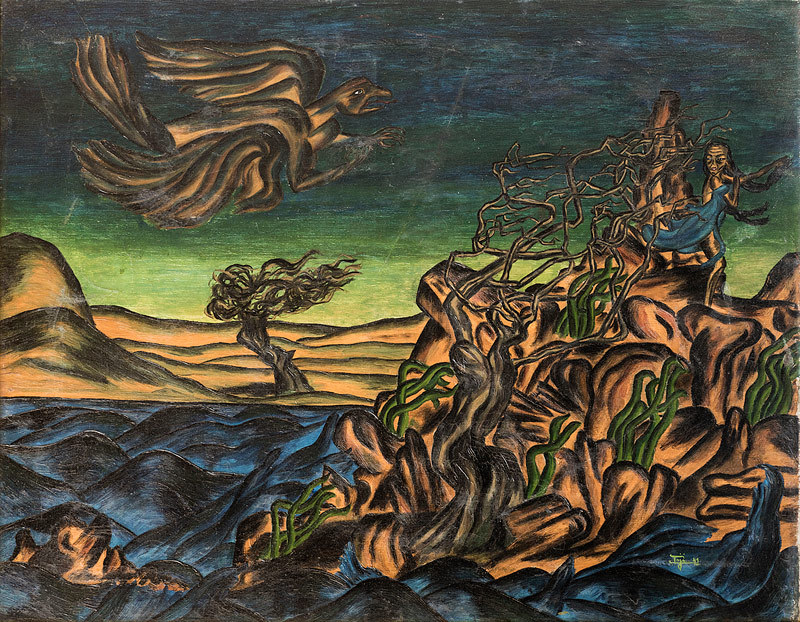
You can see works like these if you go. Besides the works I've put up here, there were really many unusual works, but unfortunately I didn't write down the titles separately, so even if I wanted to put them up here, I can't. Paintings that felt like looking at aliens were hung side by side on one wall. That's how it was.
After viewing all the many paintings and a few sculptures, a thought came to me. The thought, 'If you gathered together the people among ordinary folks who know the connection between surrealism and Egypt, just how many would there be?' I think that 'sample' would be small. It's not a familiar subject to approach. Even people who know Egypt's modern and contemporary history, one of the two domains, would not be easy to find. 'Surrealism' is at least the most approachable keyword, but even though there are many people who know surrealist works to begin with, those who properly know why it arose are rare. In other words, several factors are contributing to raising the difficulty of this exhibition. So its popular appeal and accessibility fall a bit short.
So, if I may give a tip, to understand this exhibition I'd like to recommend going in knowing at least Egypt's contemporary history. You have to view it knowing things like that Egypt was, in any case, plagued by 'dictatorship' until recently, and that because it was a British colony for quite a long time, 'surrealism' is positioned as one part of the movement to draw out 'what is Egyptian.' Once you know this background and then look at the works, it'll be a bit better. 'Surrealist' works are mostly closer to things that simply pulled out consciousness itself rather than works that went through some refining process of consciousness, so it would be normal for the forms of the images appearing in the paintings or sculptures to be hard to understand; even if you study beforehand, there's a high chance you still won't get it, so since that's the case, if you go knowing at least the history, I think you'll be able to examine a bit the 'emotional aspects' contained in those images. In the way of understanding pain by looking at a painting, or understanding a yearning for freedom.
Of course, it's not that the works as a whole consist entirely of 'incomprehensible images.' Surrealism aimed to create 'images that transcend reality,' but as for Egyptian surrealism, the more the image expression of trying to overcome reality is highlighted, the more you can confirm the problems of reality. Of course, there won't be realistic paintings like 'realism.' Nor is there anything that reveals people's everyday scenery like impressionism. But all artworks are the self-expression of the artist who created that artwork, and Egypt's experience of colonial rule can be confirmed in various forms through the subject matter of the paintings. In that sense, this exhibition is in a different direction from the recent exhibition of ancient Egyptian relics at the National Museum of Korea. For one, it's in a different direction in that it compared 'ancient' and 'modern,' and it's also in a different direction in that it presents the familiar and the unfamiliar. So I think many people will find it difficult, and there will probably be many works that feel abstruse. However, for those who normally like surrealist works, I think it'll be a somewhat different experience. The surrealism of Salvador Dali, Magritte, and Joan Miró was relatively bright in its colors, but in Egyptian surrealism it was very hard to find a work with bright colors. Almost all of them were dark and gloomy, so they were hard to look at..
P.S. As I was writing, since I've somehow given a very basic explanation of 'surrealism,' it seems there won't be a separate posting on surrealism for the time being.
Exhibition difficulty ★★★★☆
Familiarity ★★☆☆☆
Variety of works ★★★★☆
Ticket price ★★★★★ (At 2,500 won including palace admission, there's no more bang-for-your-buck exhibition than this.)
Price of souvenirs like postcards/bookmarks ★★☆☆☆ - There are no postcards and everything is in the form of a 'small poster,' showing a price of 3,500 won each. The difference in size isn't even much..ugh ugh....
Suitability as a date course ★★★☆☆ - There's too much prior knowledge required to understand the paintings and the paintings are abstruse, so I don't recommend it, but I think it could be quite suitable for showing off an intellectual side. Also, if you like abstruse paintings, then by all means..
References
André Breton, Surrealist Manifesto, Mimesis, 2012
Comments 0
No comments yet. Be the first.