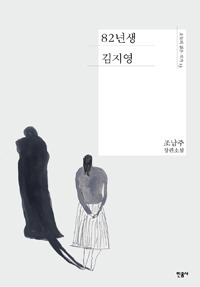
- This piece contains a lot of the novel's content. -
0. A Talked-About Work
"People call me a mom-roach" is the sentence written on the back of this novel. Mom-roach? Mom-roach, yes. Usually the word 'roach' (chung) carries the meaning of that 'bug' we're all familiar with. If you ask why 'bug' of all things, I can only say that social convention chose the Sino-Korean word 'chung' as a kind of suffix used with the derogatory meaning of 'a bug-like person'. The suffix 'chung' was often used before, too. Especially at school. Words like jamchungi (a word teasing kids who only sleep) and sikchungi (a word teasing kids who only care about eating) are examples. Looking at the word 'mom-roach' in this context, it's a word that disparages 'mothers'. In the novel's context, it can be seen as meaning 'a woman who just lives off men's money and drinks coffee'. In particular, here the 'coffee' price wasn't the 3,000-won-plus coffee of Starbucks or Coffee Bean, but 1,500-won coffee.
The first time I encountered this novel was through a 'card news' floating around online, and afterward, since I had no occasion to go to a bookstore, I had no occasion to see the book—and reading it like this, I felt it deserves to be called a talked-about work. I don't think it's a 'controversial work'. I think there are few people who'd regard this novel as problematic. This work is clearly a talked-about work.
1. Another Experiment in Third-Person Narration
I've grandly named it another experiment, but I'm not sure whether it really is another experiment. It's just that, in my subjective feeling, this novel's form was, in its own way, indeed an experiment. A novel like reportage, perhaps. The method of narrating a story from a third-person viewpoint and revealing at the novel's end that the story was about someone connected to that 'third person' is something I'd encountered before in novels I'd read—Yi Cheong-jun's 'The Falconer' and Kim Seung-ok's short story 'Fantasy Notebook'. Of course, 'The Falconer' is more head-spinning because its frame is not two-tiered but three-tiered, and Kim Seung-ok's 'Fantasy Notebook' has a two-tiered frame but the 'inner-frame story' is narrated from a first-person viewpoint, so there's the difference that I read it while empathizing with the emotions of the inner-frame story's protagonist. 'Kim Ji-young, Born 1982' maintains distance through its third-person narrator almost from start to finish. The distance gained by referring to Kim Ji-young as 'Ms. Kim Ji-young' makes it feel less like a novel and more like reading some kind of observation log. Without the subtitle 'a novel', I might have seen it as a kind of anecdotal record. Of course, it's necessary to keep in mind that thanks to the fact that this 'Ms. Kim Ji-young' is not a real person but 'fiction', this work appears as a 'novel' that doesn't seem like previous novels. Moreover, the figures of social statistics that appear here and there in the middle of the novel make you wonder whether this is really a novel, while at the same time constantly informing you that the difficulties, pain, and discomfort the protagonist 'Ms. Kim Ji-young' experiences happen not only in the novel's reality but in actual reality too.
Personally, this kind of novelistic method isn't to my taste. Moreover, the 'prospect-less ending' that appears at the last part of the novel's structure is an even more disappointing part. On top of that, the fact that the person who happened to observe all this is a psychiatrist means, in a way, this novel can be said to have a truly formulaic story structure. If the person observing and narrating this content had been not a psychiatrist but a new occupation like an 'oral historian', I'd have found it truly fresh—but the ordinariness of being a doctor, and the fact that this doctor, too, says he'll hire 'unmarried people', is a part that, while I understand it because the author intended it, on the other hand makes me feel a regret over whether even the author's thinking wasn't too schematic.
2. The Broad Framework of Gender Discrimination as Content
The novel's content can be summed up as gender discrimination against women. Examples include the discrimination Kim Ji-young received from her grandmother in childhood for being a 'daughter' rather than a 'son', the discrimination at school as a 'female student' rather than a 'male student', and the discrimination at the company as a 'female employee' rather than a 'male employee'. And this discrimination makes up much of the novel's content, and is its entirety as well. I can't mention it all, but I think this much lets you guess much of the novel's content, so I'll omit a summary of the content. Well, one thing is clear: whether I omit it or not, much of the framework consists of statements that can be summed up as the formula 'a woman must be ~~~'. If I had to pick a few impressive bits, I'd choose the teacher's remark that female students are restricted to 'black stockings' or 'sheer stockings' with their shoes and limited in what they can wear under their blouses, and the words a woman sitting beside her on the subway said while bumping her shoulder as she passed. Well, the grandmother's discrimination goes without saying. But one thing to consider: after reading this book, I want to say it's a bit of an error to feel that gender discrimination exists only against 'women'. Because gender discrimination exists against both men and women. It's just that the gender discrimination that happens to women is more intuitive and has more constraints, so it stands out; gender discrimination appears against the men in the novel too. For example, the idea that the youngest shouldn't be the one doing the housework.
3. Conflict with Reality
A little while ago, just a few minutes after finishing this book, my friend A happened to call. He'd called to tell me the solution to something I'd previously consulted him about, and when he asked what I'd been doing, I answered that I'd read a 'novel', and when that friend asked back what kind of novel, I answered it was a novel about 'feminism'. And the question 'again?' came back, and I answered, 'Yeah, this novel's apparently famous these days.' There are many reasons this novel is famous, but I think the biggest is that the novel's 'shared resonance' was greater than other novels'. But before that, let me talk a bit about 'what my friend said' first. My friend A talked about how the women around him try to gain rights while not bearing the duties or corresponding responsibilities. This remark of my friend's has, to me, parts that are right and parts that are wrong. Since I don't want to construct my message starting with a rebuttal of friend A's opinion, let me mention the parts I feel his opinion is right and the parts I feel are mistaken, as follows. For reference, these are stories I heard from people I can trust or saw directly.
Case 1. Those who insist they want to leave work early while still receiving the same wages as men
Case 2. An anecdote in which, on the school's sports day, when it suddenly began to rain during the event, the female teachers all went inside and only the male teachers remained, hurriedly moving the equipment that mustn't get wet into the shade
Case 3. A female manager who, when heavy objects had to be lifted and moved and the person in charge tried to assign lifting the heavy objects only to men, asked back, 'Why can't women lift them? Women have strength too.'
Case 4. Those who said that men must be tough and bold
Case 5. A close older friend (hyung) who, after applying for parental leave, came to take charge of childcare at home
Case 6. Adults who say a man must never cry in his life
Well, I think it's hard to say which claim is more right or wrong. People who say discrimination against women is more severe can be seen as having lived a life that was actually like that, or as having seen those parts more because the gender discrimination they were able to perceive was mostly limited to 'women'. Also, the reason no one really tells you about the physical changes experienced after childbirth is that many people who experienced childbirth before were never taught by anyone that they 'should speak' about what changes they went through after having a child, nor did they ever think they ought to speak about it. Moreover, when very elderly grandmothers or grandfathers say 'the household must be led by the son', you can't say it's simply wrong. Because when they were forming their values, that way of thinking was taken for granted. The criticism that Korean society is, so to speak, experiencing in 60 years what took Europe nearly 200 years has many valid points. The fact that change between generations is too fast can be seen as the very proof of this.
4. What Should We Do Going Forward.
Personally, comparing the upbringing of those around me with my own upbringing, I belong to the men who have formed 'good experiences'. I don't unconditionally call the values of grandmothers and grandfathers wrong. To them it's taken for granted, so there's a need to understand that. But I have not the slightest intention of forcing these values on others. When I got in a taxi and the driver said 'I generally don't take a woman as my first customer', one might feel no particular antipathy, or one might—and you can't say the person who feels none is wrong. Because the 'taxi driver' simply held such values. Some will likely point out that this is too permissive, but in a social atmosphere where everyone's upbringing must be respected, conflict grows if I say only I am right and the other is wrong. But because society doesn't change drastically in an instant, I keep finding myself worn out the more I keep saying such things, so these days I'm holding back. In the past too, adults who had the awareness that the proposition 'a woman must be ~~' was wrong educated their daughters the same and sent them to university the same. There were just fewer of them. Society is gradually changing.
The conflict that occurs among people my age is, perhaps peculiarly, that men and women who advocate 'gender equality' have conflict with men and women who don't advocate 'gender equality'. Because now there are more people talking about gender equality. The part I'm personally paying attention to is a bit different. That part is the conflict that occurs between men and women who both advocate 'gender equality'. That conflict arises from the perception and emotion of 'men' who feel that men and women are in an almost equal situation, versus those who feel that men and women are still very much within discrimination so that women are in a more disadvantageous situation.
5. To Close.
The ending of 'Kim Ji-young, Born 1982' closes with the record of a male psychiatrist. The third-person narrator who observed a woman's life was a man. And that narrator ends the novel thinking that, regarding having to newly hire a contract worker because one of his employees is taking maternity leave due to pregnancy, from now on he should hire male employees. I can only think this composition is a decidedly intentional conclusion. In a way it's a composition that 'highlights' the hardship of reality; on the other hand, it's a discrimination by men against women that's almost excessive. I think going too far is a shame, and this part is a shame for me. It's too dark a prospect for an ending. It would have been a less pessimistic novel if the male employee had instead empathized with the female employee's maternity leave.
I think the liberation of the 'Man box' and the liberation of women lie on the same line. And I think one can't say that the discrimination of any particular gender is more severe. Individuals' 'sensitivities' are parts that can't be empathized with and can't be quantified. Because you can't easily say that men don't experience the pain of discrimination women experience. The anger women feel at words like 'a woman must be ~~' is surely different from the anger felt at words like 'a man must be ~~', but that's a difference arising because they're not the same person, not a difference that can be defined as arising because one is male and the other female. I'd cite as grounds the fact that, even within the same women, and within the same men, the emotions or cognitive outcomes felt about that discrimination differ.
This has gotten long, but let me close with a recently memorable anecdote. Because of the Department of Physical Education's presentation event at school, the PE students were lined up in the dormitory cafeteria to do the 'sori-tong' (a spirited group chant). But there wasn't a single female student? So I thought maybe there really were no female students and that's why the female students didn't come out for the sori-tong, but lo and behold, this morning I saw female PE students with '17th class' (first-years) written on them. Who tipped them off that women don't have to do the sori-tong? Women should do it too. It's something women can do equally, so it made me wonder why they were left out. Well, there may have been personal circumstances, but if there weren't, I think men and women should have done it equally..
Comments 0
No comments yet. Be the first.