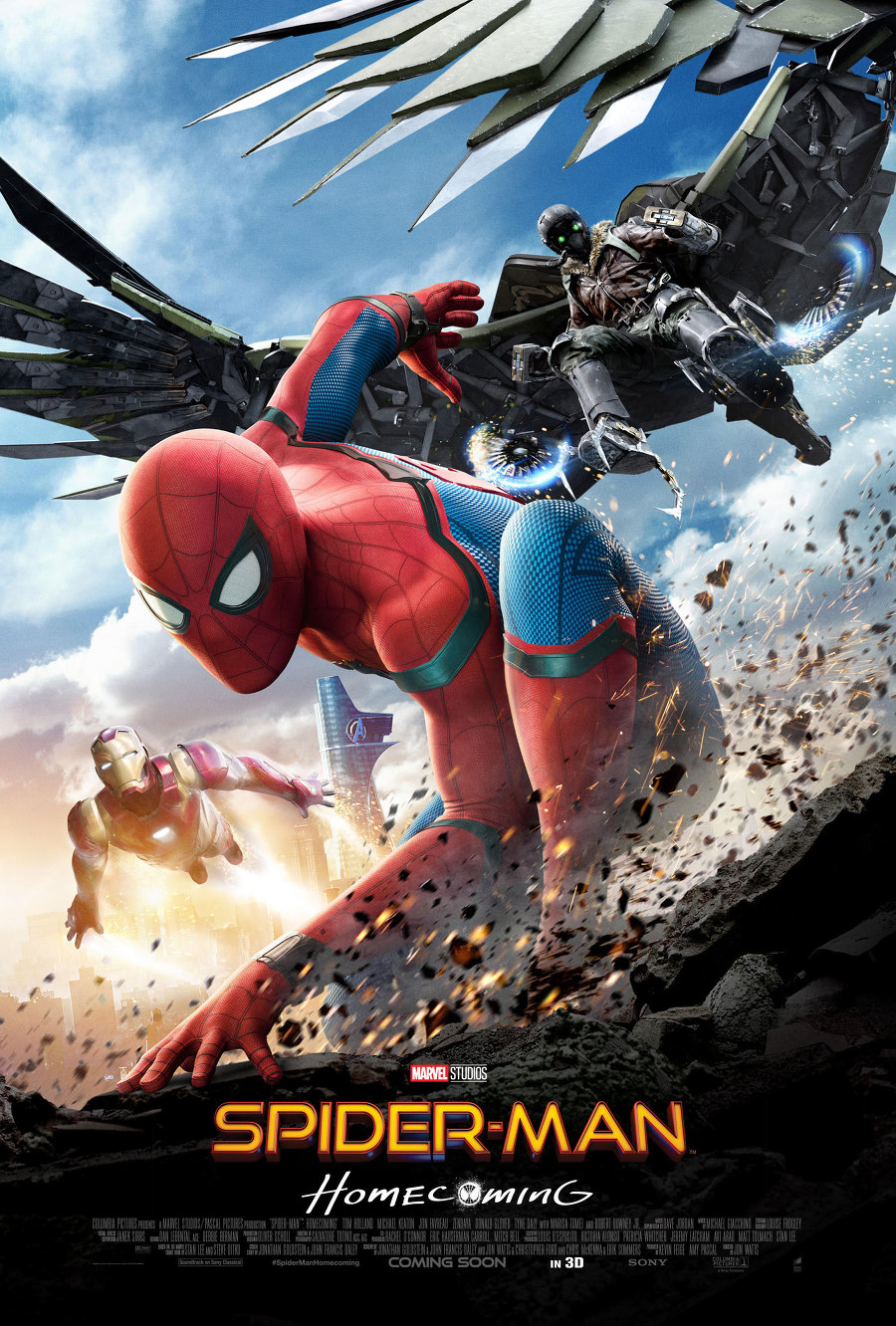
- A short review -
I still love Spider-Man movies. For me, the best Spider-Man movie isn't the recent one starring Tom Holland, but Sam Raimi's Spider-Man starring Tobey Maguire, and the reason is that in realizing Spider-Man's 'ordinary character,' I felt Tobey Maguire was more suitable than Andrew Garfield. Andrew Garfield seemed too much like a figure who contributed to making a romantic comedy, which was a shame. Of course, he portrayed the 'dark and gloomy Peter Parker' well. In that sense, Tom Holland's own characteristic could be said to be that he shows more of the bright side of a teenager.
The parts I paid attention to in the movie could largely be divided into two. One was, at the very beginning, the scenes showing the process of how the 'Vulture' becomes a villain. In a situation where the 'Vulture,' having obtained approval from the city authorities, even sold his own assets to buy trucks and hire workers in order to collect and clean up the alien creatures, the 'Stark' company declares that from today they will be in charge of this district and tells them to leave. It's an eviction absurd enough to be called outrageous; the matter could have been resolved if Stark Industries had hired these people (job succession), but they didn't, and this ends up becoming the cause of the conflict that arises. Whether this form of public authority can be permitted is something I think we need to consider more, but in my case I rather disliked it, and I feel the regret of wondering whether there wasn't another way. Of course, I can't say that Liz's father did 'well' afterward either. But it's true that I felt regret about Stark Industries and the city authorities' administrative handling that created social conflict. I disliked the very fact that public authority is operated in this form.
The other was that it's a movie that revealed racial diversity. In Sam Raimi's earlier Spider-Man trilogy and director Marc Webb's Amazing Spider-Man series, there are only white people. White people really make up 95 percent. Occasionally Asian people appear, and the Asian people I remember are only the assistant scientist who appears in the second film and the street singer who sings the 'spiderman, spiderman, where is the spiderman' song. Black people sometimes appear as firefighters, and Hispanic people appeared as wrestlers but are hard to find. Such a Spider-Man movie, after absorbing racial diversity, could be confirmed through the Hispanic Flash, Liz who has a white father and a Black mother, and Ned, Spider-Man's best friend who appears to be Asian. In that the movie reflects realistic aspects like this and broke away from being a movie with only white people, this part deserves praise. Well, there will probably be few people who pay much attention to these parts in the method of realizing 'Spider-Man,' though.
As for the regrettable point, there's not a single thing shown about the reason why Peter Parker 'tries to help' people. Rather than grasping him as simply being a born owner of an 'altruistic disposition' who helps people, there seems likely to be some decent reason, and I think it would be fine if a bit more plausibility were secured in this part. The biggest reason many people were enthusiastic about Sam Raimi's Spider-Man trilogy is that it appropriately portrayed the meaning contained in the line 'With great power comes great responsibility' and Peter Parker's growth process of seeking out that meaning, yet in this part the Spider-Man of 'Spider-Man: Homecoming' showed a deficiency. I pray this part is resolved a bit more in the next installment. Also, I wish the web action would become a bit more refined.... I'll wrap up this piece, realizing how very hard it is to surpass the trilogy that Sam Raimi accomplished.
Comments 0
No comments yet. Be the first.