#temporary #temporaryteacher #island #islandvillage #islandvillagelife #facultyhousinglife
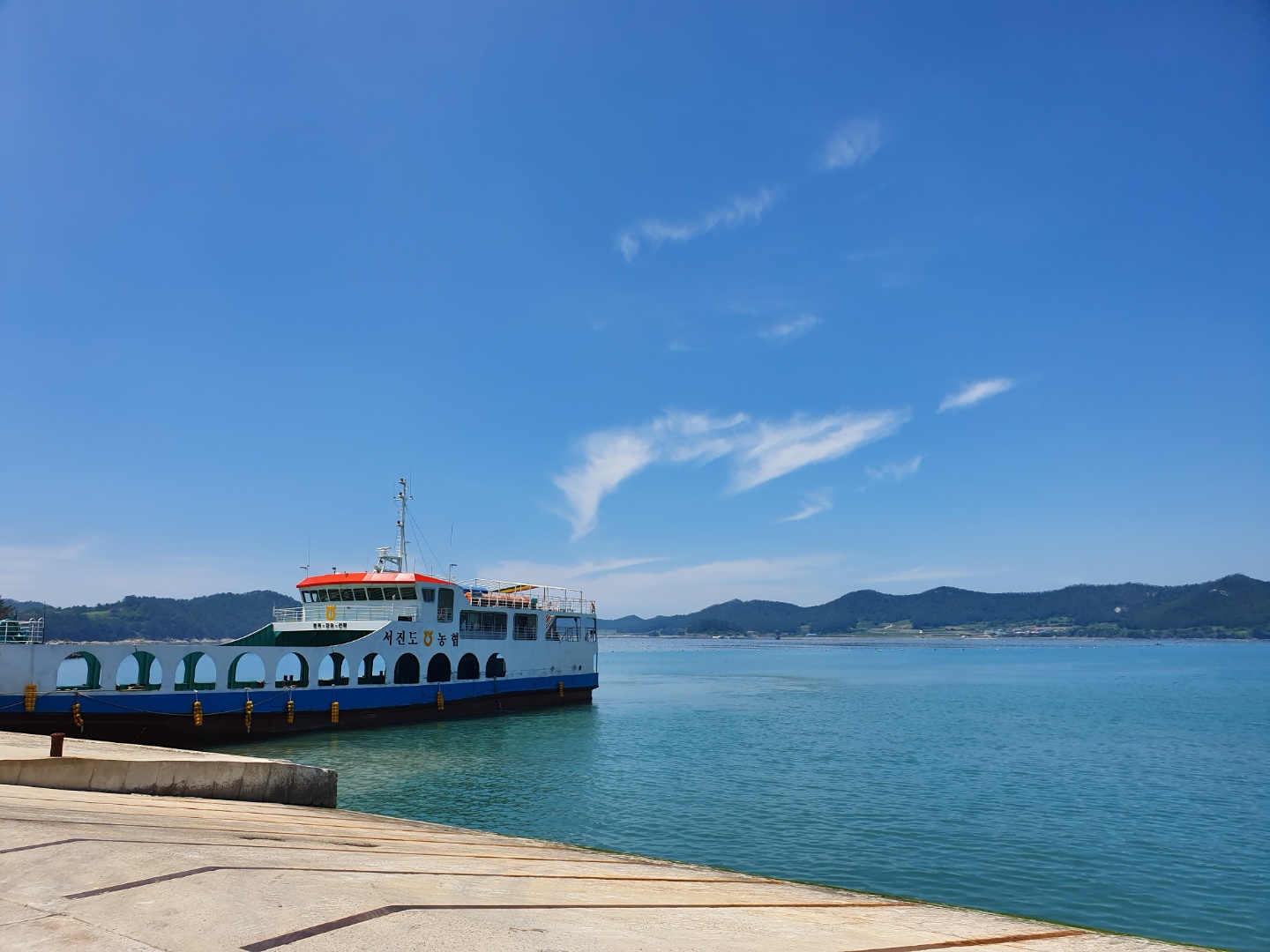
It has only been three days since my life on Jodo ended, but I wanted to write at least a little to sort through and record that life, so I put my hands on the keyboard. My mother told me that the memory of being a 'first teacher' would stay with me for a long time, so I half-wondered whether I really needed to sort through those memories, but in the end I decided to do so, since organizing things seems to suit my personality better. For a while I plan to write slowly. I will have to divide this life into a few themes, but at any rate the main theme is 'school.' I am going to write about the many things I experienced at school.
1. A small school
The middle school I was at is a small school. Being a small school carries both advantages and disadvantages in various respects at the same time. As is the case with every school's characteristics, this small school was a truly proper small school. There were fewer than ten students per grade, with one class per grade for a total of three classes. The entire student body numbered twenty.
I had been told that being a small school does not mean the number of official documents you have to send out decreases, and just as my mother said, although that school too was small, the things it had to send out were exactly the same. For example, that school also had a library; it was not as though, being that school, there was no grade-management committee; the school operating committee existed all the same; and a school-rules revision committee had to be convened if needed. A library operating committee was needed too. Well, to the point where it gets tiresome to keep listing them, a school has various internal deliberative bodies that must be organized at a minimum, and since these all exist mechanically regardless of whether the 'total population' is large or small, I think I felt the workload had increased.
The work I was assigned in the staff office was the work of the previous teacher. The previous teacher's duties were broadly divided into 'Korean language department,' 'character education,' 'assessment and basic-academic-ability management,' and 'library' work.
1) Korean language department
Korean language education is famous for not making any special demands. To the extent that I remember an anecdote I once heard that, at the upper department of the Ministry of Education, the Korean language department was the only one without a dedicated official, the Korean language department had nothing that could be called an education-emphasis project distinctive to it. By my standard, I think 'reading and discussion' ought to be brought in, but since reading-discussion is not the exclusive property of the 'Korean language department,' that is where it gets tricky. My personal view was that it would be right for the 'Korean language department' to take a stake in the methods and strategies of reading-discussion, while the content subjects of each discipline take a stake in the expertise, reliability, and validity of the topics and content of reading-discussion. If I had to pick just one, I could pick 'reading one book per semester,' but since I am in the position of opposing this achievement standard, I once sent in a survey saying I wanted this achievement standard removed because it ought to be abolished.
The stance and area of expertise of Korean language teachers may differ from school to school, but our department is broadly divided into the tool-subject area (listening, speaking, reading, writing) and the content-subject area (grammar, literature). Of these, I taught with weight placed on the tool subjects. This is partly because the content areas are the parts ordinary Korean teachers focus on, and partly because I thought listening, speaking, reading, and writing were far more important.
For reading (reading books), listening and speaking (debate, discussion, meetings, presentations), and writing (composition), I emphasized them even more during periods that included the relevant achievement standards, and I strongly emphasized their importance even to grades that did not. Whether or not one takes the College Scholastic Ability Test, their importance is higher than that of literature, higher than that of grammar. Because the people you meet for the first time when you reach your twenties are not so generous about the 'communication habits' you had previously.
I held a contest only once (two were planned): a book-review writing contest. I thought it would be fine to accept entries as computer files, so I used that as a submission method too, and I think the students lowered their writing burden through 'computer writing' more than I expected. Because it is more effective for simply laying out the content in a row than writing by hand.
For exams, I set a total of 50 questions twice. (25 questions each for the two grades, midterm and final.) Setting the questions was a bit of a burden. Setting 50 questions alone is certainly not easy. Still, I did set them, so I am satisfied. Once I ended up creating a question with multiple correct answers, and because of that I convened the grade-management committee.
The teaching load was 4 periods each across 3 grades, a total of 12 periods, and although the load was small, preparing 12 lessons a week was quite grueling. Even after thinking and preparing, you only get to use it for exactly one hour, so there is a lot of futility, and the big problem was that even if you want to revise it and try again, there is no opportunity to do so. Well, it couldn't be helped.
2) Character education
Honestly, I did nothing in the way of character education. There was one chance to receive character-education training, but I had no car and could not figure out why I should go early, so I just didn't go. Still, I think I can sum up the elements of character education as I see them in a few points. The elements of character education as I see them are consideration, respect, and empathy. The method of teaching these at school is not fixed to any particular method. Usually I explained many things by dissolving them into forms like 'cooperative learning' within subject-learning time, by watching a movie together and talking about the actions or remarks of the protagonists in the film, or by explaining the reasons why, as a teacher, I think 'consideration' is necessary. Beyond this, there isn't really anything more to say; that is character education.
Well, but a large part of it is that I wasn't able to try many things. I think the more correct method is not to teach by inserting the elements of character education into various subjects, but to find the content elements of subjects within real-life problems. The situations of character education, or the content of character education itself, exist in a very complex and unstructured state, and trying to realize that within structured subjects means it has no chance of being realized.
3) Assessment, academic level
There are various kinds of assessment, but what the teacher in charge of assessment at a school does is the planning and operation of the 'midterm and final exams.' Setting the exam questions is done by individual teachers, but reviewing them is done by the teachers in charge of assessment. They also handle the OMR sheets. However, since this is a small school, the number of OMR cards was very small, which made it convenient. But the toil of the teachers in charge of each subject in setting exam questions was beyond words. With each person putting out at least 40 questions, of course it was hard.
Besides that, what I did was manage the academic level. Work concerning basic academic ability. All students took a basic-academic-ability diagnostic test about once a year. Since our school is a school in an island region, I had worried a lot, but fewer students fell below the basic-academic-ability threshold than expected, so the work decreased. But in any region, students below the basic-academic-ability threshold are one of a school's major concerns. Those targeted for basic-academic-ability instruction had not suddenly become subjects of basic-academic-ability education. In the case of those who came to middle school, it would be more reasonable to see it as a case where learning deficits from the 'elementary school' years had already accumulated. You can see that it usually occurs a lot in 'mathematics,' and I wondered whether, for the students, continuously taking tests because of falling below 'basic academic ability' might be somewhat stressful, and in reality the students were indeed experiencing stress. It had already become a 'stigma,' and I wanted to erase those stigmas, but it seems it didn't go as I wished.
4) Library
It was a small school, but it had a library. I suspect it was probably the place with the most books for 'adults' among the libraries on that island. But oddly, ordinary rural middle schools are located somewhat far from the township office. Here was no different. So the local residents didn't use it much. Still, the books in that library were almost all recent books. Our school was an integrated school, and an integrated school means a middle school and a high school together. Thanks to that, the library was completed as bookshelves within a single 'room' that used up the budgets of both the middle and high schools. Of course there couldn't help but be many books.
There wasn't much work I did related to the library. I did the purchasing of books, but it was a field with hardly anything special to it. Personally, I even came to think that a 'librarian' is needed at a school only in the sense of organizing books. In fact, this is all the more so because I strongly felt that education in reading 'books' or in selecting 'books' is also something that can sufficiently be done within the Korean language department.
Apart from these 'duties,' the library was our school's main meeting room. For us, who had nothing that could properly be called a meeting room, having a space as close and large as the library was a blessing.
For now, I should write only this much for the first piece. The things I experienced living at that school are not few.
I should jot down just keywords for the content I will write about going forward, so I don't forget.
After-school programs, the school trip, volleyball (South Jeolla Province), the Sewol ferry events, parcel delivery, faculty-housing life (poor facilities), relationships with the teachers, organizational characteristics, staff dinners, deliberations at school, the professionalism of the work, relationships with the students, and so on—there is a lot I want to write, but I'm not sure I'll be able to write it all. I'm jotting down these pieces this time so I can look at them again later before my interview. I think they'll be helpful at the interview down the road.
Comments 0
No comments yet. Be the first.