#contractteacher #fixedterm #contractteacherhousing #facultyhousing #facultyhousinglife #islandvillage #Hajodo #Jodo #islandlife #island
In this post I'd like to write about my reasons for going to the island and life in the faculty housing. Before this story, I should first talk about my time in England.
0. Life in England
As I've told the students at school many times, I never felt that island life was difficult. One reason I can give is that I had lived in a mountain village in England where even the internet barely worked. Even looking at the map again now, Coleg Elidyr was deeper in the mountains than I had initially expected. It was a place I had never imagined, where the mobile data signal on my phone wouldn't even connect. Even the internet had to go through a proxy. There was no supermarket nearby. The nearest pub was about a 30-minute walk away, and a single glass of beer there cost somewhere between 5 and 6 pounds (about 9,000 to 10,000 won in Korean money at the time). There I routinely cooked my own meals (with ingredients provided by the Coleg), mingled with the volunteers and staff who lived there, and led a communal life. One day I would cook, and the next day other friends would cook; one day I would take out the trash, and a few days later those friends would take out the trash for the house we all shared. In that monotonous, you could say closed-off, space, I spent six months without anything happening. To get to the nearest 'mart,' you had to drive out for more than 20 minutes at a speed of 50 to 60 km/h. On foot it would take about 2 to 3 hours. I don't know why I did so well there. I just did.
As for alcohol, naturally I bought it all at once whenever I went out. For food I mostly used the ingredients provided, and, well, fortunately they provided detergent there too. So laundry was no problem.
1. A few days before going into Hajodo.
Before going into Hajodo, I looked into whether there was a mart there. When I opened a map app and searched, there was a Hanaro Mart not far from the school. From that moment on, I had hardly any worries. Where I lived in England, getting to a place like Hanaro Mart would have been a 4-hour round-trip walk, whereas in Hajodo the round trip would be under an hour, I figured.
On top of that, I had a feeling the internet would work well too. As I see it, Korea has very good internet facilities even in its island regions. Hajodo was no exception. It worked so well that I really lived without a care. For the students it must have been different, of course. To get out to the city, they would have to think of taking a ferry for nearly an hour and then getting in a car to move around. Looking purely at absolute time, in England a 40-minute drive would get you to a town like Jindo's Sibilsi. In that respect, the Coleg where I stayed in England might have been better, but I wasn't in a position to go out like that every day. I think I could usually get out about once every two weeks. Thinking about it that way, on Jodo I could actually go to Hanaro Mart every day. With the teachers' help I could even make the trip by car. That took about 20 minutes. So it was no hindrance to me at all.
In any case, I wasn't particularly afraid of living in a remote place like England. I thought nothing much would happen. And in reality it seems it didn't. There was nothing about life on Jodo that you could call inconvenient.
In England I didn't live in a whole house; I lived in one room of a house. I shared the combined toilet and bathroom, and the dining table where we ate breakfast was communal too. So I lived in a kind of 'share house.' Compared to that, this Jodo was heaven.
2. Actual Life
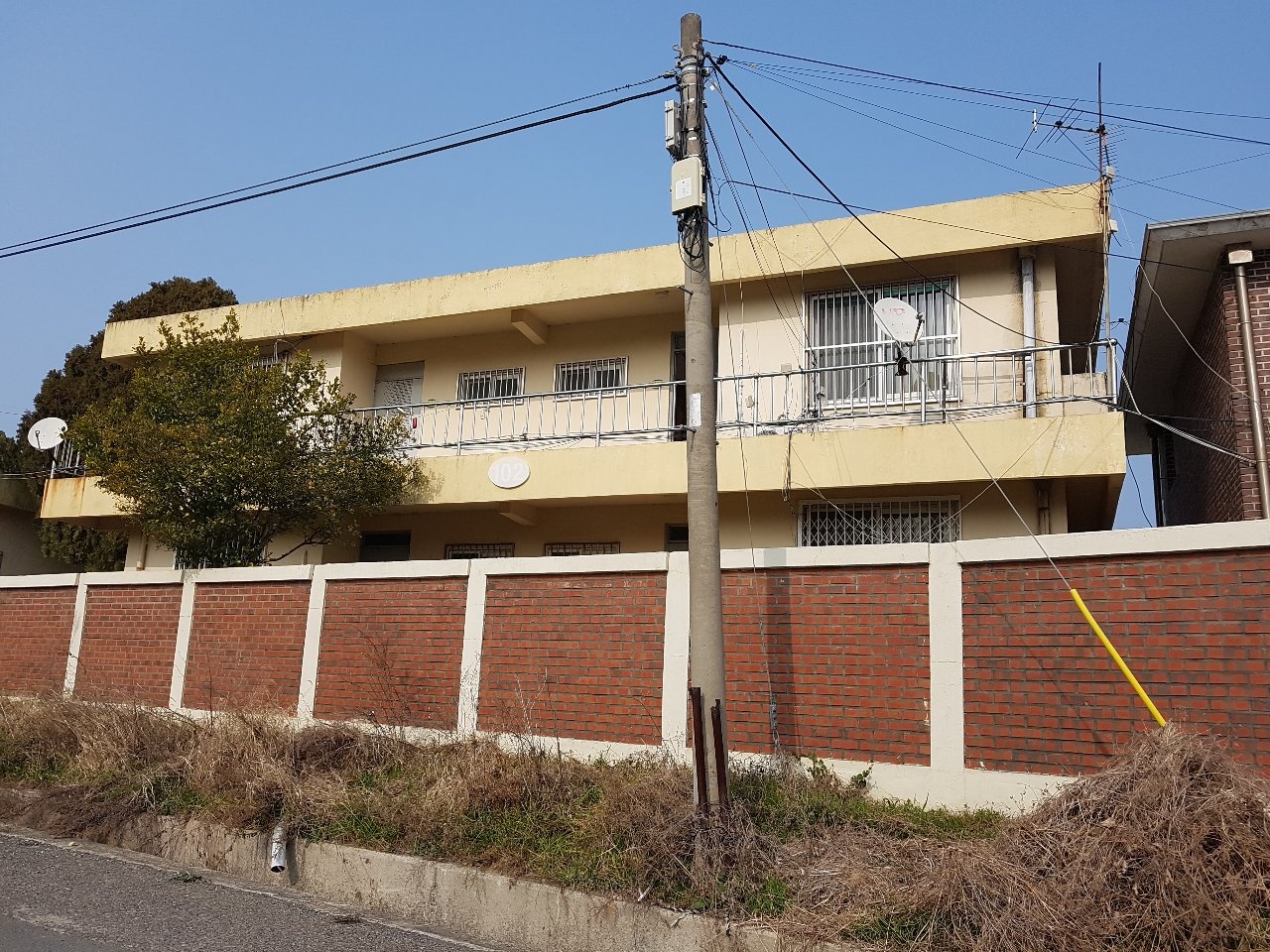
This is a photo of the faculty housing I lived in. It looks roughly like this. Among the faculty housing in this area still in existence for the teachers nearby to live in, this one is on the older and more run-down side. But even this housing, when you hear the stories of teachers who have lived on Jodo for a long time, doesn't seem so bad after all. I was told that housing of this level is plenty good. They said that at first the entrance door was just a glass door. Then it was changed to an iron door. After I moved in, the air conditioner started working well too. After I had the gas refilled, cold air came whooshing out nicely. The gas range, regrettably, was a two-burner one, and I split only the water bill three ways among the three people living in the building, while we each paid our own electricity bill. Anyone who has lived as a single-person household will know that a single person's electricity bill can't be expensive even if it tried.
The things I found inconvenient in this housing were, for example, the toilet, the washing machine, the oil boiler, and the humidity. First, as for the toilet, well, the biggest inconvenience was that there was no separate washbasin. This was so inconvenient. I remember living before, when I lived at a school, in a place that also had no washbasin, and it was just as inconvenient then as it was this time. Because there was no washbasin, the concept of 'washing up' usually became similar to the concept of 'taking a shower.'
The reason the washing machine was inconvenient was that the bathroom wasn't big enough to fit the washing machine, so the drain pipe was connected from the kitchen side into the bathroom, which meant I couldn't close the bathroom door. This too was a bit inconvenient.
As for the oil boiler, there's the fact that it used 'kerosene,' the fact that you had to buy and refill the oil, and the fact that unless you bought 100L at a time, you had to receive the oil in a 'jerry can' and pour it in yourself, and so on. Strangely, my room smelled of oil. In the case of the second-floor housing, the boiler room door was connected to the kitchen. It would have been nice if there were an exterior door like on the first floor, but there wasn't.
The 'humidity' was both good and bad. 'Hajodo' is an island. Being an island, a humid wind always blew. This humid wind had its good points. It protected my throat. Even when I talked a lot all day long, my throat didn't hurt thanks to the humid air. During the two weekend days when I stayed in the housing I hardly spoke at all, and after spending the weekend like that my throat would return to a fresh state. Every time I went out to Gwangju for a bit, I would feel that my throat was dry. The bad thing about the 'humidity' was that the room was full of moisture. So I bought a dehumidifier. Moisture is largely resolved if you buy a 'dehumidifier.' When leaving for work I would empty the water tank, set the 3-hour timer, and set it to 35% humidity. When I came back from work the dehumidifier would be full of water, and emptying that water was how I began my housework at home. I'd heard that without a dehumidifier mold forms. That seems about right.
I didn't mention this earlier, but 'bugs' are one of the issues too. Fortunately I was never bitten by a centipede. But there were times a centipede had died inside the house while I was away in Gwangju over the weekend. And I suffered a lot from 'mosquitoes.' Maybe it's because it was an island, but there really were a lot of mosquitoes. Actually, rather than because it was an 'island,' I think it should be seen as being more because it was natural surroundings.
3. Other stories.
The thing that wasn't difficult in faculty housing life on Hajodo was using the mart. Of course, it's not that there were no regrets.
1) There was no convenience store on Hajodo. That meant I couldn't use the 4-cans-for-10,000-won beer deal. There is one at Paengmok Harbor, but if I bought beer at Paengmok Harbor, unless I loaded it into a car and put the car on the ferry, I couldn't manage that walk from Hajodo's Changyu Harbor to the housing. So it was a shame there was no convenience store. There was no foreign beer. As it happened, I often reached for Cass.
2) Vegetables couldn't come into the Hanaro Mart. This was because the demand from people buying vegetables at the Hanaro Mart was very low. When I looked into it, I was told the Gwangju side wouldn't send the goods. In the end I used a local neighborhood supermarket on Hajodo. There I bought onions, sweet potatoes, and carrots.
3) The internet generally works well, but on rainy days it became a bit unstable. This couldn't be helped. It wasn't just me becoming unstable; it was a setup where the whole island became unstable. It seemed to be shared via fiber-optic cable connected through the phone lines. To explain in detail for those who don't really know what 'becoming unstable' is like: it 'cuts out.'
4) There were way too many cats. On Hajodo there was no apex predator for cats. So the cats' breeding never stopped. I'll omit the details. It was so noisy.
Here are the things that were good.
1) My next-door neighbor and the person downstairs were good. I can say they're the two people I became closest with. Thanks to these friends, my short contract-teacher life was one I could live enjoying a lot of happiness. When will I be able to see them again? Of course, this can differ from person to person. I think I was blessed. When you go to new faculty housing, whether as a contract teacher or just as a permanent employee, you can't assume the people next door or upstairs and downstairs will be good. This is probably the inconvenience of faculty housing. The feature of it being communal housing, yet everyone being someone you know.
2) It was good being very close to the school. I didn't worry about commuting. There was no taking public transit or driving a car for an hour. Of course, when going to Gwangju or another city on weekends, Hajodo was remote enough that you had to drive like that. I feel I should quickly express my gratitude to the two teachers who mostly gave me rides. I feel I should at least chip in for gas money.
3) It was good having the sea, and good being able to see the stars. I'm the type who enjoys natural scenery. City scenery is nice too, but I'm the type who thinks the sounds of nature are even better. So life here suited me. Every night the stars were visible, and I could see the sea whenever I wanted.
4) The facilities were independent. As you know, most faculty housing is intended for 'single-person households.' There is 'family housing,' a 'large unit' designed with families living together in mind, but that didn't apply to me. So I paid the electricity bill alone and split only the water bill.
Next time I should write a bit about the things that were good at the school.
Comments 0
No comments yet. Be the first.