0. This piece was written purely because I wanted to share with others the many thoughts I had while teaching how to write personal statements at school. As for other motives — well, if there's one, it's to raise my Google AdSense revenue, even a little. For reference, I plan to include this later as part of a 'how to write a personal statement' section if I publish a book.
So I give notice in advance that unauthorized redistribution and use after partial copyright modification are not permitted.
- The writing date of this piece is from July 24, 2020. -
1. A brief explanation of the genre of writing called the personal statement (topic, purpose, reader)
1) Before writing, I usually suggest thinking about the 'purpose' of the writing. Because a piece like a 'personal statement' is a prime example of writing premised on 'interaction.' Unlike other expository pieces, articles, or problem-solving structures, it's writing in which the utility of the writing appears most directly. General writing tends to have a very slow ripple effect, but a personal statement, since it's usually writing premised on 'hiring,' has the feature that its result is immediate. To that extent, the 'purpose' is to produce a 'satisfactory piece' that fits the other party's demands or tastes.
2) The topic of 'content that can reveal me': writing a story about 'me' to fit the 'conditions' can be said to be the basis of a personal statement. At this point, let's briefly look at the personal-statement question conditions of a recent public institution, 'Korea Electric Power Corporation (KEPCO).' Writing content that fits conditions like these is the main 'topic.'
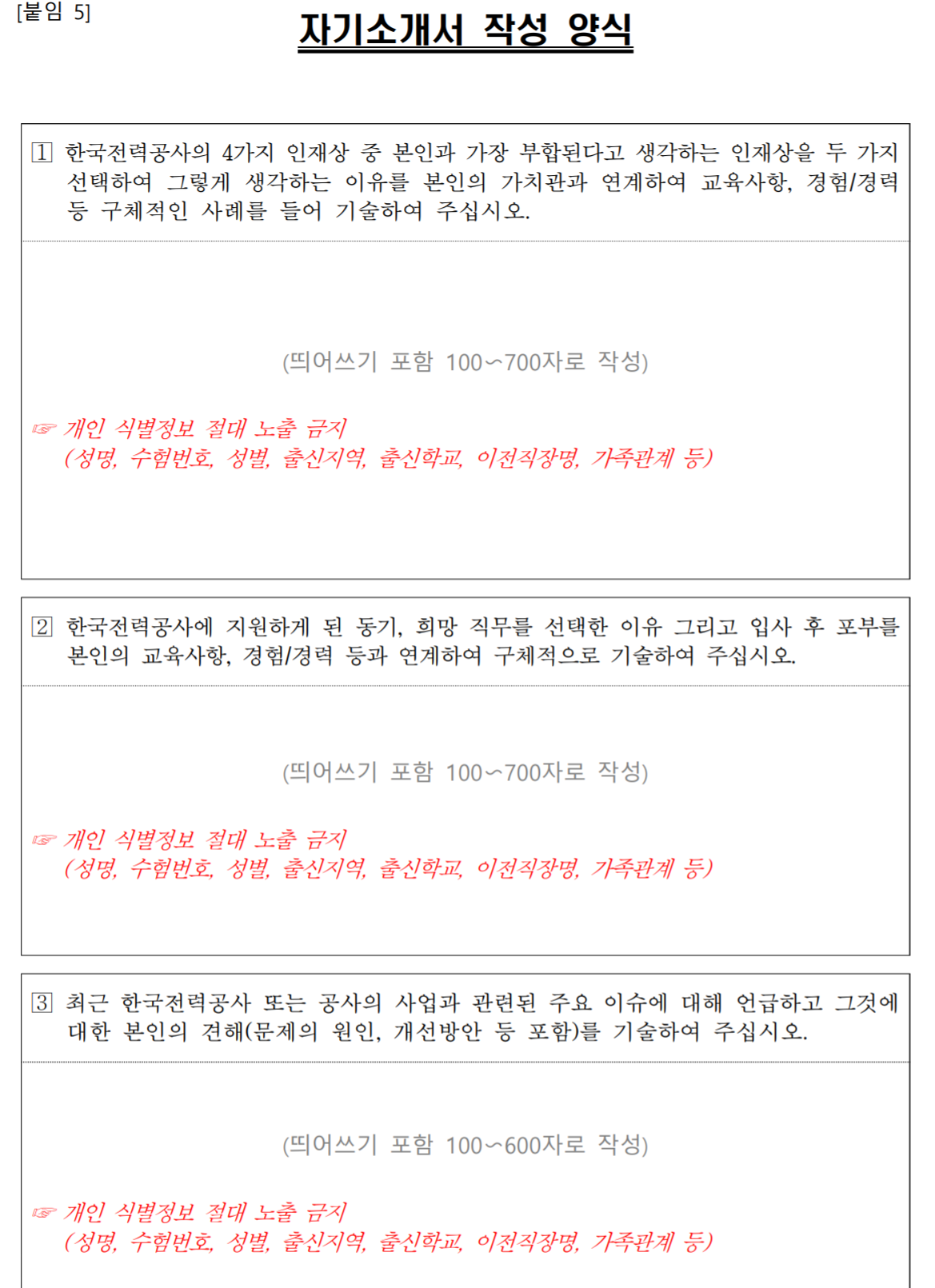
Looking at KEPCO's personal-statement form as above, the 'topic' is very clear. The topics include, for example, the ideal-candidate image, experiences, the job you applied for, recent issues or general knowledge related to this company, job experience, and so on. How you generate content for these contents ends up being the core task. Using a standardized structure for the writing can reduce the burden of writing, but if you think you can write extremely well, it's fine to break that standardized structure. Of course, such structural changes can bring different results depending on individual ability, so it's not a method I can easily recommend. So for now I'd like to recommend the everyday/basic method.
2. The basic method of content generation
- The most basic method of content generation is 'thinking about myself' and talking about 'me' with the people around me. Most personal statements tell you to write about experiences, but no one can decide for you which experience to choose and write about. So first you need to lay those experiences out. A wise way to organize your thoughts about yourself is to use your phone. Most people carry their phones, so while riding the bus home or to school, on the way to the library, or while spending a little time in the bathroom, you need to jot down the things that come to mind about yourself. I think most of the experiences gathered that way can be used in a personal statement. With any experience, only the size of its lesson or degree of resonance differs; whether you achieve the purpose (passing the document screening / selling yourself, etc.) depends on how logically you craft the interpretations of the experience in the writing. Here are a few examples.
Example 1) Successful-communication experience: when asked to write about an experience of successful communication, an experience of successful interaction, or an experience of gaining something by yielding, the basis is to write what communication problem you faced and what communication method you used (yielding, listening, cooperation, negotiation, etc.) in the process of solving it. You can also note the resolution of problems that arose when using that communication method. In my case, for example, I could write that when the organization's direction couldn't be decided due to a disagreement with another team member, if my proposal was even slightly lacking, I chose the strategy of boldly abandoning it. The reason I abandon my own proposal is that when I find a shortcoming in my own proposal, revising it is very difficult. Revising others' proposals isn't hard for me, but revising a proposal I created myself was very hard. So abandoning my own item, accepting the other party's, and adding my opinion based on it could be the easier and more respectful method.
Example 2) Problem-solving experience: problem-solving can't be pinned to one thing because the kinds of problems are so varied. It's not wrong to say everything is a problem. Examples of problems I consider include 'a situation where it's hard to achieve a set goal,' 'a situation where a goal can't be set,' 'a situation that won't progress because conflict is severe,' 'a situation where the current state hasn't been properly analyzed,' 'a situation where no improvement happens even with time invested,' and so on. Beyond these, you can set anything as a 'problem.' Since it's a problem-solving experience, the solution should be concrete and effective — that's good both for writing and for using in interviews. For example, if you described the problem that it takes a long time to learn newly studied content, you can compose, as your answer/the writing's content, the solution of showing diligence by working harder and investing more time than others so you can achieve it.
To give a concrete problem I faced: in my freshman year of college I can speak of a discussion about performance format. At the time I was in a club that did piano performances, and since the club I belonged to was a 'newly formed' club, I wanted to show students that ours was a capable club, and I concluded that to show this, doing a performance that broke away from existing performances was the most 'impressive method.' In the end, the performance format I proposed earned the response 'fresh' from the other club members too, and we once gave a very satisfying performance. (Filming a silent film and performing music suited to that film's story.)
Example 3) Issues related to the company/the company's business: this must be writable based on thorough research. If you go into ALIO: Public Institution Management Information Disclosure System, you can check disclosed information on most public institutions. Referring there to business reports or business status, you need to grasp what this company does and what goals it sets. Once you research the company this way, you can learn what this company currently sets as its 'goals,' and you should emphasize that you are prepared to contribute to those goals. For example, given a business status showing they're focused on developing secondary-battery charging stations, if you can present that you anticipated the problems that might arise after developing and installing secondary-battery charging stations, you end up presenting content that can be understood as decent 'job competency' or interest in the 'job/company.'
Example 4) Motivation for applying: for the motivation, it's important to emphasize 'it had to be this company.' It's the part where you must show 'praise' for the company and 'earnestness' toward it. This earnestness lies in 'sincerity' and 'building common ground,' which is the hardest. It's hard to find a reason anyone could understand. Next time, if I find a personal statement that wrote this part well, or if what I wrote is decent, I'll post it.
For now I'll write up to here. Next time I plan to post a personal statement I wrote imagining myself as an actual applicant.
Comments 0
No comments yet. Be the first.