The work 'Late Autumn,' made as many as four times, was remade twice under different names and twice under the same name. Maybe it's because it's counted as a classic of Korean melodrama, but the remake of this film at the time became quite a 'talking point,' and with the casting of 'Hyun Bin' and 'Tang Wei'—the top stars of the era—as the film's leads, I kept anticipating, all throughout its making, what kind of film it would be. Then Hyun Bin, riding the popularity of 'Secret Garden,' and Tang Wei, making her face known through 'Lust, Caution,' began in an instant to be talked about among people.

The spatial setting of this film is Seattle, a dark city where within a year there are fewer than 60 'sunny' days and more than 300 'cloudy' days. Perhaps this is because the city is located at a point where ocean currents stop. Moreover, since it's a west-coast zone of westerly winds, humidity naturally builds up a lot, and that much it's hard for the city to be clear year-round. At any rate, compared to the previous films, this one clearly tried to maximize the weight of the 'male lead.' 'Hoon' appears more often than in the earlier Late Autumn, and because the presence of the actor 'Hyun Bin' was sky-high at the time, I had meant to watch for Hyun Bin! But as I watched the film, I gradually began to think, 'Ah, this isn't Hyun Bin as the main figure, it's Tang Wei,' and as a result this film ultimately became 'Tang Wei's' film. By objective measure, the amount of screen time Tang Wei gets is itself far longer and more varied, and on top of that, while the way Anna's 'past story' is shown is very direct and expressive, Hyun Bin appears less and 'Hoon's' past is mostly told through 'phone calls' and decorated with only a few conversations. From the start, if you want to talk a lot about a protagonist who carries great weight, you have to properly know that protagonist's 'background'—that is, the scenario carried the intent to tell 'Anna's' story.
If the other 'Late Autumn' films had continuously used and used and used the very classic material of 'fallen leaves' to create the image of 'autumn,' in director Kim Tae-yong's Late Autumn fallen leaves rarely appear; instead it's expressed through the 'color' of the costumes and through 'fog.' 'Anna' always wears a camel trench coat (she buys and wears clothes just once, but throws them away the moment she puts them on and walks out), and Hoon goes about in a brown long coat. I think this is the part that most creates the autumn mood, but if there's one more thing, it's precisely the 'fog.' This fog creates the mood that spans the whole film.


Because the mood is formed through fog like this, what expresses the image of 'Late Autumn' in this film can only be the 'fog' that appears in the film, rather than the color of the clothes. Not all the film's fog was made directly—they created this film's picture using CG and fog-making tools, and using the local (Seattle) weather. You might feel stifled the whole way through watching, but to me this fog came across as quite an attractive element. (It reminded me a little of my school. Korea National University of Education really has a lot of fog... the moment autumn arrived, it was the kind of place where every night was full of fog. In the mornings too, of course. Except at lunchtime, it was fog all day...) Dreamlike, yet should I say it creates the calmest mood for unfolding their story? Rain can make you a little melancholy, but fog rolling in doesn't even make you melancholy. It's just that you can't see well ahead. It seems this film tried to express, with 'fog,' that kind of relationship—one in which something unknowable seems about to appear.
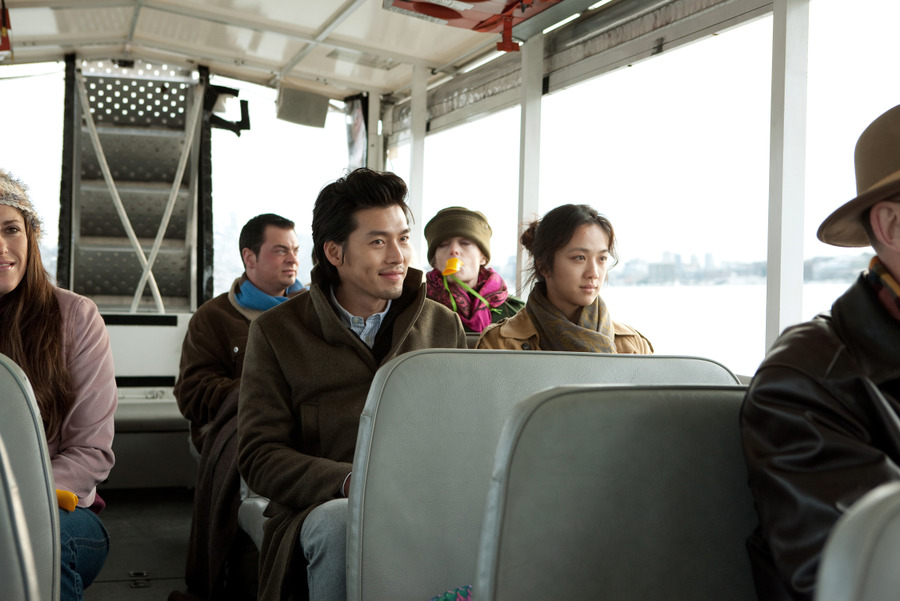
And then, well, doesn't the sunlight appear? In that scene where Anna and Hoon smile and clap, the sunlight appears. The vehicle in the photo above was an amphibious car, and as the bus suddenly enters a lake? a seaside? the sun rises in the sky and the sunlight beams down. In an instant. It seemed director Kim Tae-yong was telling us that this moment now is, between the two of them, a time like 'sunlight' amid the fog. At this time Anna finds a bit of laughter, and Hoon smiles too. Throughout the film Hoon is brighter than Anna, and you can see consistently how Hoon tries to find ways to always make Anna smile, but, hmm.. it doesn't quite work. It's a part where you can guess a little that it takes a long time for 'Anna' to tell her story.

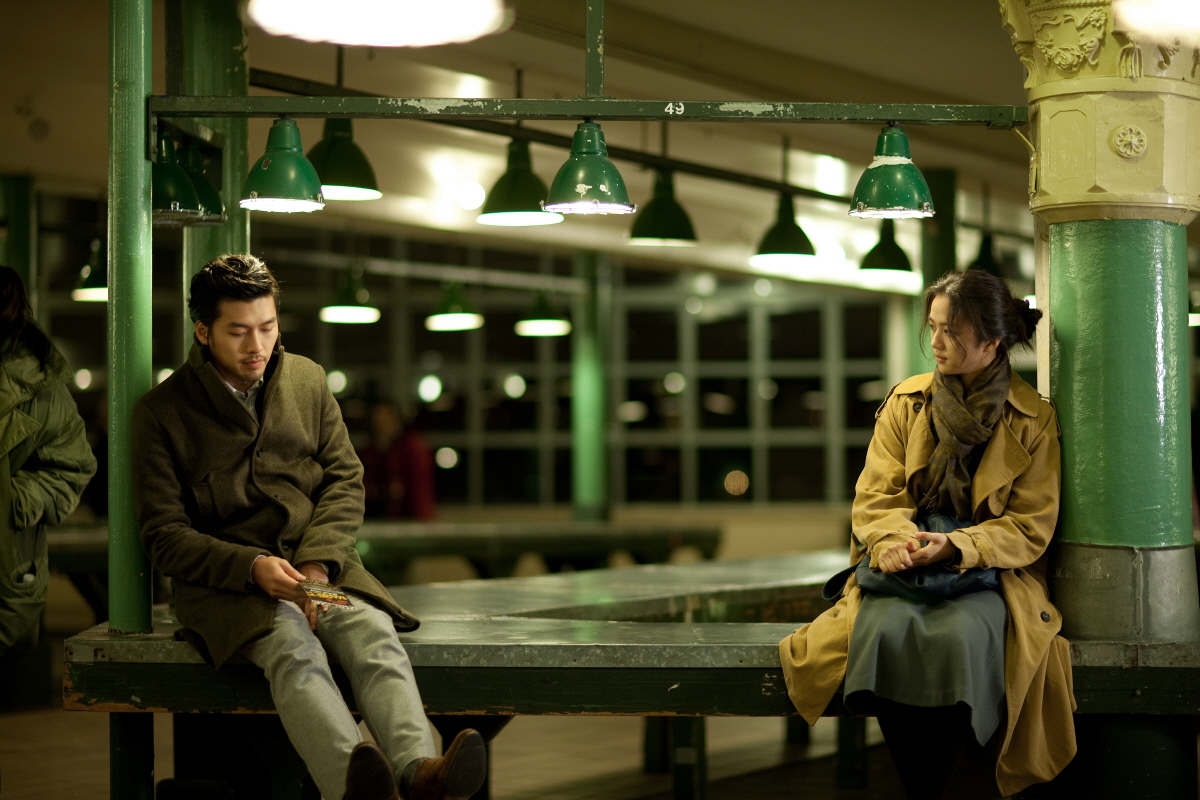
The conversations they share at the amusement park, the market, the terminal, the bus, and the funeral hall show that they are gradually drawing closer to each other, and the scene where, at the 'amusement park,' they stop while riding bumper cars and 'ventriloquize' the conversation of some local couple is very impressive. I really can't forget it; in this scene Anna and Hoon open their hearts little by little. When the couple's mouths move silently, Hoon and Anna speak in time with them. Of course you might say this only works 'because it's a film,' but yes, because it's a film I got to see this scene, and it was a very, very beautiful scene. Should I say it indirectly conveys, through dialogue, the words that well up from the heart?
I have a lot to say while watching this film together later, but in the end last time I couldn't watch this film together. I'm thinking that next time I'll definitely watch it together, so I hope I get the chance..... damn, the fact that Hyun Bin comes out looking so cool must be my heart filled with envy...... Besides, that trench coat of Tang Wei's really seems to express 'autumn' just as it is, so it's beautiful. Rather than emphasizing the fit that's the 'trend' in clothes these days, it seemed to convey something a bit loose but beautiful and full of atmosphere. I should look forward to it.
Comments 0
No comments yet. Be the first.